Yom Kippur began last night at sunset. The holiest day of the Jewish calendar, Yom Kippur concludes a period of ten Days of Awe and Repentance that began on Rosh Hashanah, the Jewish New Year. It is a day of fasting, prayer, and reflection. Yom Kippur is one of four times in a year that Yizkur, a memorial prayer for the dead, is recited. Here’s a musical reflection by David Stock.
Yom Kippur is also the inspiration for the central movement of one of my favorite pieces by Ernest Bloch, the “Israel Symphony” of 1916. The first movement is titled “Prayer in the Desert” and the last “Succoth,” named for the Jewish harvest festival, which begins this year on the evening of October 6th.
May you be inscribed in the Book of Life.
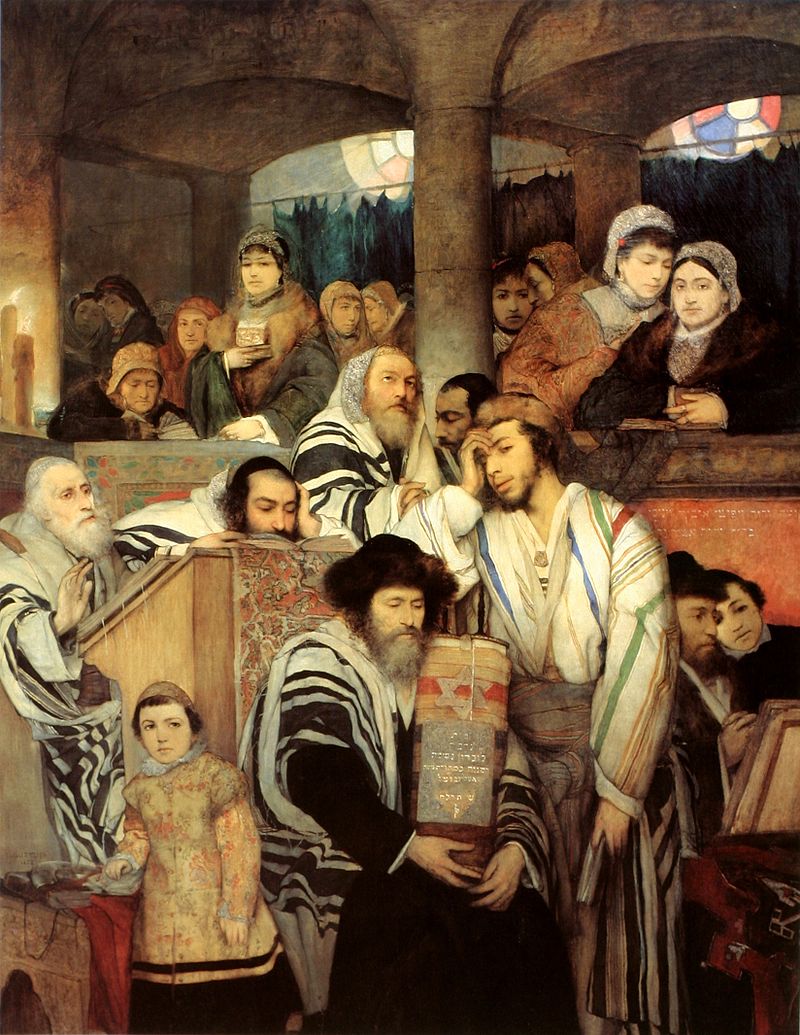
IMAGE: “The Day of the Great Forgiveness of the Jews or Celebration of Yom Kippur in a Synagogue on Rue Saint Louis en l’Ile, Paris,” artist unknown
Yom Kippur begins tomorrow night at sundown. The Day of Atonement marks the culmination of ten days of awe and repentance. Observed with fasting and prayer, it is the holiest day on the Jewish calendar.
This week on “The Lost Chord,” we offer best wishes for a happy, healthy, and sweet new year with two complementary works inspired by the High Holidays.
Jacob Weinberg’s String Quartet, Op. 55, of 1950, falls into three movements: “Rosh Hashana” (the Jewish New Year), “Yom Kippur,” and “Sukkot.” “Yom Kippur” is based on the cantorial chant “Kol Nidre.” You know, the same melody employed by Max Bruch in his famous cello piece.
Ernest Bloch’s “Israel Symphony,” composed between 1912 and 1917, is more like an orchestral rhapsody in three sections – “Prayer in the Desert,” “Yom Kippur,” and “Succoth” [sic] – played continuously and culminating in parts for four vocal soloists.
Sukkot, which follows Yom Kippur by only five days, is the harvest festival, during which temporary dwellings (or sukkot) are erected to commemorate the Jews’ 40 years wandering in the desert after the Exodus from Egypt. In modern times, these are decorated with fruits and vines. In contrast to the austerity and fasting of Yom Kippur, Sukkot is a celebration of life and abundance. But in ancient Israel, it was a solemn affair, with sacrifices offered at the temple.
Welcome the year 5784, with musical reflections of the High Holidays, and then some, on “Totally Awesome,” on “The Lost Chord,” now in syndication on KWAX, the radio station of the University of Oregon.
Remember, KWAX is on the West Coast, so there’s a three-hour difference for the Trenton-Princeton area. Here are the respective air-times of my recorded shows (with East Coast conversions in parentheses):
PICTURE PERFECT, the movie music show – Friday on KWAX at 5:00 PACIFIC TIME (8:00 PM EDT)
THE LOST CHORD, unusual and neglected rep – Saturday on KWAX at 4:00 PACIFIC TIME (7:00 PM EDT)
The Jewish High Holy Days are a period of reflection, ten days of awe and repentance. This Sunday night on “The Lost Chord,” the mood is largely meditative for Yom Kippur.
In 1950, Jacob Weinberg composed a string quartet, published as his Opus 55. The work falls into three movements, bearing the respective subtitles “Rosh Hashanah” (the Jewish New Year), “Yom Kippur” (the Day of Atonement) and “Sukkot” (the harvest festival).
Weinberg’s “Yom Kippur” is based on the famous sung prayer “Kol Nidre” that opens the Yom Kippur Eve service, best known to gentiles, probably, through a setting for cello by Max Bruch. Bruch, though not Jewish, always had a good ear for characteristic melodies of different cultures (further exemplified by his “Scottish Fantasy,” “Swedish Dances,” “Suite on Russian Themes,” etc.).
Likewise, Emil Nikolaus von Reznicek – he of “Donna Diana Overture” fame – was moved by the Yom Kippur melody, on which he wrote a large-scale set of orchestral variations. In contrast to the reverential setting by Bruch, Reznicek puts the theme through a befuddling array of permutations, pivoting back and forth from light to serious. It’s not synagogue music, but it is fascinating.
The hour will conclude with a reverential setting by Patrick Sinozich of ”Avinu Malkeynu” (“Our Father, Our King”) by Max Janowski, performed by Chicago a cappella.
Make room for rumination. I hope you’ll join me for “Tones of Atonement,” this Sunday night at 10:00 EDT, on WWFM – The Classical Network and wwfm.org.
Somehow, in my 40-plus-year passion for classical music, I have never before stumbled across this theory. But now that I know, it’s definitely out there. A Google search turns up plenty.
There are those who speculate that Beethoven’s String Quartet No. 14 in C-sharp Minor, Op. 131, contains a quotation from the Yom Kippur melody “Kol Nidre.” It’s certainly possible.
When the first Reform synagogue opened in Vienna in 1825, the theory posits, Beethoven was approached to supply a cantata. He never committed, though it appears he did devote some time to the study of Jewish music. However, by 1825, he was already stone deaf.
It’s also been speculated that, as a younger man, in Bonn, he happened to be sweet on Rachel Levin, the daughter of a wealthy jeweler, who traveled in artistic circles. The two met in Teplitz at a gathering of poets, musicians, and intellectuals. Levin’s parents were opposed to Beethoven pursuing a relationship. Levin would distinguish herself as a radical thinker, gaining notoriety for her rejection of bourgeois values. Ironically, she later converted to Christianity to marry the biographer Karl August Varnhagen von Ense. Was Beethoven looking back, perhaps still carrying the torch?
The melody of “Kol Nidre” was first written down in Berlin in the 18th century, but its origins reach back deep into the Middle Ages, perhaps earlier. Legend has it that the tune has remained unchanged since Moses climbed down from Sinai.
The alleged quotation appears in the sixth movement of Beethoven’s quartet. I’m not sure I’m entirely convinced. If it is indeed true, which would be very cool, I wish that the composer would have gone for broke, à la Max Bruch, rather than simply feinting at the melody.
Yom Kippur begins at sundown. The Day of Atonement marks the culmination of the Jewish High Holy Days, ten days of awe and repentance. Observed with fasting and prayer, it is the holiest day on the Jewish calendar.
Beethoven, String Quartet No. 14, Movt. VI: Adagio quasi un poco andante (1826)
Yom Kippur, the Day of Atonement, begins at sundown. To mark the occasion, the holiest day on the Jewish calendar, I’ll present Jacob Weinberg’s String Quartet, Op. 55, which incorporates melodies for the High Holy Days; Enest Bloch’s moving “Israel Symphony;” Joseph Joachim’s “Hebrew Melodies;” David Stock’s “Yizkor;” and Emil Nikolaus von Reznicek’s “Symphonic Variations on ‘Kol Nidre.’” It all begins at 2 p.m. EDT, on WWFM – The Classical Network and wwfm.org. G’mar Hativa Tova.