Tag: Young People’s Concerts

  • Bernstein, Liszt & the Devil’s Symphony

    Bernstein, Liszt & the Devil’s Symphony

    I don’t know about you, but if I were a kid I’d be all over my parents to be able to attend a program called “Liszt and the Devil.”

    In one of his celebrated “Young People’s Concerts,” from 1970, Leonard Bernstein makes the bold assertion that “A Faust Symphony” is Franz Liszt’s greatest work. I think “grandest” would be less controversial. I mean, Liszt was the composer of probably the most revolutionary piano sonata of the 19th century.

    Despite Bernstein’s effusion that “A Faust Symphony” is one of the monumental works of the whole Romantic Movement, it is hardly the most frequently programmed of his compositions. His piano concertos are heard much more frequently. So are some of his symphonic poems, at least on the radio. (When was the last time you heard “Les Preludes” in concert?) He wrote oratorios, masses, organ works, songs, and even an opera. His later works are on another plane entirely, as he hurled his lances into a future he would never live to see.

    As a pianist, he is frequently cited as a kind of proto-rock star, whipping his audiences into extravagant displays of emotion. Men wept and women fainted. Some fought over carelessly abandoned gloves or cigar butts or even his coffee dregs. Doctors seriously debated the causes and effects of “Lisztomania,” as it was described, and it remains a topic of speculation in academic and medical circles today.

    Liszt was a peculiar mix of prophet and showman. He could be flashy or profound, fiendishly difficult or insistently memorable, offputtingly vulgar or transcendentally beautiful. Interestingly, in his mid-30s, he retired from public life as a recitalist (recital, by the way, was a term he coined), shifting his focus instead to composition, conducting, teaching, and philanthropic efforts. In his mid-50s, he took the cloth. As the Abbé Liszt, he was, among other things, a licensed exorcist. Which takes us back to the matter at hand.

    I happen to share Bernstein’s enthusiasm for “A Faust Symphony.” It’s always been a great favorite of mine. Sadly, you don’t really see it programmed very often anymore – if it ever was. But back in the day, Bernstein and Solti and maybe a few others kept it alive. Bernstein recorded it twice: with the New York Philharmonic for Columbia Records in 1960 and with the Boston Symphony Orchestra for Deutsche Grammophon in 1976. Riccardo Muti conducted it in Philadelphia, back in 1982 – sadly two years before my arrival in the City of Brotherly Love – and recorded it for EMI. The recording is very good. Come to think of it, I don’t think I’ve ever heard “A Faust Symphony” live. This must be rectified!

    I love that Bernstein doesn’t talk down to the kids and lays some pretty heavy, adult concepts on them. Not only in the philosophical examination of the essential dichotomy of the human character, but also the nitty gritty of debauched adult behavior. I’m sure there are moments when the moms and dads in the audience are wondering whether maybe they should have taken the young ones to Radio City Music Hall instead. Around 28 minutes in, Bernstein delves into the Devil, the seduction of Gretchen, and “the wages of sin.”

    It’s fun that Bernstein can go to the piano to illustrate so many of his musical points and that he’s got so much Liszt under his fingers.

    This is the second “Young Person’s Concert” I’ve seen in which Bernstein gets so carried away conducting that he loses his baton (at 44 minutes in). The other was during a Sibelius program from 1965, in which he conducts the Symphony No. 2. In that instance, a moment after the baton takes flight, he reaches beneath the lectern and actually produces a spare! Here he rides it out with his bare hands, as Mephisto’s spirit of negation is itself negated by Gretchen’s innocence.

    This is Liszt’s original version, by the way. Three years later, he appended a coda for chorus and tenor. That’s the version Bernstein recorded.

    Bernstein knows a thing or two in comparing Liszt to Faust. He had a little bit of Faust in his own character, as well. But then, don’t we all?

    Happy birthday, Franz Liszt!


    “Young People’s Concert: Liszt and the Devil.” All in all, an intelligently presented, entertainingly delivered lecture and performance. I hope you enjoy it.

    Bernstein’s classic 1960 recording with the New York Philharmonic

    Also fun to hear “A Faust Symphony” turn up among the musical selections on the soundtrack to this restoration of the 1926 silent film “Masciste in Hell”

  • Bernstein Villa-Lobos TV’s Lost Art

    Bernstein Villa-Lobos TV’s Lost Art

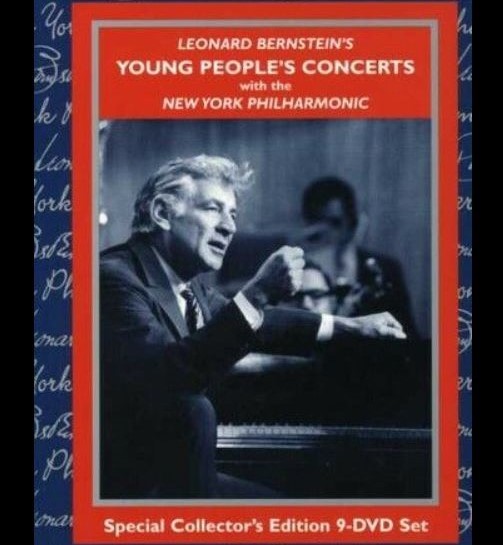
    Like so much else in the United States, the standards of broadcast television have eroded beyond recognition since the days of Leonard Bernstein’s “Young People’s Concerts” first aired on CBS from 1958 to 1972. The most celebrated American conductor – communicative, charismatic, and cool – introduced classical music to receptive kids in living rooms across the nation. Such was the network’s belief in this Saturday morning program that for three years it was broadcast in prime time. Later, it was shown on Sunday afternoons. The shows were syndicated in more than 40 countries, and the series was honored with five Emmys.

    It’s sad to reflect that there was once a time when those who set the standards for network television actually saw it as part of the medium’s mission to educate and to elevate. How quaint of legislators and executives of our grandparents’ generation to want that.

    Of course, at the same time, the Flintstones were hawking cigarettes…

    Inevitably, the lure of lucre would trump public service, and the presence of educational and artistic programming would dwindle. I’m thankful that remnants of this sort of thing were still around in the ‘70s and ‘80s, though mostly thanks to PBS – now under fire by small minds and empty souls determined to undermine anything that truly does make this country great.

    Here, on the birthday of Brazilian master Heitor Villa-Lobos, Bernstein sums up the composer’s musical aims in four minutes in this “Young People’s Concerts” broadcast of 1963:

    Then he conducts Villa-Lobos’ biggest hit, “Bachianas Brasileiras No. 5.”

    On an earlier broadcast, in 1960, Bernstein conducted the composer’s second-biggest hit, “The Little Train of Caipira,” from “Bachianas Brasileiras No. 2”

    Happy birthday, Heitor Villa-Lobos, and requiescat in pace, American sanity.

  • Bernstein Sibelius & Lost Musical Treasures

    Bernstein Sibelius & Lost Musical Treasures

    Last night, I pulled out my collection of Leonard Bernstein’s Young People’s Concerts with the New York Philharmonic to see if I owned a DVD of the broadcast that introduced a young André Watts in the Liszt Piano Concerto No. 1. I do not – though thankfully someone else posted it on YouTube. I decided instead to view “A Tribute to Sibelius,” presented in honor of the composer’s 100th anniversary.

    I learned from Bernstein’s spoken introduction that President Johnson declared 1965 “Sibelius Year” in the United States. And yes, there was a time when Sibelius was that popular in America, though I would say it was a few decades earlier. In 1935, the composer’s 70th year, the New York Philharmonic surveyed 12,000 listeners of its Sunday afternoon radio broadcasts to learn their musical preferences. When asked who their favorite composer was, Sibelius was mentioned more than any other. Beethoven came in second. I always suspected I was born too late!

    I also thought it was clever of Bernstein to compare Sibelius’ handling of his thematic material to a good detective story, in which clues are planted at the beginning, the true significance of which is only gradually revealed. He demonstrates this by following a three-note motif through its various permutations in the Second Symphony. “Those three innocent scale-notes turning up in a hundred different disguises…. [I]n the end they all link up, so that when the final light dawns, and all is made clear, you feel the thrill of having solved a great mystery, you yourself.” It’s an apt simile, even a brilliant one, in that it makes the listener feel like an active participant. But Bernstein was always an effective popularizer.

    The young soloist in the Violin Concerto is the Romanian-born Sergiu Luca, who would later distinguish himself as an early music pioneer. Among Luca’s teachers was Ivan Galamian, who also taught Itzhak Perlman. At the age of 9, Luca made his debut with the Haifa Symphony Orchestra. (At the time, his family was living in Israel.) Like Watts, his U.S. debut was with the Philadelphia Orchestra, conducted by Eugene Ormandy – in Luca’s case, playing the Sibelius concerto – which brought him to the attention of Bernstein and led to his appearance on the New York Philharmonic telecast later that year.

    Also of interest, from the end credits, I notice that the assistant to the director was none other than John Corigliano, Jr., son of the Philharmonic’s concert master, who went on to become a Pulitzer Prize and Academy Award winning composer himself. Corigliano won the Oscar for Best Original Score for his music for “The Red Violin.” He also scored “Altered States.”

    Assistant to the producer was Mary Rodgers, daughter of Richard Rodgers and composer of “Once Upon a Mattress.” On the side, she also wrote “Freaky Friday.”

    But arguably the part of the broadcast that brought me the most amusement was when Bernstein, conducting the Symphony No. 2, in the thrill of the moment, loses his grip on the baton when gearing up for the return of the big tune around 43 minutes in. I was all set to watch him ride it out with nothing but his bare hands, à la Stokowski, but a few seconds later, sure enough, he reaches under his music stand and produces as spare!

    Hopefully nobody lost an eye.

    Bernstein’s Young People’s Concerts were broadcast nationwide on CBS television and were eventually picked up around the world. The series, which ran from 1958 to 1973, received multiple Emmy, Peabody, and Edison Awards.

    Crazy to look back at the orchestra now and realize there were no women, much less people of color. I remember reading a piece by Dave Barry once, decades ago, in which he humorously described white jazz clarinetists of yore as snapping their fingers in front of a bunch of guys dressed like dentists. The musicians of the New York Philharmonic from this era are kind of like that, only without the snapping fingers.

    Predictably, some of the kids in the audience look a little distracted, though still well-behaved (and well-dressed), but a surprising number of them appear to be genuinely engaged. It’s sad that young people lack these kinds of opportunities anymore to be exposed to this kind of music. Classical music plays less of a part in American life now than it ever has since the rise of broadcast media.

    There was a time in our history when people aspired to be better and believed that the way to do that was to acquire an education and expose themselves to the finer things. It was still like that when I was growing up, in the 1970s and early ‘80s. But that’s a long time ago now. From the perspective of the 21st century, we have passed our peak. This sort of television programming, especially from a network, endures only in memory or, if we’re lucky, in archival footage.

    It seems like only yesterday that I was listening to the “Grand Canyon Suite” in music class and watching film strips of “Madama Butterfly” and “Amahl and the Night Visitors.” I feel sorry for anyone who has never been exposed to longer-form music, experienced its fantasy or been made to shudder at its ennobling beauty.

    There’s so much more to music – and to life – than three-minute cuts manufactured in a recording studio. I don’t think I would have made it this far if I thought that’s all the world had to offer. Are these noble monuments to our shared humanity all really in danger of just fading away?


    “A Tribute to Sibelius” (broadcast date: 2/19/65)

    https://www.youtube.com/watch?v=Gx3lJpN6tMU

    A transcript of the show, with a sample of Bernstein’s scrawl, in pencil, on a yellow legal pad

    https://leonardbernstein.com/lectures/television-scripts/young-peoples-concerts/a-tribute-to-sibelius

    And in case you missed it when I shared the link earlier this week, a 16-year-old André Watts plays Liszt’s Piano Concerto No. 1 (broadcast date: 1/15/63)

Tag Cloud

Aaron Copland (92) Beethoven (95) Composer (114) Film Music (119) Film Score (143) Film Scores (255) Halloween (94) John Williams (185) KWAX (229) Leonard Bernstein (99) Marlboro Music Festival (125) Movie Music (134) Opera (198) Philadelphia Orchestra (86) Picture Perfect (174) Princeton Symphony Orchestra (106) Radio (87) Ralph Vaughan Williams (85) Ross Amico (244) Roy's Tie-Dye Sci-Fi Corner (290) The Classical Network (101) The Lost Chord (268) Vaughan Williams (102) WPRB (396) WWFM (881)

DON’T MISS A BEAT

Receive a weekly digest every Sunday at noon by signing up here


RECENT POSTS