This week on “Sweetness and Light,” it’s an hour of “unbowed strings.” All of these string instruments will be plucked, struck, or strummed, with not a bow in sight. We’ll hear works for zither, guitar, cimbalom, harp, and mandolin, by composers Anton Karas, Ferdinando Carulli, Zoltán Kodály, Reinhold Gliere, and Samuel Siegel. We forgo the bow, but strings are the thing on “Sweetness and Light,” this Saturday morning at 11:00 EST/8:00 PST, exclusively on KWAX, the radio station of the University of Oregon!
Stream it, wherever you are, at the link kwax.uoregon.edu and soon here at rossamico.com/radio!
Tag: Zoltán Kodály
-

Unbowed Strings on “Sweetness and Light”
-

János Starker Cellist Legend at 100
The great cellist János Starker would have been 100 years-old today. Hard to make out what this commercial might actually be for, since he’s living quite large, enjoying some music (on vinyl), a cigarette, and what looks like a glass of scotch – interestingly at odds with his ascetic sartorial and decorative choices. Spoiler: the ad is for a stereo system.
That looks like a portrait of composer Zoltán Kodály on the wall. By coincidence, Kodály’s educational system of solfège hand signs plays an important part in Steven Spielberg’s “Close Encounters of the Third Kind,” which I only just posted about this morning. Starker knew Kodály, who was on the faculty while he was a student at the Franz Liszt Academy of Music in Budapest.
Starker survived internment in a Nazi concentration camp (he was Jewish) to become one of the world’s most celebrated cellists. He served as principal with the Dallas Symphony Orchestra, at New York’s Metropolitan Opera, and with the Chicago Symphony, and left his mark as an outstanding soloist and chamber musician. In all, he made over 150 recordings.
For over 50 years, he was on the faculty of Indiana University Jacobs School of Music. He died in 2013 at the age of 88. Not bad, considering he smoked 60 cigarettes a day and consumed copious amounts of scotch.
It’s doubtful American television would have aired a 90-second ad like this, even back in 1982.
Starker plays the third movement of Kodály’s Sonata for Solo Cello
Starker first played the sonata for the composer in 1939, at the age of 15. He did so again, shortly before Kodály’s death in 1967. Kodály told Starker, “If you correct the ritard in the third movement, it will be the Bible performance.” The cellist recorded the work four times, in 1948, 1950, 1956, and 1970.
François Truffaut lectures on Kodály hand signs in this scene from “Close Encounters of the Third Kind.”
-
Hungarian Night Music & Bela Lugosi
“Children of the night – what beautiful music they make!” So says Hungarian superstar Bela Lugosi in his signature role of Dracula. The observation (spoken in response to the howling of wolves) might equally be applied, under less chilling circumstances, to three of Lugosi’s composer-compatriots, whose nocturnal meditations we’ll enjoy this Sunday night on “The Lost Chord.”
Miklós Rózsa, himself a figure with cinematic associations, wrote nearly 100 film scores and won three Academy Awards – for “Spellbound” (1945), “A Double Life” (1947), and “Ben-Hur” (1959). He was also an active concert composer, writing concertos for Jascha Heifetz, Leonard Pennario, Gregor Piatigorsky, and Pinchas Zukerman.
In the summer of 1962, Rózsa composed “Hungarian Nocturne” on a commission from Edward B. Benjamin, a New Orleans millionaire with a fondness for quiet music. However, in order to maintain interest, the composer realized, there was no way he could remain quiet for the entire span of the piece. So the nocturne eventually builds to a climax before returning to the serene mood of its opening. His patron wasn’t entirely pleased, though he did draw enjoyment from the quieter parts. The piece was an attempt by the composer to recapture the rare beauty of nights on his estate in rural Hungary.
Though Antal Doráti would ultimately become world famous as a conductor, he studied composition at the Franz Liszt Academy under Zoltán Kodály and Leó Weiner. He also studied piano with Béla Bartók. A fine Bartok interpreter, Doráti would later conduct the world premiere of his teacher’s Viola Concerto.
Doráti’s own music has always been regarded as something of a sidelight. His “Night Music,” from 1970, is a collection of evocative miniatures for flute and orchestra. We’ll hear it performed by Alison Young, now a host for Minnesota Public Radio.
Unlike Rózsa and Doráti, who were both natives of Budapest, Zoltán Kodály was born in a small town in Southern Hungary. He claimed that his first exposure to folk music was through the singing of servant girls in his own home. He went on to become one of the most important figures in Hungarian musical life, as composer, ethnomusicologist, and educator.
Kodály will be represented by his orchestral idyll, “Summer Evening,” music originally composed in 1906, then revised in 1929, to fulfill a commission from Arturo Toscanini. Kodály himself will conduct, on a gorgeous recording with the Budapest Philharmonic.
That’s “Children of the Night” – Hungarian composers take wing – this Sunday night at 10:00 EDT, on WWFM – The Classical Network and wwfm.org.
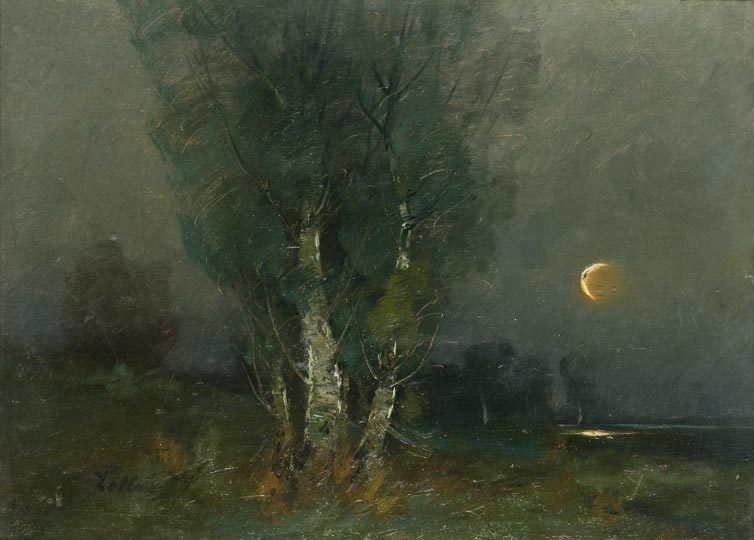
IMAGE: “New Moon,” by Mihály Zeller
-
Close Encounters’ Hidden Musical Genius
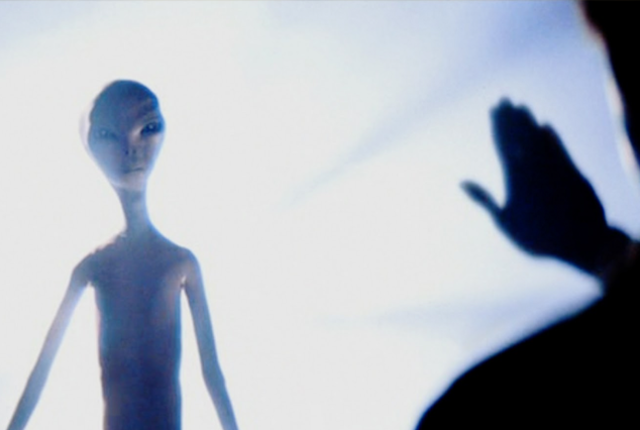
Is “Close Encounters of the Third Kind” the most musical non-musical blockbuster ever made?
I don’t know at what point I recognized Zoltán Kodály’s contribution to “CE3K.” It was certainly not as an 11-year-old boy, which is how old I was at the time I was first spooked and awed by Steven Spielberg’s UFO masterpiece. But somewhere along the way, Kodály took on more significance than simply an exotic-looking name on a chart.
In addition to being one of Hungary’s most respected composers – with his friend, Béla Bartók, at the forefront of the whole Hungarian nationalist movement – Kodály was extremely influential in the field of music education. The hand signals employed by François Truffaut’s Claude Lacombe, when he addresses a conference of UFO scientists and researchers, correspond to specific musical tones. The signals are an integral part of the Kodály method, and they contribute to the film’s memorable climax. Millions who have never heard of Kodály outside the context of “CE3K” will be familiar with the five-signal sequence.
Of course, music imbues just about every aspect of Spielberg’s storytelling. Composer John Williams went through over 300 permutations of the five-notes-to-a-theme before arriving at the now-iconic motive that ties the whole film together. There was no “aha! moment.” It was only after Spielberg learned there were over 130,000 possibilities that they just settled on a sequence they thought would be effective. A significant portion of the score for the last half hour of “CE3K” would be recorded in advance of the actual filming. It’s a rare luxury for composers to have a film cut to their music, as opposed to the other way around, but this is what was done, necessarily, for the film’s climactic encounter.
At the time, Williams’ “CE3K” theme was widely parodied and likely as well recognized as his theme for “Jaws.” His score would be nominated for an Academy Award in 1978. He actually wound up losing to himself, for “Star Wars.” A banner year for John Williams!
Interestingly, the composer tailored a cello solo specifically for Eleanor Aller Slatkin, formerly of the legendary Hollywood String Quartet. Aller was the widow of violinist Felix Slatkin and the mother of conductor Leonard Slatkin. She had been active in Hollywood since the 1940s, introducing Erich Wolfgang Korngold’s Cello Concerto in the film “Deception,” with Bette Davis and Claude Rains. Paul Henreid “played” the concerto onscreen.
French pianist and educator Odette Gartenlaub, a Messiaen pupil and solfège authority who taught at the Paris Conservatory, has a cameo during the climactic extraterrestrial communication scene.
And of course, “When You Wish Upon a Star” is heard on a music box early in the narrative, only to be picked up in Williams’ underscore during the film’s apotheosis. Spielberg said that he relied on the spirit of the song as a kind of guide for the overall feeling he wanted “CE3K” to convey.
“Close Encounters” is a work of great humanity, wonder and hope. Is it any wonder that music would play such an important role? In a story in which so many of the human characters experience frustration in their spoken interactions, running up against all kinds of barriers to effective communication, the key to universal understanding turns out to be music. It is one of the most satisfying and uplifting movies about music ever made. Unusually, it also seems to get everything right.
There were many experienced hands involved in the writing of the film, but in the end it was Spielberg who received the sole screen credit. Somebody really knew their music. I wonder who directed Spielberg to Kodály?
For further reflections on “CE3K,” join Roy Bjellquist and me – with a special appearance by my brilliant cousin, Joseph R. Metz – on the next “Roy’s Tie-Dye Sci-Fi Corner,” to be live-streamed on Facebook this Friday evening at 7:00 EDT.
https://www.facebook.com/roystiedyescificorner
More about the Kodály Method here (with hand signals):
And an interview with Kodály, in English!
-

Hungarian Night Music Bela Lugosi’s Requiem
“Children of the night – what beautiful music they make!” So says Hungarian superstar Bela Lugosi in his signature role of Dracula. The observation (spoken in response to the howling of wolves) might equally be applied, under less chilling circumstances, to three of Lugosi’s composer-compatriots, whose nocturnal meditations we’ll enjoy this Sunday night on “The Lost Chord.”
Miklós Rózsa, himself a figure with cinematic associations, wrote nearly 100 film scores and won three Academy Awards – for “Spellbound” (1945), “A Double Life” (1947), and “Ben-Hur” (1959). He was also an active concert composer, writing concertos for Jascha Heifetz, Leonard Pennario, Gregor Piatigorsky, and Pinchas Zukerman.
In the summer of 1962, Rózsa composed “Hungarian Nocturne” on a commission from Edward B. Benjamin, a New Orleans millionaire with a fondness for quiet music. However, in order to maintain interest, the composer realized, there was no way he could remain quiet for the entire span of the piece. So the nocturne eventually builds to a climax before returning to the serene mood of its opening. His patron wasn’t entirely pleased, though he did draw enjoyment from the quieter parts. The piece was an attempt by the composer to recapture the rare beauty of nights on his estate in rural Hungary.
Though Antal Doráti would ultimately become world famous as a conductor, he studied composition at the Franz Liszt Academy under Zoltán Kodály and Leó Weiner. He also studied piano with Béla Bartók. A fine Bartok interpreter, Doráti would later conduct the world premiere of his teacher’s Viola Concerto.
Doráti’s own music has always been regarded as something of a sidelight. His “Night Music,” from 1970, is a collection of evocative miniatures for flute and orchestra. We’ll hear it performed by Alison Young, now the host of American Public Media’s “SymphonyCast.”
Unlike Rózsa and Doráti, who were both natives of Budapest, Zoltán Kodály was born in a small town in Southern Hungary. He claimed that his first exposure to folk music was through the singing of servant girls in his own home. He went on to become one of the most important figures in Hungarian musical life, as composer, ethnomusicologist, and educator.
Kodály will be represented by his orchestral idyll, “Summer Evening,” music originally composed in 1906, then revised in 1929, to fulfill a commission from Arturo Toscanini. Kodály himself will conduct, on a gorgeous recording with the Budapest Philharmonic.
That’s “Children of the Night” – Hungarian composers take wing – this Sunday night at 10:00 EDT, on WWFM – The Classical Network and wwfm.org.
IMAGE: “New Moon,” by Mihály Zeller
Tag Cloud
Aaron Copland (94) Beethoven (95) Composer (114) Film Music (149) Film Score (143) Film Scores (255) Halloween (97) John Williams (197) KWAX (232) Leonard Bernstein (105) Marlboro Music Festival (125) Movie Music (164) Mozart (91) Opera (215) Philadelphia Orchestra (90) Picture Perfect (174) Princeton Symphony Orchestra (110) Radio (90) Ross Amico (244) Roy's Tie-Dye Sci-Fi Corner (290) The Classical Network (101) The Lost Chord (269) Vaughan Williams (107) WPRB (397) WWFM (881)