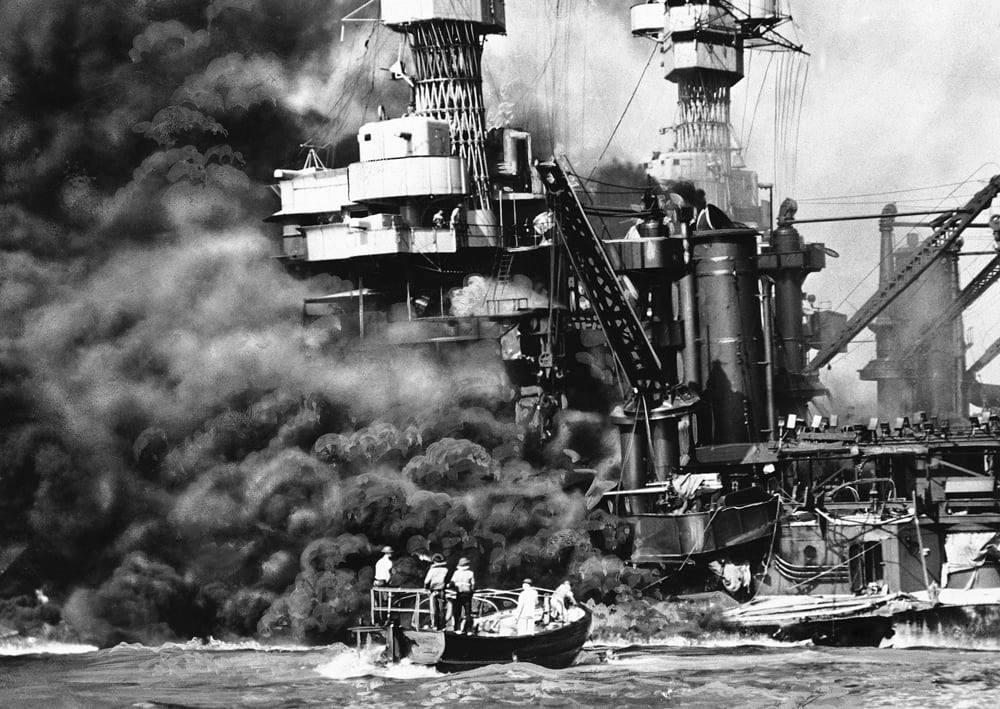
On the morning of December 7, 1941, a Japanese strike force of 353 aircraft laid waste to the United States naval base on Oahu, Hawaii. Thousands of American servicemen and civilians were killed, precipitating the country’s entry into World War II.
Though Europe, Russia, and the Far East were already at war, for the U.S. the attack on Pearl Harbor was an unwelcome surprise in peacetime. It brought with it not only the loss of life, but also a loss of innocence. It is a date that has, as President Roosevelt so memorably expressed, lived in infamy.
For Aaron Copland, in common with millions of Americans, the war was not simply an abstraction. The ripple effect from Pearl Harbor would claim the life of his friend, Lieutenant Harry H. Dunham, a pilot killed while on active duty in the Pacific.
News of Dunham’s death reached Copland just as he had put the finishing touches on his Violin Sonata in 1943. Copland’s response was to dedicate the work to the memory of his friend. While there is no way Copland could have known of Dunham’s imminent demise, for a listener, the extra-musical association lends the sonata’s central movement an added poignancy.
A graduate of Princeton University, Dunham was a familiar figure on the New York City arts scene. He was close enough to Copland to have traveled to Morocco with him and writer-composer Paul Bowles.
Virgil Thomson wrote of the Violin Sonata in the New York Herald Tribune, “I suspect it is one of the author’s most satisfying pieces… It has a quality at once of calm elevation and buoyancy that is characteristic of Copland and irresistibly touching.”
Here is Copland’s sonata at its world premiere, with violinist Ruth Posselt and the composer at the keyboard. Amazing what one can find on YouTube.
Leave a Reply