I am sure there are those who are resistant to the art of Virgil Thomson – Thomson the composer, I mean. His brand of Americana-inflected simplicity could easily be reduced to “faux naïve.”
Personally, I find the blend of French and American elements fascinating. Thomson, like Aaron Copland and so many others, studied in Paris with the legendary pedagogue Nadia Boulanger. The next time you listen to “Appalachian Spring,” or anything by Copland, note the French influence – the uncluttered textures, the neoclassical winds. It’s inescapable. If anything, these qualities are even more evident in Thomson’s music, and he adhered to a French sensibility for the rest of his life.
Thomson was equally renowned (and feared) as critic for the New York Herald-Tribune. As a critic, he certainly was not afraid to speak his mind. He was also more vocal than most in his conviction that the alleged rarefied aesthetics of music, at least in his case, were secondary to the needs of the bank account. Fortunately for Thomson, the two were not necessarily incompatible.
His most famous work, perhaps – other than the film scores he wrote for the documentaries “The Plow That Broke the Plains,” “The River,” and “Louisiana Story” (the only film score to date to be awarded a Pulitzer Prize) – is the “Symphony on a Hymn Tune.”
The symphony, composed during his years in Paris, was inspired by Thomson’s memories of his Kansas City boyhood. The “Sunday best” of the church hymns occasionally gets tangled up in a few modernistic burrs – the exchanges between the violin, cello, trombone and piccolo at the end of the first movement, for instance – but in 1928, it was a landmark in establishing a distinctly American idiom.
This is perfect Thanksgiving music.
Happy birthday, Virgil Thomson (1896-1989)!
Here’s an amazing discovery: a two-part 1981 interview with Thomson, conducted by David Dubal, then music director of WNCN, now host of WWFM – The Classical Network’s “The Piano Matters.” The interview is punctuated by recordings of Thomson’s music.
Part 1 includes “Sea Piece with Birds,” “Four Blake Songs” (with Mack Harrell), and “The Plow That Broke the Plains.”
Part 2 includes “Ragtime Bass” (performed by Dubal), “The Feast of Love,” “Bugles and Birds” (a portrait of Pablo Picasso), and “Alternations” (a portrait of Maurice Grosser).
Boy, does this make me nostalgic for old-time radio, right down to all the ticks and pops.
Thomson, by the way, made good on his promise to compose a portrait of Dubal. Here it is in its orchestral guise.
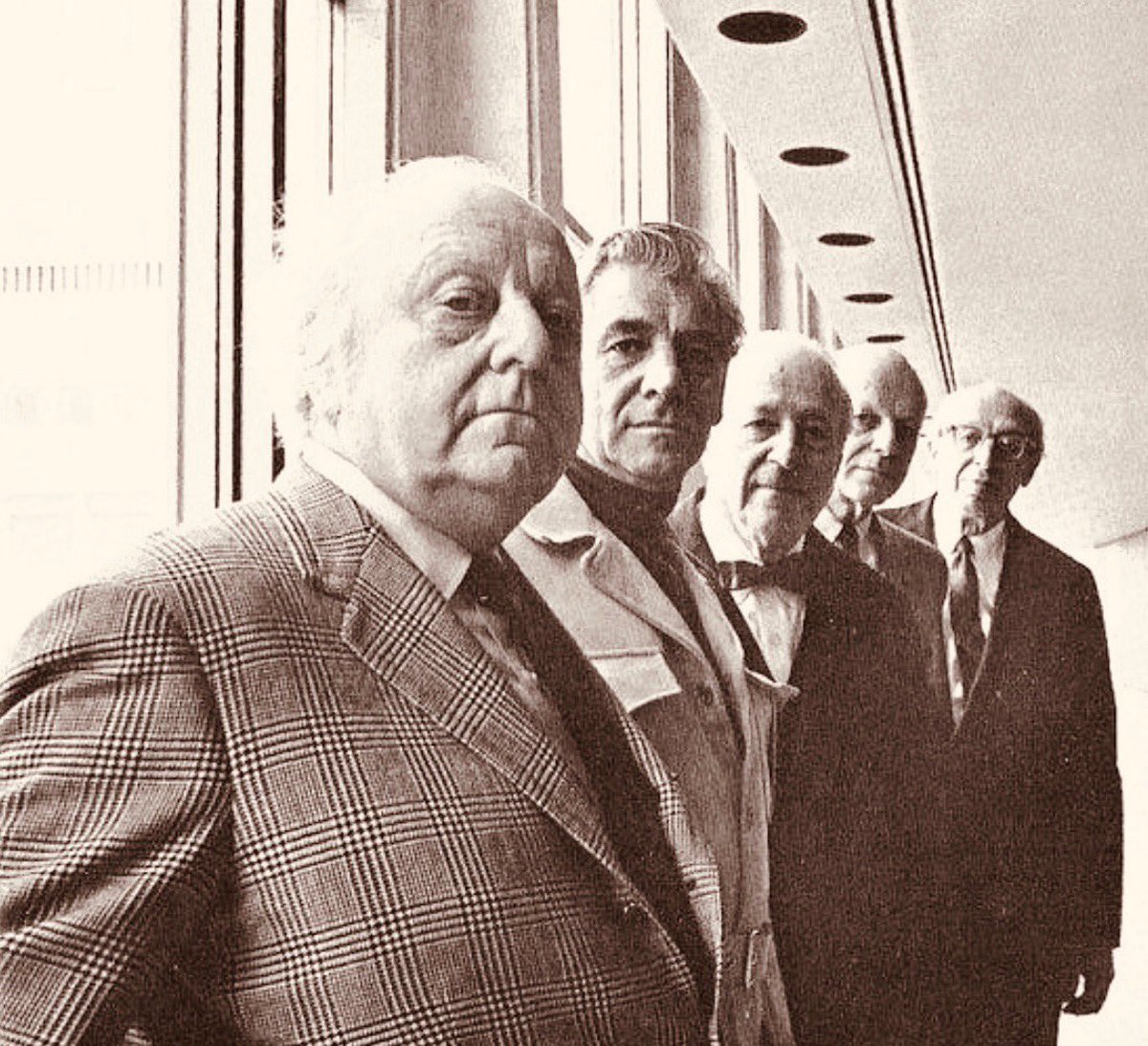
PHOTO: If mid-century American music had a team of Avengers-style superheroes, this would be it: (from front to back) Virgil Thomson, Leonard Bernstein, Walter Piston, William Schuman, and Aaron Copland at Lincoln Center in 1970
Leave a Reply