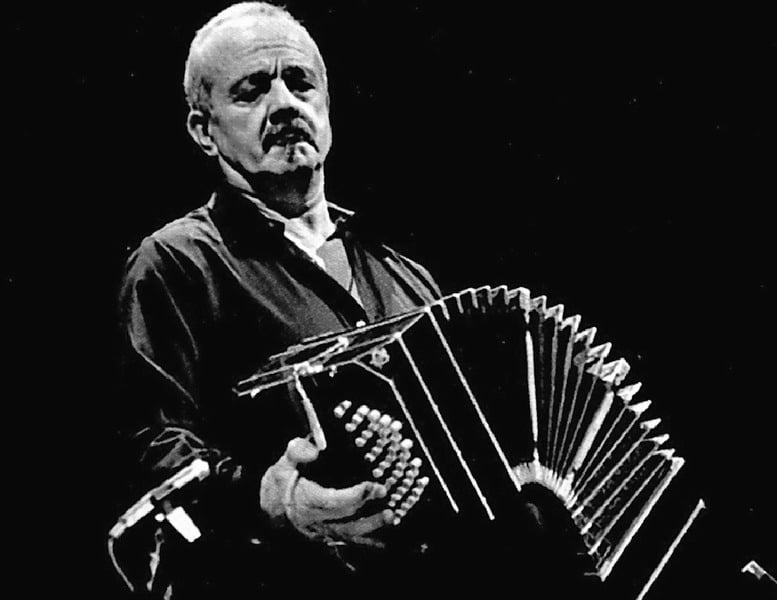
Today is the 100th anniversary of the birth of Argentinian master Astor Piazzolla. It also marks a year since my last live air-shift at WWFM The Classical Network.
With the white caps of Covid already beginning to crest on the horizon, hosts scrambled to get five weeks-worth of recorded shows in the can, against the event that the college would have to shut down. I mean, if everyone stayed home for five weeks, cases would dwindle to nil, and we’d all be back to work, right?
At least I am still selecting my shows from the archive, which is vast, but I think it’s high time to begin assembling a home studio already. Too many significant anniversaries have gone by – including my 25th at the station, and the 10th of “Picture Perfect” – to say nothing of missed holidays and lost musicians who should have been memorialized. At the very least, I should be producing new material. I should not be squandering my time sharing music links on Facebook.
That said…
Although Astor Piazzolla wrote in all forms, he is best remembered for reinvigorating the tango. He accomplished this by drawing on modern classical techniques to deepen its expressive possibilities.
He first discovered the bandonéon – like the accordion, a member the concertina family – when his father purchased one from a pawn shop in Greenwich Village. Piazzolla took up the instrument that would become his constant companion in 1929, at the age of 8. He composed his first tango at 11. At 13, he was invited by Carlos Gardel to join his band. His father forbade it – fortunately, it turns out, since Gardel and his musicians died in a plane crash while on tour.
Piazzolla also attracted the attention of Alberto Ginastera, with whom he studied for five years. Then, in common with many of the great composers of the 20th century, he traveled to Paris, hoping to broaden his understanding of classical composition under the guidance of Nadia Boulanger. After he played one of his tangos for her, the legendary pedagogue took his hands in hers and said, “Here is the true Piazzolla – do not ever leave him.” Her advice paid off. By embracing Argentina’s national dance, Piazzolla not only secured his place in the hearts of the public, but also in the classical concert repertoire.
Spring is a time of renewal. With this in mind, here is Piazzolla’s “Four Seasons of Buenos Aires.” The work is often performed these days by violinists – its movements interleaved with those of Vivaldi’s “The Four Seasons” – to charming effect. Here it is, as Piazzolla intended, with the composer on bandonéon:
Piazzolla plays “Libertango”:
Happy birthday, Astor Piazzolla!
In case you’re interested, I’ve appended the playlist, divided into hours, from my last live air shift, on March 11, 2020, which touches on some juicy birthdays: those of American mavericks Henry Cowell and Carl Ruggles, “Beethoven of Kentucky” Anthony Philip Heinrich, Catalan composer Xavier Montsalvatge, and yes, Astor Piazzolla. Not included is “Music from Marlboro,” which followed at 6 pm and consisted of Brahms’ String Sextet No. 2 and the Air from Bach’s Orchestral Suite No. 3. Who knew so much time would pass?
Leave a Reply