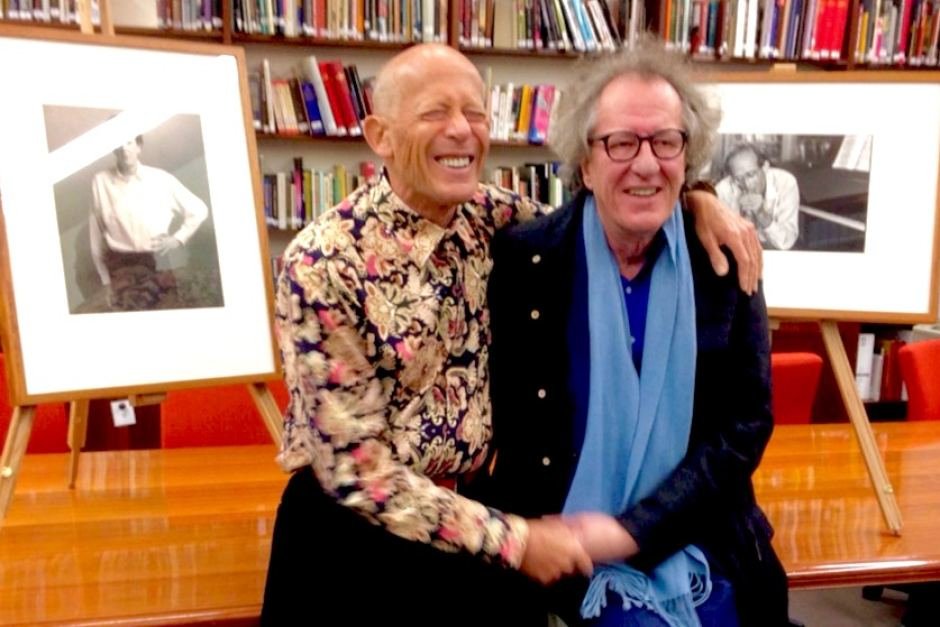
Anybody remember David Helfgott? I note that he is 75 years-old today.
Helfgott was the Australian child prodigy who attained international recognition as a concert pianist, only to collapse into mental illness. Then, after more than a decade of unimaginable travails, he rose Phoenix-like to fulfill, to some extent, his former promise.
Helfgott’s inspiring story became the subject of the film “Shine” (1996), which earned Geoffrey Rush an Academy Award for Best Actor and Helfgott a few recordings released on RCA.
While unquestionably Helfgott’s story is extraordinary and deserving of nothing but admiration and respect, I personally found the movie to be a 105-minute eyeroll. More often than not, I don’t like movies about music anyway. They almost always get it “wrong,” with some producer, screenwriter, or actor not understanding the first thing about it.
In the case of “Shine,” the venerable Sir John Gielgud is resurrected to slice ham as Helfgott’s Yoda-like mentor, expounding on the mystical underpinnings of “Rach 3” (shorthand for Rachmaninoff’s Piano Concerto No. 3).
Rush is a fine actor, of course, and the first, thanks to his work in “Shine,” to be honored for the same performance at the Academy Awards, the BAFTA Awards, the Critics’ Choice Awards, the Golden Globe Awards, and the Screen Actors Guild Awards. Admirably, in preparation for the role, he resumed his piano studies, which he had broken off at the age of 14. This allowed him to act as his own “hand double.”
But if you ask me, it was Noah Taylor, who played the teenaged Helfgott, who did most of the heavy-lifting. Rush appears only for about four minutes at the start of the film, and then he drops out until the second hour. It is Taylor with whom the audience bonds and who cements our belief in the character.
Undoubtedly, the motivation for getting Helfgott’s story on the screen was sincere. The film was something of a passion project for director Scott Hicks, who had seen the pianist perform in 1986, and was so moved by his story that he was determined to have it produced. Equally, he claims, he took care not to draw any “pop-psychology conclusions.”
But really, could “Shine” be any more pop? Granted, a dramatic film intended for mass consumption has to be entertaining, and to the average Joe or Jane, I’m sure “Shine” pushes all the right buttons, as it follows the classic arc of a sudser screenplay. But for anyone who actually knows music, it’s kind of like those movies that have actors pantomime a performance, when it’s evident no one on the set has any idea how a particular instrument should be held. I’m not saying Rush is unbelievable at the piano, just drawing a comparison in regard to the film’s execution.
It’s said that Hicks and screenwriter Jan Sardi tried to imbue “Shine” with a distinctive musical structure, so that the film might emulate a concerto. The screenplay is divided into “movements,” alternating fast-slow-fast, and employing the standard elements of exposition, development, and recapitulation. Reading this makes me curious to watch it again.
Hicks went on to direct two other music-themed feature documentaries: “Glass,” in 2007, and “Highly Strung,” in 2015.
“Shine” was nominated for seven Academy Awards, including one for Best Picture. Granted, it is a film I have not seen in a quarter-century. So perhaps I should give it another chance – even if I have no real desire to do so.
Again, this is not to belittle Helfgott’s very real struggles, courage, and determination, or the barbarity of the therapy to which he was subjected. After all, that’s really the motivation for the movie – the fact he was able to overcome so much and return to concertizing.
It’s just too bad the film also had to be about music.
But I suppose I should just be grateful at this point for anything that brings a wider awareness of the art. Happy birthday, David Helfgott, and congratulations on your magnificent comeback.
Helfgott plays “Flight of the Bumblebee” at the Academy Awards
Rush in “Shine” (Helfgott on the soundtrack)
Gielgud, as corny as I remember
Fly on the wall perspective of Helfgott performing the first movement of “Rach 3.”
A complete live recording
Trailer for Hicks’ “Highly Strung”
Trailer for “Glass,” a portrait of Philip Glass
Helfgott documentary “Hello, I Am David”
Helfgott and Rush on the 20th anniversary of “Shine”
Leave a Reply