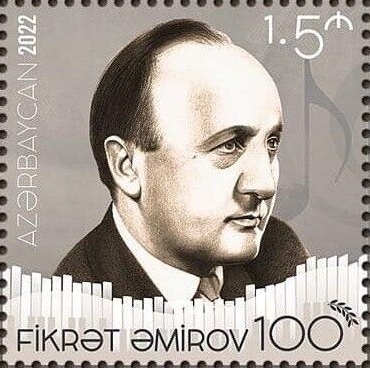
Despite the admiration of Leopold Stokowski (who recorded “Azerbaijan Mugam”) and Michelle Kwan (who skated to “Gulistan Bayati-Shiraz”), the music of Fikret Amirov is still rarely-encountered in the West. This Sunday night on “The Lost Chord,” for the centenary of Amirov’s birth (on November 22, 1922), get to know Azerbaijan’s best-kept secret.
Collectors of a certain vintage may recall Stokowski’s recording, with the Houston Symphony Orchestra, of “Azerbaijan Mugam.” Its native title is “Kyurdi Ovshari.” That language barrier may in part explain Amirov’s relative obscurity in the West. Even taking into account the more accessible title, what exactly is a mugam? Why, it’s a highly rhapsodic and improvisatory form, alternating between song and dance episodes, characteristic of Azeri music. But you see what I mean.
It is that very “exoticism” which makes Amirov difficult to market, yet at the same time, it is what makes him so interesting. In an increasingly multicultural climate, with light being shed now in all corners of the repertoire, perhaps Amirov’s day has finally come.
Tonight, we’ll sample his “Six Pieces for Flute and Piano” of 1970, consisting of “Song of the Aushug,” “Lullaby,” “Dance,” “In the Azerbaijan Mountains,” “At the Spring,” and “Nocturne.” If Amirov’s music at times reminds one of Khachaturian, one need only remember that Azerbaijan shares a border with Armenia. Without getting too much into politics, relations between the two countries are tense, to say the least. His music is also colored by the influence of other neighboring and nearby countries – Turkey, Russia, and Iran.
This is something to bear in mind when approaching his full-length ballet, “The Arabian Nights.” The work, given its premiere in 1979, is one of the rare adaptations to come out of a region which gave us the original stories that make up “A Thousand and One Nights.” The world famous adventures of Sinbad, Ali Baba, and Aladdin are enshrined in these tales, and each of them make an appearance in the ballet’s second act.
This week, we’ll hear selections from Act I, which sets up the framing device, with the unfaithful wife Nurida, the Sultan’s declaration of vengeance against all womankind, and the introduction of Scheherazade, the vizier’s daughter who enthralls the Sultan with her wit and creativity and finally restores his ability to love.
I hope you’ll join me for “Azerbaijani Come Lately” – late works by Fikret Amirov, for his 100th anniversary – this Sunday night at 10:00 EST, on WWFM – The Classical Network and wwfm.org.
Stokowski conducts “Azerbaijan Mugam”
Michelle Kwan’s “Taj Mahal” routine, skated to Amirov’s “Gulistan Bayati-Shiraz”
Leave a Reply