It’s a sad world, in which artists, especially artists of the past, are too often held accountable for the sins of the current leadership of whatever their home country happens to be – leaders whose ideologies, in most instances, if they were still alive, they would privately, if not openly, oppose.
In the weeks following the Russian invasion of Ukraine, orchestras in the West began dropping Tchaikovsky and Shostakovich as if they were blistering samovars. As recently as last month, the New York Philharmonic replaced a series of performances of Shostakovich’s “Leningrad Symphony,” allegedly because of a “scheduling conflict” (the reason I was given right before I turned back my tickets); but if you ask me, I think they were uncomfortable with the work’s significance as a symbol of Soviet resistance.
Seriously? Come on, NY Phil! It was World War II, for crying out loud. Soviet citizens were being starved to death as their city was blockaded by the Nazis! Shostakovich was no crazed nationalist. He did what he had to do in order not to get a bullet in the back of the head, but I think it’s fairly evident that the man was a humanist who understood the insanity of war, and even more so, the fear and suffering that came with having to live under an authoritarian regime.
You think that Tchaikovsky, or Rachmaninoff, or Prokofiev, all who had personal connections to Ukraine, would support the Russian invasion? Yet for all the displays of anti-Russian indignation, where is the embrace of Ukrainian music? Why is no one programming Boris Lyatoshynsky, or Mykola Lysenko, or even Reinhold Glière – Ukrainians all, who composed much attractive music? Every once in a while, someone will program a short piece by Valentin Silvestrov, maybe. He’s the only Ukrainian composer anyone in the West seems to know.
As is too often the case, concert programmers are lazy, they can’t be bothered to step outside their comfort zone, or they’re scared to frighten off subscribers. How else to explain their unwillingness to adapt? We want peace and universal brotherhood? Let’s do Beethoven! After the Ukrainian national anthem, of course. Why not try Lyatoshynsky’s Symphony No. 3? The last movement bears the superscription “Peace will defeat war.” You can’t get much more relevant than that.
Be that as it may, this is all preamble to stating that, for as justifiably unpopular as Russia is right now, I’m not sure if I’m supposed to feel guilty for so thoroughly enjoying the films of Aleksandr Ptushko, who lived from 1900 to 1973. You’ll note Ptushko died 49 years before the invasion of Ukraine.
Sometimes referred to as the Soviet Walt Disney, Ptushko was more akin to Willis O’Brien, or George Pal, or Ray Harryhausen, for his pioneering role in animation. Eventually, he expanded into directing live-action films steeped in fantasy, horror, and Russian mythology. I’m particularly fond of his films based on Russian fairy tales. I watched my first of these, “Sadko” (1952), just before the invasion, and since then, I’ve been ordering the rest of his movies surreptitiously off eBay, like I’m smuggling porn out of a convenience store in a brown paper wrapper.
I would think that classical music lovers, especially, would be susceptible to their charms, as a good number of them are based on Pushkin or Gogol or other sources that provide the bases for so many of the great Russian operas. The score for “Sadko” is actually adapted from Rimsky-Korsakov.
However, in the case of “Ruslan and Ludmila” (1972), I was intrigued to note, the score is not lifted from Glinka, composer of the famous opera, but rather it’s an original contribution by Tikhon Khrennikov, whose birthday it is today.
History has not been kind to Khrennikov, who often comes across as perhaps the most loathsome bureaucrat in Soviet music. He used his position as Secretary of the Union of Soviet Composers to make life miserable for many of his more talented colleagues, especially Shostakovich, Prokofiev, and Mieczyslaw Weinberg. It’s said that cellist Mstislav Rostropovich, who was a large man, once stormed into Khrennikov’s office and gave him a good shaking by his lapels for being such an A-one a-hole.
But Khrennikov was also one of the great survivors. Following the death of Stalin in 1953, he managed to ride out each successive regime, for four more decades, holding on to his influential post until the collapse of the Soviet Union.
Allegedly, there are some who claim that Khrennikov was actually quite the sensitive fellow, who used his influence to quietly protect some of his more vulnerable colleagues. Whether or not that is true, I cannot say. He was a controversial figure, no doubt.
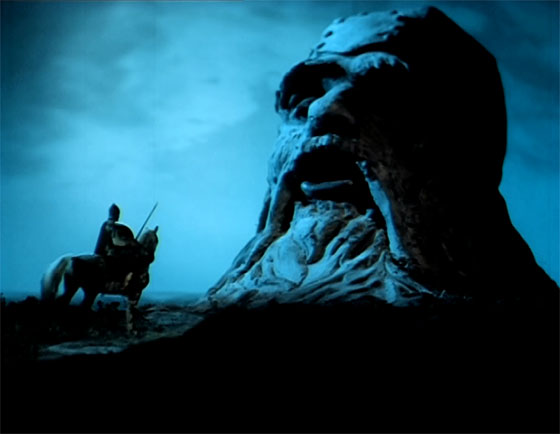
At any rate, he wrote the score for Ptushko’s “Ruslan.” As I watched the film, which I must say is yet another Ptushko delight, I began to notice that the insinuating love theme sounded awfully familiar. When the movie ended, I went to my library and confirmed, sure enough, it was reused as the Adagio from “A Hussar’s Ballad,” Khrennikov’s ballet from 1978 (not to be confused with a score he wrote for a film on the same subject in 1961). It’s actually a rather lovely piece.
But just because Khrennikov was an artist doesn’t mean that he was a nice person. Later in life, he disparaged Perestroika and lauded Stalin as a genius. It takes a special kind of apparatchik to express admiration for Stalin, well after he was dead and couldn’t do anything about it one way or the other.
Khrennikov himself died in 2007 at the age of 94. He enjoyed a longevity in that area of the world reserved only for the unprincipled, and he was as resilient as a cockroach.
I’ll try not to think about it tonight, as I watch Ptushko’s “Ilya Muromets” (1956), based on the same legend treated in symphonic form by the previously-mentioned, Ukrainian-born Reinhold Glière.
There is good and evil in the world, no doubt, but such characteristics cannot – and should not – be determined based exclusively on one’s nationality.
Adagio from “A Hussar’s Ballad”
Ptushko’s “Ruslan and Ludmila”
Boris Lyatoshynsky, Symphony No. 3 “Peace Will Defeat War”
PHOTO: Ruslan’s parley with the giant head
Leave a Reply