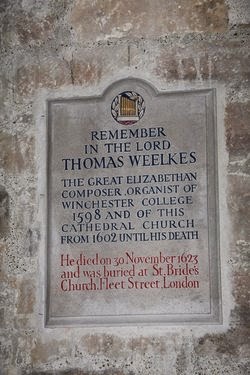
It is the greatest irony that classical music is so often viewed as “elitist,” and even a little prissy, when its greatest practitioners could be as antiestablishment and badly behaved as the most celebrated rock star. Take the case of composer Thomas Weelkes, who died 400 years ago today.
Weelkes served first as organist of Winchester College, where concurrently he began writing the madrigals on which much of his lasting fame rests. Then, after two or three years, he was hired as organist and choirmaster at Chichester Cathedral. Somewhere along the way, Weelkes discovered alcohol.
By 1616, he was “noted and famed for a comon drunckard [sic] and notorious swearer & blasphemer.” Also around this time, he was fined for urinating on the Dean from the organ loft during Evensong. But even that wasn’t enough to get him fired. He was dismissed for drunkenness and rough language during divine service. A short while later, he was rehired, and he did it all over again.
“Dyvers tymes & very often come so disguised eyther from the Taverne or Ale house into the quire as is muche to be lamented, for in these humoures he will bothe curse & sweare most dreadfully, & so profane the service of God… and though he hath bene often tymes admonished… to refrayne theis humors and reforme hym selfe, yett he daylye continuse the same, & is rather worse than better therein.”
He also impregnated at least one woman out of wedlock. Not a big deal now, but surely scandalous behavior back then. However, he made the best of a “bad” situation and married her (Elizabeth Sandham, from a wealthy family) and the child was born six months later. Perhaps it was a happy marriage, as the couple went on to produce two further children. Elizabeth died in 1622. Weelkes met his Maker a year later. He was roughly 47 years-old.
True, a great composer’s legacy frequently transcends his human frailty. When the creator is dust, his or her creations live on. The hellraiser is elevated and those he offended are vaguely recollected by historians and specialists, at best. None of it matters in the end but the work. Or as we like to say, it all comes out in the wash.
How talented was Weelkes? Face it, he routinely showed up to work drunk, was disruptive during religious services, and literally urinated on his boss. Yet 400 years after his death, he is still celebrated for his madrigals and church music. Weelkes wrote more Anglican services than any other major composer of his time.
Raise your lighters to Thomas Weelkes, rock star!
Weelkes madrigal in praise of tobacco
“To Shorten Winter’s Sadness,” complete with fa-la-las.
In a loftier mode, the anthem “When David Heard”
Further anthems
Leave a Reply