Around here, there are at least two Ingrid Bergman movies that get played with some frequency. One is “The Bells of St. Mary’s,” which I watch every year around Christmas. Bergman’s delightful in it, and her bantering interaction with Bing Crosby is priceless. Of course, any viewing is followed by the inevitable debate with whomever I happen to be watching as to whether or not it’s actually a Christmas movie. (I maintain that it is.)
The other, of course, is “Casablanca,” which could very well be my favorite movie of all time. I mean, I have lots of favorites, but rare is the film that manages to stay fresh with every viewing – that is, where I’m actually living every moment of it, rather than simply having it wash over me (having seen it so many times), anticipating certain moments, noting how far into the movie I am, testing my memory of the dialogue, and so forth. But I hardly need to sing the praises or enumerate the qualities of “Casablanca” here. As Captain Renault (Claude Rains) comments to Major Strasser (Conrad Veidt), “Everybody comes to Rick’s.”
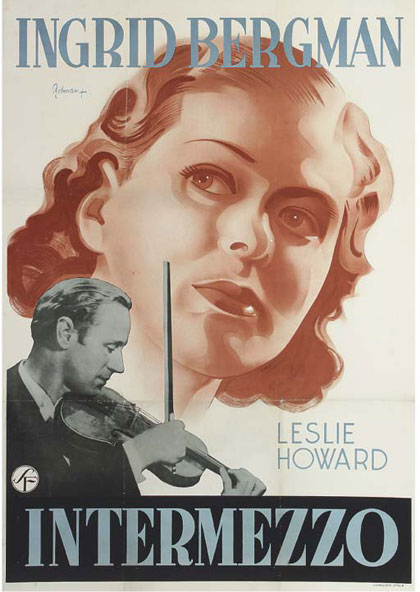
Last week, prior to my most recent viewing, I decided to check out Bergman’s American debut, “Intermezzo,” which believe it or not, even as a classic movie buff, I’d never seen. This is especially surprising, in that the characters are all musicians. Then again, historically, at the movies, that can be something of a mixed blessing.
“Intermezzo” is set, for the most part, in Sweden, I guess to accommodate Bergman’s accent. (She is radiant even here and seems younger – she IS younger – even though it’s only three years before “Casablanca.”) Also, it’s a remake of one of Bergman’s Swedish films, so there’s that. More difficult to explain is why the very English Leslie Howard plays Holger Brandt, an international violinist, who returns home to Stockholm between tours to be with his family.
Bergman plays his daughter’s piano teacher, Anita. When, during a social gathering, Anita is persuaded, after some hesitation, to perform, she launches into the first movement of Grieg’s Piano Concerto – in the living room, yet somehow managing not to drown out all extraneous conversation – and Holger/Howard is suddenly compelled to pick up his violin and join her for an impromptu duet. Kitsch crashes against the promontory of high art in a manner than can only be described as pure Hollywood. Furthermore, there are repeated statements throughout the film of Holger’s favorite encore, one of his own compositions, “Intermezzo,” which his daughter plays repeatedly on the hi-fi whenever her father is on tour.
The actual composer of the piece was Heinz Provost. Provost, responding to a contest held for the original Swedish film in 1935, submitted “Souvenir de Vienne” (Vienna being the city of his birth). He had no qualms about changing the title to “Intermezzo,” and the royalties made him a wealthy man. Provost actually moved to Stockholm in the late 1940s and died there in 1959.
The same year as the Hollywood version, 1939, Howard would play Ashley Wilkes, in vibrant Technicolor, in “Gone with the Wind.” Both films were David O. Selznick productions. Selznick was a complete autocrat, micromanaging every aspect of his films, and there’s no denying his mogul genius. As a craftsman and as an entertainer, he possessed exceptional instincts. I also give him credit for appreciating classical music, or at least recognizing its inherent quality. However, his actual musical taste could be questionable.
In his correspondence, Selznick asserts repeatedly that his ideal would be to have his movies scored with the world’s great masterpieces (which is why we get all that Debussy in Selznick’s “Portrait of Jennie”). Miklós Rózsa hated working on “Spellbound” (another Bergman film), as he repeatedly butted heads with Selznick, who wanted his hands in everything. At least Rózsa won an Oscar for his troubles. Not so poor Max Steiner, who was practically run into the ground, flying on amphetamines the entire time, as he worked around the clock trying to meet Selznick’s demands for “Gone with the Wind,” under threat of having the entire project yanked away and handed off to Herbert Stothart (who, ironically, beat out Steiner that year because of his involvement with “The Wizard of Oz”).
I realize I’m flirting with digression here, but I suspect Selznick’s musical appreciation – and comparative musical ignorance – explains why “Intermezzo,” set in Sweden, is so top-heavy with Norwegian music. I mean, to Selznick, to your average American with a passing knowledge of classical music, it would all be pretty much be the same thing, right? Sweden, Norway, what’s the dif? So we get Grieg and we get Bergman humming Christian Sinding’s “Rustle of Spring.”
Naturally, a forbidden attraction develops between Holger and Anita. But I must say, I was surprised by certain wrinkles in the storyline, as the lovers allow their passion to flair, consequences be damned – the complete opposite, in fact, of “Brief Encounter,” with Trevor Howard (no relation) and Celia Johnson agonizing to Rachmaninoff. A question for the ladies: Leslie Howard certainly has it all over Trevor in the looks department, but does anyone actually find him sexy? Apparently, women did then.
“Brief Encounter,” being British, eschews Hollywood fantasy to give us something that more closely resembles life. Given the choice between movies, I’d stick with the latter. “Intermezzo” is entertaining enough and certainly worth seeing if you’re a classic movie buff, but “Brief Encounter” holds up better, even if the ideals the characters uphold may seem hopelessly antiquated in our more cynical time, when the concepts of honor and sacrifice are frequently viewed ironically or derided. But I think most of us, to some degree, still respond to the nobility and beauty, especially if bittersweet, of doing the right thing. Which is one of the reasons we all still love “Casablanca.”
I could just end there, but as a footnote, I happened to look up Ann Todd, who plays Holger’s daughter and Anita’s pupil. Typical of many child actors, Todd had a comparatively brief career in the movies – although at 14 years, still a pretty good run. Later, she studied library science and became a librarian at U.C. Berkeley. She wrote reviews for the Music Library Association journal and served as its music review and book review editor. In 1984, she established Fallen Leaf Press, which published music books and scores of contemporary American chamber music. Among those in the Fallen Leaf catalogue were Charles Fussell, Robert Greenberg, and Virgil Thomson. Having come across some of these books over the years, I found this interesting. Todd died in 2020 at the age of 88.
On the soundtrack of “Intermezzo,” we hear professional musicians, but I must say, Bergman does a very impressive job of pantomiming. To my eyes, she’s hitting all the keys. By contrast, it’s evident that Howard never held a violin in his life! For close-ups, a musician stood on his knees off-camera and provided all the fingering. So the pitiable bowing is all Howard and the left hand is that of violinist Al Sack, who also doubled for the actor in long shots in front of an orchestra. On the soundtrack, Toscha Seidel played the violin, and Norma Drury played the piano.
Bergman also portrayed a pianist in her final feature film, “Autumn Sonata,” directed by Igmar Bergman (no relation), in 1978. Howard was killed in 1943, only four years after he made “Intermezzo” and “Gone with the Wind,” when during a flight from Lisbon to Bristol, his plane was shot down by the Nazis. He was 50 years-old.
Provost’s “Intermezzo,” played by violinist Toscha Seidel and pianist Eugene Kusmiak
Leave a Reply to ช่างภาพเชียงใหม่Cancel reply