Book people can be peculiar people, as can be, for that matter, classical music people. In fact, anything I like seems to attract more than its share of idiosyncratic personalities. Face it, people are strange. Knowing this makes me a little cautious about spending too much time gazing into the mirror.
Anyway, I don’t mind quirky. It’s ANNOYING I find, well, annoying, and I’ve long realized I have been very fortunate indeed to have had a life filled with eccentric, funny, intelligent, and vivacious people, most of whom have been too colorful not to stand out in a sea of babbitts.
If you want to meet interesting people (some annoying ones too), open a bookshop. I ran a couple of them in my time, and I will always remember characters like Professor Rieff, once married to Susan Sontag, always nattily dressed (bowler, tweeds, and spats), who had difficulty getting around (walking with two canes), but would often drop by after matinees of the Philadelphia Orchestra to bemoan the state of music (“John Adams makes Aaron Copland sound like a veritable Beethoven!”) and amass stacks of purchases, all the while humble-bragging about his academic achievements and holding forth on the ills of society. Later, I would have to smuggle everything into to his house, under the nose of his second, imperious wife.
Also, Jack the Tattoo Man, born on Christmas Day, a Navy veteran who once worked as a side show attraction for Ringling Brothers. Jack was a big man and an enormous personality, and he had tattoos on his face before it became fashionable. He was like Queequeg’s brother from another mother. He spoke loud and clear and articulated things in a manner that would have been considered old school even back in the 1990s. I felt tense for anyone else who happened to wander into the shop while he was there, but he led a very colorful life and was always full of interesting anecdotes and information. He too was virtually immobile. He walked with canes and later rode a scooter. I could always hear him making his way up the marble steps into the foyer when he visited. He wore these enormous Frankenstein boots. Like Rieff, once he plopped down into the overstuffed chair across from my desk, I knew I was in for the long haul.
Another regular was Tony M., always with a twinkle in his eye and a smile on his mustachioed face. He filled the shop with Italian warmth as he conversed effortlessly, always wanting to know how life was treating you, while he searched for transformative books he could pass along to troubled souls at crucial junctures of their lives. It was Tony who spurred me to read “Les Misérables” and who introduced me to Manzoni’s “I promessi sposi.” Again like Rieff, he had to smuggle his purchases past his wife, who he always mentioned with affection. I was sorry to learn Tony passed only recently, having long suffered from a degenerative disease.
Of course, some of the customers were not so pleasant, like the arrogant son-of-a-bitch lawyer who paid cash on the barrel, counting out the bills with a cigar in his mouth and a big ring on his finger, for my extremely rare and pricey limited edition of the novella that became the basis for the film “It’s a Wonderful Life.” I never should have sold it to him. But when you run a bookstore, you have to pay the rent. Even thinking about him brings a certain heaviness to my core. So let’s move on.
My most recent, delightful bookstore acquaintance is the proprietor of H.A.S. Beane Books in Red Hook, NY, a shop I like to visit every summer during the Bard Music Festival. Kind and even-tempered and, unsurprisingly, very knowledgeable about books – also, sensitive to her customers’ personal relationships with them – she listened to my admiring remarks prompted by a certain hardbound volume, a crisp reprint of “The Wind and the Willows” with the original Ernest H. Shepard illustrations – one of my favorite books when I was a kid that I had only recently read for the third time – and insisted that I take it with me as a gift. That was in 2024.
This year, I returned with a gift of my own: a beautiful cloth copy of James Stephens’ “The Crock of Gold,” another personal favorite, with the original color plates by Thomas Mackenzie, which I felt fairly confident she did not know. (Few people do.) She received it graciously and expressed interest in reading it – it’s hard to put it down once you’re caught in the first paragraph, so wise and witty is the writer, if again, a bit old school – but I really did not expect anything else in return.
Nevertheless, she had something for me when I dropped by the shop for a second visit the next week, and now we seem to be caught in a perpetual cycle of exchanging books. (Not to worry, I buy things there too.)
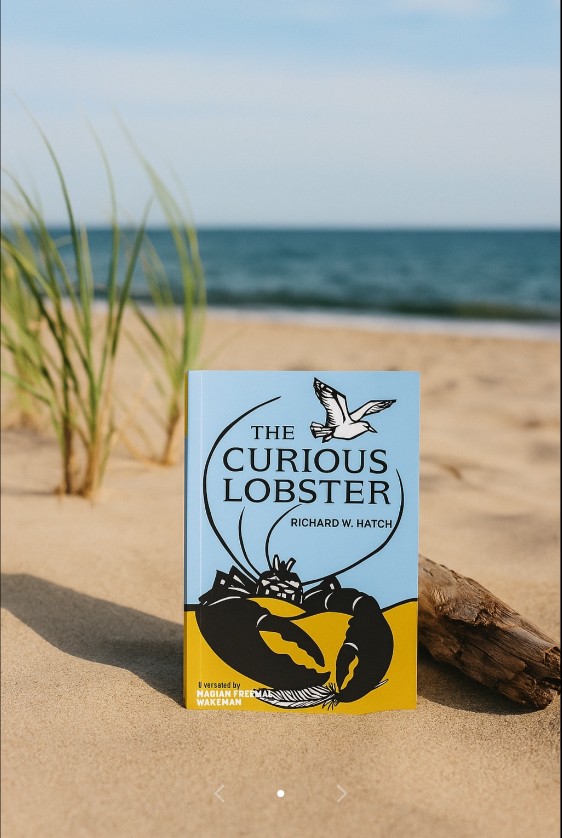
Her choice of “The Curious Lobster” was the very thing to bring my summer to a perfect close. I had never heard of the book – actually two books combined here in a single volume, “The Curious Lobster” (1935) and “The Curious Lobster’s Island” (1939) – but it’s been described as a kind of American cousin to “The Wind and the Willows.” (Some also compare it to “Winnie-the-Pooh.”) The author, Richard W. Hatch, was a graduate of the University of Pennsylvania, and a native of the state, who later returned to his ancestral home in Marshfield, MA. He became head of the English Department at Deerfield Academy and in the 1950s lectured at the Center for International Studies at MIT. It was while serving on a Navy aircraft carrier that he began thinking about the adventures of a long-lived lobster with an unquenchable thirst to expand his knowledge.
“The Curious Lobster” perhaps lacks the lyricism of “The Wind and the Willows” – and certainly anything akin to its strangest episode, “The Piper at the Gates of Dawn” – but the comparison is apt. The three main characters around which the stories revolve are Mr. Lobster, at 68-years-old, curious, empirical, and wise, though not immune to making mistakes; Mr. Badger, his adventurous friend, with a humorous glint in his eye, always eager to push beyond everyone’s comfort zones, often to their detriment; and Mr. Bear, an earnest homebody, who fancies himself as “civilized,” because his house has a window and he likes to fry his fish. Mr. Bear being the most dour, of course repeatedly becomes the brunt of hilarious misfortune. But the three are steadfast in their friendship.
There’s also a memorable and amusing supporting cast: a supercilious sculpin, who predicts constant disaster for the questing Mr. Lobster; an arrogantly knowledgeable owl that drives Mr. Badger to extreme life choices, since Badger considers himself independent and doesn’t like to be defined; a humble, scraping mouse, grateful simply not to be eaten; a sea turtle with wanderlust, but really only wishes to relax; an island snake who aspires to be a venomous serpent; a sea gull who repays the friends’ clemency for the crime of having devoured their picnic; and a “permanent partridge,” who rivals the owl in knowledge.
As I began the second book, I thought surely I would prefer the first, as “The Curious Lobster’s Island” opens with the friends disbanding for the winter, so that Mr. Bear and Mr. Badger can hibernate, and then settles into an overarching narrative, more in the manner of a novel than the picaresque vignettes of the first book. But it also wound up containing the biggest laughs, most of them of course at Mr. Bear’s expense.
It’s interesting, as I was reading it, it never occurred to me that it was supposed to be a children’s book. I read it as I would “The Wind and the Willows” and “The Crock of Gold.” Then one day I picked it up and saw the word “kids” printed on the spine. If this is indeed a kid’s book, it is the best kind. It reads just as well as a work of fiction for a more mature audience. (Writers didn’t pander to kids in the 1930s, but wrote for them as if they were intelligent young people.) Then it occurred to me that it would be perfect to read to a kid a bedtime. I don’t have any kids, but if I did, I would read it to them.
Mr. Lobster and Mr. Badger are always making wry observations and drawing astute conclusions that will delight adults, even as they prove instructive, although by no means didactic, to kids. Subjects include friendship, human nature (albeit anthropomorphized), the desirability of always expanding one’s knowledge, knowing when to exercise prudence and forbearance, looking for the best in others, and seeking the positive in misfortune.
My copy, a paperback reissue from 2018, published by the New York Review of Books, includes the original, adorable (though not precious) black-and-white illustrations by Marion Freeman Wakeman. The book is sweet, without being saccharine. The observations are dry and always spot-on.
I am sorry there are not more Mr. Lobster books. This is one I will surely be tempted to return to in some future summer. Now I have 11 months to come up with something equally charming as repayment to my benefactress in Red Hook (who also helped me to settle on “Persuasion” as my next Jane Austen novel, to celebrate the author’s 250th birthday in December).
If you’re in the area, drop by H.A.S. Beane Books in Red Hook, NY, and tell them Classic Ross Amico sent you!
Leave a Reply