It’s got to be Oscar season. It’s rare for me to see two movies I liked – I mean, really enjoyed – in one week. (Read my impressions of Guillermo del Toro’s “Frankenstein” from November 6.) I mean, I don’t generally make the trek to a theater to see anything I know is going to be trash anymore – unless it’s “Indiana Jones and the Dial of Destiny” (ouch!) or “Megalopolis.” “Blue Moon” is on a more intimate scale, but quietly thrilling in a way neither of those enormously-budgeted films were.
Local hero Ethan Hawke, who grew up in West Windsor, NJ, and hung out in Princeton – where he attended the Hun School and gained early acting experience at McCarter Theatre – plays the acerbic, needy, soulful, brilliant lyricist Lorenz Hart, smarting from the fledgling success of his longtime creative partner, composer Richard Rodgers, on the opening night of “Oklahoma!” – Rodgers’ inaugural effort with Oscar Hammerstein II. Hart, the wound of rejection oozing like sour grapes through all the malbec and bourbon, delivers rapid-fire, barbed arias and elevated panegyrics to ineffable beauty – unsurprisingly, given his vocation, always lighting on the “mot juste.” He observes that any show that ends in an exclamation point isn’t worth seeing. He’s hard on “Oklahoma!’s” middlebrow success (and I can’t say that I disagree). He thirsts for art that’s more inventive, more challenging, one that takes creative chances. He bristles at facile lyrics such as corn that’s “as high as an elephant’s eye,” as all good folk should. Except, of course, the beauty of what Rodgers & Hammerstein achieved at their best also defies logic.
Hart was no slouch either, if exasperatingly difficult to pin down. It’s made abundantly clear that he had to be a nightmare to work with, especially for someone as disciplined as Rodgers, with his regular work habits. By contrast, Hart enjoys the pleasures of distraction and dissipation, staying out after-hours and sleeping until noon. You couldn’t find a better example of clashing personalities sharing an inexplicable chemistry, although of course such bonds are abundant in the history of the creative arts. We’re reminded from the start that the Rodgers & Hart partnership yielded a thousand songs, including “Bewitched, Bothered and Bewildered,” “My Funny Valentine,” “Isn’t It Romantic,” “The Lady is a Tramp,” and the titular “Blue Moon.” The soundtrack is a juke box for admirers of the golden age of the American Songbook, with the soundtrack pretty much wall-to-wall Richard Rodgers, Irving Berlin, Jerome Kern, and George Gershwin.
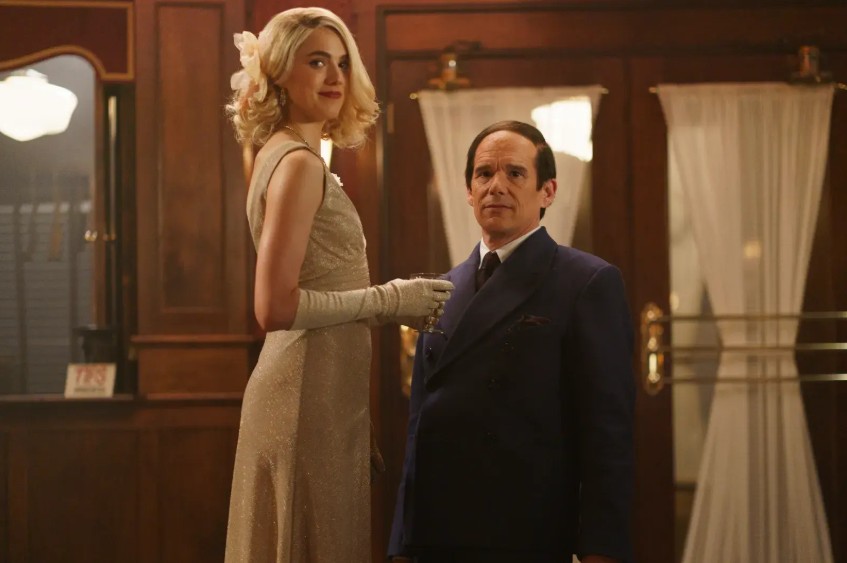
There are running gags about “Casablanca,” as Hart banters with Eddie the bartender (Bobby Cannavale), an earthy but sympathetic foil, and in-jokes about Stephen Sondheim and “Stuart Little.” E.B. White (Patrick Kennedy) happens to be sitting in a corner booth. There’s also a plum role for Magaret Qualley, as the self-described “ambisexual” Hart’s statuesque, 20-year-old muse. There’s an extended conversation in a cloakroom that allows both actors to really shine.
Hawke, who in life is 5’ 10” with a full head of hair, disappears into the character, made to appear physically diminutive, sporting a combover and double-breasted suit, and for much of the movie, swilling booze and chomping on a monstrous cigar. (In the old days, Hart could have been played by Lionel Stander.) The illusion is broken only in a couple of shots, when he’s shown wearing a hat in profile, which obscures the make-up, and we can’t help but notice that it is indeed Ethan Hawke. Otherwise, the magic is sustained for 100 mesmerizing minutes.
The film is directed by Richard Linklater, who’s written and/or directed mostly modest yet persistently memorable movies, including “Slacker,” “Dazed and Confused,” and “School of Rock.” I’m not by any means a rocker, but I do have a soft spot for the Jack Black opus, which I still find myself quoting often. (I too have lived the legend of the rent.) Also, the trilogy of films starring Hawke and Judy Delpy that began with “Before Sunrise.” And the even more ambitious “Boyhood,” shot in installments over 12 years, so that the actors (including Hawke, but especially the young Ellar Coltrane, who plays his son) could age in real time.
Despite taking place largely in one location (the legendary theatrical hangout, Sardi’s), “Blue Moon” is more rapid-fire, with enough dialogue for four or five movies, and I wouldn’t be the least bit surprised if it takes on a second life as a play. The screenplay is by Robert Kaplow, whose book, “Me and Orson Welles,” Linklater shepherded to the screen in 2008. The dialogue is very good – smart, often acrobatic, but always believable – and the actors stick every line.
There’s a moment when Hart holds Rodgers (Andrew Scott, no less excellent) back from an upstairs reception and the two men – Rodgers now at the peak of his career and Hart sensing he is at the end of his – stand on a landing together, cycling through a gamut of emotions that color their complex personal relationship, with its shades of friction, annoyance, exasperation, and underlying affection. It is some finely tuned and nuanced work, those emotions flitting across their faces and reflected in their body language as subtly as wisps of cloud on a sunny day. Anyone who’s lived long enough has surely experienced similar moments with a complicated friend or family member. The movie is full of such touches, which stand in absorbing contrast to Hart’s alcohol-propelled bluster.
I’ve been meaning to get around to seeing this, which I had been anticipating ever since I saw the trailer weeks ago, but I missed it in Princeton, where it had a very short run. But I was able to catch it up Route 206 at Montgomery Cinemas (where, by the way, “Frankenstein,” is also still playing). My stepfather saw it a week or two ago, and he brought it up during our most recent telephone conversation, knowing what a music guy I am. We always talk movies. We’ve done so our entire lives, and I know he gets a kick out of it, probably in large part because I still know who people like Lionel Stander are. He said he’d tell me what he thought of it once I had a chance to see it. He didn’t want to color my impressions of it, he said. To me, that suggests he was lukewarm on it. One of his most-hated experiences in a theater was viewing “My Dinner with André” (which I also really like), which is basically André Gregory and Wallace Shawn conversing at a table in a restaurant for two hours. I could see how, for him, this movie might have a touch of that, but I would think also that there are just so many period references – he’ll recognize Sardi’s and “Casablanca” and the American Songbook, even if he might not pick-up on E.B. White and Sondheim – he would at least got some enjoyment from it. I guess I’ll find out.
Anyway, I wouldn’t be surprised if there are Academy Award nominations for Hawke, who’s come a long way from “Dead Poets Society,” and screenwriter Robert Kaplow.
It’s the rare movie about music that I actually like. I feel like “Blue Moon” actually gets it right, largely because it avoids the Scylla and Charybdis of, on the one hand, attempting to portray the mystifying act of creation (a mostly internal, undramatic process), and on the other, attempting to define the ineffable (a word Hart really likes) essence of music.
“Blue Moon” works as a character portrait of a fictionalized Hart, with just enough supporting players and good performances to make this pocket-dramedy sing.
“Blue Moon” Sings
by
One response
Comments
One response to ““Blue Moon” Sings”
-
… [Trackback]
[…] Info to that Topic: rossamico.com/2025/11/12/blue-moon-sings/ […]
Tag Cloud
Aaron Copland (92) Beethoven (94) Composer (114) Film Music (116) Film Score (143) Film Scores (255) Halloween (94) John Williams (185) KWAX (228) Leonard Bernstein (99) Marlboro Music Festival (125) Movie Music (131) Opera (197) Philadelphia Orchestra (86) Picture Perfect (174) Princeton Symphony Orchestra (106) Radio (86) Ralph Vaughan Williams (85) Ross Amico (244) Roy's Tie-Dye Sci-Fi Corner (290) The Classical Network (101) The Lost Chord (268) Vaughan Williams (99) WPRB (396) WWFM (881)
Leave a Reply