It’s got to be Oscar season. It’s rare for me to see two movies I liked – I mean, really enjoyed – in one week. (Read my impressions of Guillermo del Toro’s “Frankenstein” from November 6.) I mean, I don’t generally make the trek to a theater to see anything I know is going to be trash anymore – unless it’s “Indiana Jones and the Dial of Destiny” (ouch!) or “Megalopolis.” “Blue Moon” is on a more intimate scale, but quietly thrilling in a way neither of those enormously-budgeted films were.
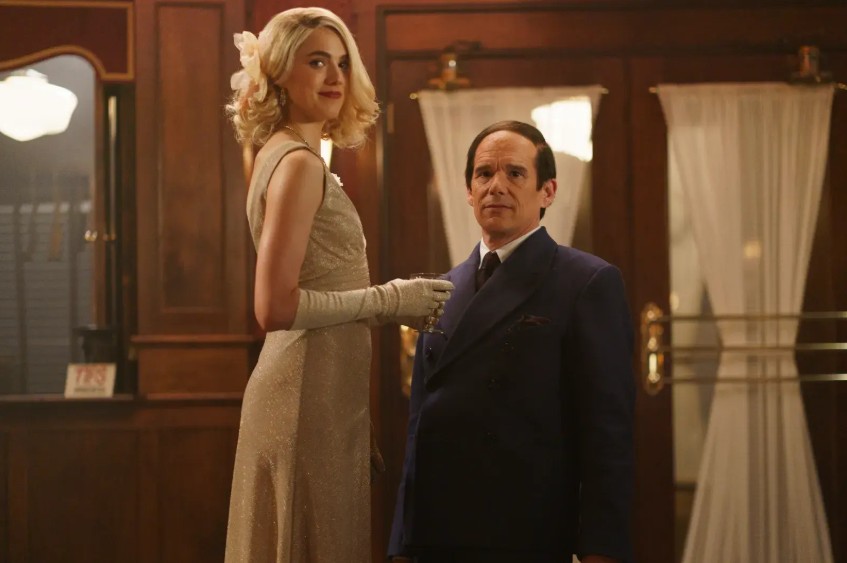
Local hero Ethan Hawke, who grew up in West Windsor, NJ, and hung out in Princeton – where he attended the Hun School and gained early acting experience at McCarter Theatre – plays the acerbic, needy, soulful, brilliant lyricist Lorenz Hart, smarting from the fledgling success of his longtime creative partner, composer Richard Rodgers, on the opening night of “Oklahoma!” – Rodgers’ inaugural effort with Oscar Hammerstein II. Hart, the wound of rejection oozing like sour grapes through all the malbec and bourbon, delivers rapid-fire, barbed arias and elevated panegyrics to ineffable beauty – unsurprisingly, given his vocation, always lighting on the “mot juste.” He observes that any show that ends in an exclamation point isn’t worth seeing. He’s hard on “Oklahoma!’s” middlebrow success (and I can’t say that I disagree). He thirsts for art that’s more inventive, more challenging, one that takes creative chances. He bristles at facile lyrics such as corn that’s “as high as an elephant’s eye,” as all good folk should. Except, of course, the beauty of what Rodgers & Hammerstein achieved at their best also defies logic.
Hart was no slouch either, if exasperatingly difficult to pin down. It’s made abundantly clear that he had to be a nightmare to work with, especially for someone as disciplined as Rodgers, with his regular work habits. By contrast, Hart enjoys the pleasures of distraction and dissipation, staying out after-hours and sleeping until noon. You couldn’t find a better example of clashing personalities sharing an inexplicable chemistry, although of course such bonds are abundant in the history of the creative arts. We’re reminded from the start that the Rodgers & Hart partnership yielded a thousand songs, including “Bewitched, Bothered and Bewildered,” “My Funny Valentine,” “Isn’t It Romantic,” “The Lady is a Tramp,” and the titular “Blue Moon.” The soundtrack is a juke box for admirers of the golden age of the American Songbook, with the soundtrack pretty much wall-to-wall Richard Rodgers, Irving Berlin, Jerome Kern, and George Gershwin.
There are running gags about “Casablanca,” as Hart banters with Eddie the bartender (Bobby Cannavale), an earthy but sympathetic foil, and in-jokes about Stephen Sondheim and “Stuart Little.” E.B. White (Patrick Kennedy) happens to be sitting in a corner booth. There’s also a plum role for Magaret Qualley, as the self-described “ambisexual” Hart’s statuesque, 20-year-old muse. There’s an extended conversation in a cloakroom that allows both actors to really shine.
Hawke, who in life is 5’ 10” with a full head of hair, disappears into the character, made to appear physically diminutive, sporting a combover and double-breasted suit, and for much of the movie, swilling booze and chomping on a monstrous cigar. (In the old days, Hart could have been played by Lionel Stander.) The illusion is broken only in a couple of shots, when he’s shown wearing a hat in profile, which obscures the make-up, and we can’t help but notice that it is indeed Ethan Hawke. Otherwise, the magic is sustained for 100 mesmerizing minutes.
The film is directed by Richard Linklater, who’s written and/or directed mostly modest yet persistently memorable movies, including “Slacker,” “Dazed and Confused,” and “School of Rock.” I’m not by any means a rocker, but I do have a soft spot for the Jack Black opus, which I still find myself quoting often. (I too have lived the legend of the rent.) Also, the trilogy of films starring Hawke and Judy Delpy that began with “Before Sunrise.” And the even more ambitious “Boyhood,” shot in installments over 12 years, so that the actors (including Hawke, but especially the young Ellar Coltrane, who plays his son) could age in real time.
Despite taking place largely in one location (the legendary theatrical hangout, Sardi’s), “Blue Moon” is more rapid-fire, with enough dialogue for four or five movies, and I wouldn’t be the least bit surprised if it takes on a second life as a play. The screenplay is by Robert Kaplow, whose book, “Me and Orson Welles,” Linklater shepherded to the screen in 2008. The dialogue is very good – smart, often acrobatic, but always believable – and the actors stick every line.
There’s a moment when Hart holds Rodgers (Andrew Scott, no less excellent) back from an upstairs reception and the two men – Rodgers now at the peak of his career and Hart sensing he is at the end of his – stand on a landing together, cycling through a gamut of emotions that color their complex personal relationship, with its shades of friction, annoyance, exasperation, and underlying affection. It is some finely tuned and nuanced work, those emotions flitting across their faces and reflected in their body language as subtly as wisps of cloud on a sunny day. Anyone who’s lived long enough has surely experienced similar moments with a complicated friend or family member. The movie is full of such touches, which stand in absorbing contrast to Hart’s alcohol-propelled bluster.
I’ve been meaning to get around to seeing this, which I had been anticipating ever since I saw the trailer weeks ago, but I missed it in Princeton, where it had a very short run. But I was able to catch it up Route 206 at Montgomery Cinemas (where, by the way, “Frankenstein,” is also still playing). My stepfather saw it a week or two ago, and he brought it up during our most recent telephone conversation, knowing what a music guy I am. We always talk movies. We’ve done so our entire lives, and I know he gets a kick out of it, probably in large part because I still know who people like Lionel Stander are. He said he’d tell me what he thought of it once I had a chance to see it. He didn’t want to color my impressions of it, he said. To me, that suggests he was lukewarm on it. One of his most-hated experiences in a theater was viewing “My Dinner with André” (which I also really like), which is basically André Gregory and Wallace Shawn conversing at a table in a restaurant for two hours. I could see how, for him, this movie might have a touch of that, but I would think also that there are just so many period references – he’ll recognize Sardi’s and “Casablanca” and the American Songbook, even if he might not pick-up on E.B. White and Sondheim – he would at least got some enjoyment from it. I guess I’ll find out.
Anyway, I wouldn’t be surprised if there are Academy Award nominations for Hawke, who’s come a long way from “Dead Poets Society,” and screenwriter Robert Kaplow.
It’s the rare movie about music that I actually like. I feel like “Blue Moon” actually gets it right, largely because it avoids the Scylla and Charybdis of, on the one hand, attempting to portray the mystifying act of creation (a mostly internal, undramatic process), and on the other, attempting to define the ineffable (a word Hart really likes) essence of music.
“Blue Moon” works as a character portrait of a fictionalized Hart, with just enough supporting players and good performances to make this pocket-dramedy sing.
Tag: American Songbook
-
“Blue Moon” Sings
-
Remembering George Crumb American Original
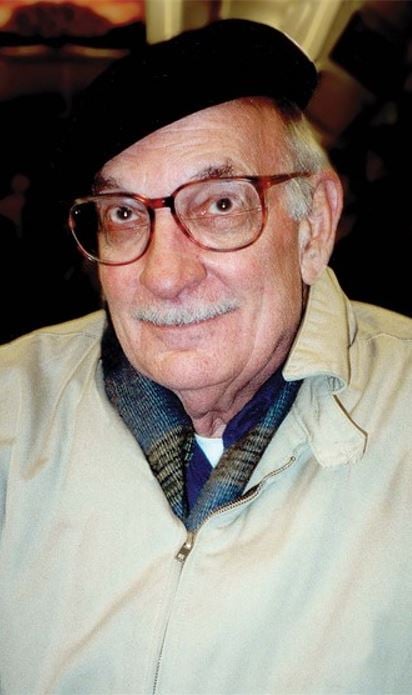
I am very sorry to learn of the passing of George Crumb, a composer I have revered for nearly 40 years, since I first encountered his work for electric string quartet, “Black Angels,” on Philadelphia’s now-defunct classical music station, WFLN. The music scared the hell out of me and completely enthralled me.
The context was a Friday night radio show, “Music Through the Centuries,” hosted by George Diehl. Diehl was at one time WFLN’s program director. He also provided program notes for the Philadelphia Orchestra. “Music Through the Centuries” was a big influence on my own Sunday night program (on WWFM The Classical Network), “The Lost Chord.”
What made this particular episode so indelible is that Diehl introduced a recording of Crumb’s otherworldly, often hair-raising quartet – a reaction to the Vietnam War – by deftly placing it in context, illuminating its structure, and supplementing it with recordings of other works referenced within the piece.
Having cut my teeth on the station’s usual, more traditional fare, my mind was officially blown. It’s not for nothing that William Friedkin incorporated “Black Angels” into “The Exorcist.” I immediately determined to pick up everything I could find on LP, and my enthusiasm continued into the CD era.
The first time I met Crumb was at a recital at the Curtis Institute of Music in Philadelphia. He was there attending a student recital in the company of Richard Wernick. It just so happened that I lived about a block away, so I was able to dash home and retrieve a CD on Bridge Records that contained works by both composers. Both were on the faculty of the University of Pennsylvania. Both were Pulitzer Prize winners.
I caught them as they were leaving the building, and Crumb, likely nonplussed by this 20 year-old autograph hound, was kind enough to sign. Wernick, who of course was with him, couldn’t very well say no. I was a little sheepish about it, and probably didn’t say much of worth. At best, I may have provided a source of amusement on their walk back to the car.
It was another 20 years, then, I think, before I saw him again (although he may have been present when I heard his orchestral work, “A Haunted Landscape,” played by Philadelphia Orchestra in 1989, part of a knockout program also featuring Ravel’s “Le tombeau de Couperin” and Vaughan Williams’ “A London Symphony”). By that time, he had entered his “Grand Old Man of American Music” phase. Furthermore, he was closely affiliated with Orchestra 2001, a contemporary music ensemble founded at Swarthmore College, practically in Crumb’s back yard. Orchestra 2001 gave first performances of many of his later pieces.
Among these were the seven cycles for voice and percussion that comprise his “American Songbook.” These are highly individual recastings of folk songs and hymns he recollected from his boyhood in West Virginia – especially effective, and affecting, when heard in concert, where the breadth and subtlety of the instrumentation can be fully appreciated.
His daughter, Broadway actress Ann Crumb, was a frequent soloist. During this time, I got to meet them both and to speak with them under more relaxed circumstances, at cocktail hours and receptions. They were lovely people. George was unfailingly approachable, good-humored, soft-spoken, and surprisingly modest. Ann, who died much too young at 69, was warm and genuine and a real animal lover. She was always bringing home strays, so that the Crumb household was full of dogs (the most notorious being “bad dog” Yoda).
It is perhaps an overused description, but George Crumb truly was an American original. He produced works with an economy and elegance that seemed to contradict – and yet, somehow, paradoxically, to reinforce – an Ivesian tendency to suggest greater vistas beyond their seemingly modest means. In the process, he anticipated the widespread proliferation of the percussion ensemble, which is now practically analogous to what the string quartet was to the 18th and 19th centuries.
No matter how “respectable” he’s become, my own reactions will always be colored by that flush of youth, when I first fell under the spell of his eerie and at times horrifying invention.
George Crumb was the recipient of the Pulitzer Prize for Music in 1968, for “Echoes of Time and the River,” and a Grammy Award for Best Contemporary Composition in 2001, rather appropriately, for “Star-Child.” All or most of his music is available in the “Complete Crumb Edition,” an ongoing project on Bridge Records, Inc.
The composer died at his home earlier today at the age of 92.
Thank you, sir, and R.I.P.
“Black Angels” in concert
“Black Angels” with score
“Ancient Voices of Children” in concert
“Star-Child”
Crumb talks about “Mundus Canis;” performs “Fritzi” with guitarist David Starobin
“Yoda” (from “Mundus Canis”)
From “American Songbook,” sung by Ann Crumb:
“Shall We Gather at the River”
“All the Pretty Horses”
“Poor Wayfaring Stranger”
“One More River to Cross”
“Give Me That Old Time Religion”
Crumb interviewed by Gilbert Kalish
Crumb at his home in 2020 (with yet more pooches)
-

George Crumb American Original at 90
George Crumb is an American original, the reigning Grand Old Man of American Music. Crumb, who makes his home in Swarthmore, PA, produces works with an economy and elegance that seem to contradict – and yet, somehow, paradoxically, to reinforce – an Ivesian tendency to suggest greater vistas beyond their seemingly modest means.
On a more visceral level, sometimes they can be downright scary. Which is especially amusing since, by all accounts – and supported by my own experience, having met him perhaps five or six times – he has been unfailingly approachable, modest and even cheerful.
It’s fortuitous indeed that his birthday falls so close to Hallowe’en. It’s not for nothing that his work for electric string quartet, “Black Angels,” was used in “The Exorcist.”
Crumb has enjoyed a remarkable Indian summer, drawing on the hymns and folk songs of his West Virginia boyhood and lending them a unique resonance through his imaginative and colorful use of percussion. These are collected into seven cycles for voice titled “American Songbook” – remarkably effective and affecting works, especially when heard live in concert, where the breadth and subtlety of the instrumentation can be fully appreciated.
Just because you’ve been pigeonholed as an avant-gardist doesn’t mean your music can’t be fun. “Mundus Canis” (“A Dog’s World”) is a musical portrait gallery for guitar and percussion inspired by the Crumbs’ family pets. Five of them are enshrined in the suite: Tammy, Fritzi, Heidel, Emma-Jean and Yoda. Apparently Yoda, a fluffy white mixed-breed, adopted from a New York City pound, was especially disobedient.
“Mundis Canis”
Many happy returns to George Crumb on his 90th birthday!
“Black Angels” (wait until after breakfast)
From his “American Songbook:”
“All the Pretty Horses”
“Poor Wayfaring Stranger”
“One More River to Cross”
“Give Me That Old Time Religion”
PHOTO: George Crumb with “bad dog” Yoda
-

George Crumb Turns 86 American Original
Today is the 86th birthday of George Crumb. Crumb is another one of our great American originals, perhaps the reigning Grand Old Man of American Music. He produces works with an economy and elegance that seem to contradict and yet, somehow, paradoxically, to reinforce an Ivesian tendency to suggest greater vistas beyond their seemingly modest means.
On a more visceral level, sometimes he can be downright scary. Which is especially amusing, since by all accounts – as well as on the perhaps five or six occasions I have met him – he has been unfailingly approachable, modest and even cheerful.
It’s fortuitous indeed that his birthday falls so close to Hallowe’en. It’s not for nothing that his work for electric string quartet, “Black Angels,” was used in “The Exorcist.”
In the last 15 years or so, Crumb has been enjoying a productive Indian summer, mining the hymns and folk songs of his West Virginia boyhood, lending them a unique resonance through his imaginative and colorful use of percussion.
Happy birthday, George Crumb!
“Black Angels”:
From his “American Songbook,” “All the Pretty Horses”:
And “Poor Wayfaring Stranger”:
PHOTOS: George Crumb (left) with The Exorcist’s Pazuzu
Tag Cloud
Aaron Copland (94) Beethoven (95) Composer (114) Film Music (148) Film Score (143) Film Scores (255) Halloween (97) John Williams (196) KWAX (232) Leonard Bernstein (105) Marlboro Music Festival (125) Movie Music (163) Mozart (91) Opera (215) Philadelphia Orchestra (90) Picture Perfect (174) Princeton Symphony Orchestra (110) Radio (90) Ross Amico (244) Roy's Tie-Dye Sci-Fi Corner (290) The Classical Network (101) The Lost Chord (269) Vaughan Williams (107) WPRB (397) WWFM (881)