Release the Kraken!
This week on “Picture Perfect,” it’s a mythological mash-up, with music from four films inspired by classical myths.
“Helen of Troy” (1956) is based on events recounted in Homer’s “The Iliad.” Like the more recent film “Troy,” this version glosses over any participation by the gods. Could it be their wrath that caused this Robert Wise-directed spectacle to be plagued with difficulties?
Reportedly three people were killed during the making of the film, extras were injured by a runaway chariot, and 80 percent of the two-acre recreation of Troy was burned to the ground by a cigarette. On the bright side, it was Bridgette Bardot’s first film made outside of France, and Rossana Podestà played Helen. A spectacle indeed! Max Steiner provided the lush, romantic score.
“Clash of the Titans” (1981) is not to be confused with the 2010 CGI-fest. This is the real deal, with special effects by legendary stop-motion maestro Ray Harryhausen.
Just as special is its luxury casting of supporting roles, including Sir Laurence Olivier as Zeus, and Claire Bloom, Maggie Smith, Sian Phillips, and Ursula Andress as fellow Olympians. Burgess Meredith is among the mortals, Flora Robson turns up in one scene as a witch, and Perseus is played by newcomer Harry Hamlin, soon to find fame on television’s “L.A. Law.”
The composer, Laurence Rosenthal, studied at the Eastman School and in Paris with Nadia Boulanger. He also wrote the music for “Raisin in the Sun,” “The Miracle Worker,” “Becket,” and the 1977 version of “The Island of Dr. Moreau.”
“Clash of the Titans” would be Harryhausen’s final film. Despite flashes of his inimitable brilliance, in sequences like the one involving Medusa, and the creation of something of a cultural icon in the Kraken, the effects came to seem a little too retro in the wake of “Star Wars” and “Superman.” Though a sequel, “Force of the Trojans,” was pitched to M-G-M, it was not to materialize. Harryhausen died in 2013, after a lengthy retirement, at the age of 92.
It would be a crime against peplum to put together a program of this sort without at least a nod to Hercules. The peplum genre originated in Italy with Maciste, a supporting character in the 1914 classic “Cabiria.” So powerful did this strongman prove that he became an industry unto himself. The Maciste craze reached its muscular peak in the late ‘50s and early ‘60s. When the films arrived in the United States, in hilariously dubbed versions, the character was invariably renamed Hercules, Samson, Atlas, Goliath, or any other mythological, Biblical, or historical bodybuilder you can think of.
A peplum revival sprang up around “Conan the Barbarian” in the early 1980s. We’ll hear a selection from “Hercules” (1983), starring Lou Ferrigno, television’s Incredible Hulk. The music is by Pino Donaggio.
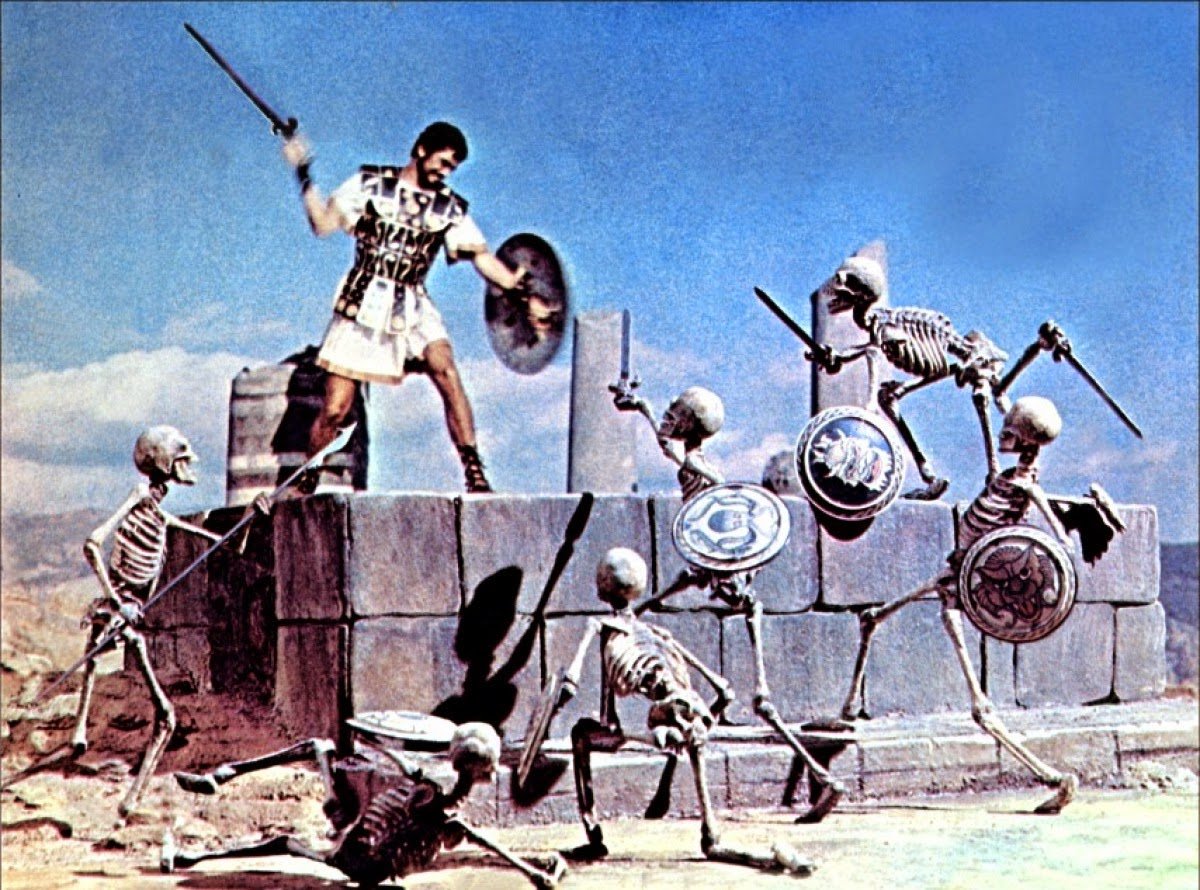
Finally, we’ll make things right again with an extensive suite from the ultimate Ray Harryhausen mythological playground, “Jason and the Argonauts” (1963). This is the one that features the climactic battle with the skeleton army. The music, by Bernard Herrmann, brilliantly suits the visuals. We’ll hear a superb re-recording of the score on the Intrada label, with the Sinfonia of London conducted by Bruce Broughton.
You won’t want to myth it, no bones about it! It’s a quest for classical mythology this week, on “Picture Perfect,” music for the movies, this Saturday evening at 6:00 EDT, on WWFM – The Classical Network and wwfm.org!
Leave a Reply