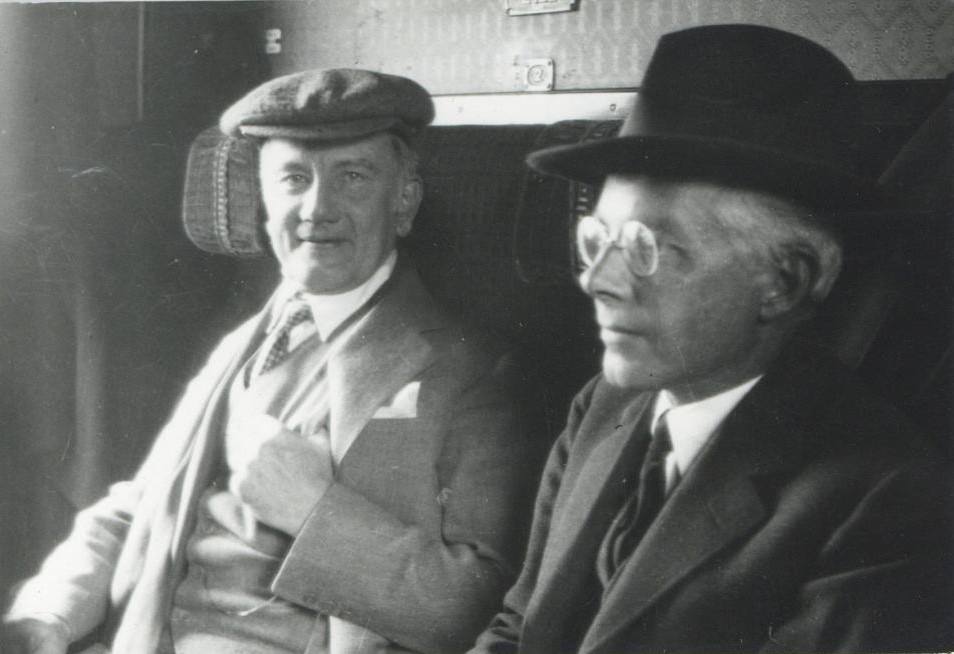
It’s all about contrasts on this week’s “Music from Marlboro.”
While Béla Bartók is respected as the foremost Hungarian composer of the 20th century, Ernő Dohnányi, until recently, has been subject to neglect, at least in proportion to his significance. Sure, Bartók and his friend Zoltán Kodály were at the forefront of the whole nationalist movement, traipsing around the countryside in order to document authentic folk traditions before they were swallowed up forever by industrialization. But as director of the Budapest Academy of Music and music director of the Budapest Philharmonic Orchestra, Dohnányi would exert as much influence over his country’s musical development as that of his folk music-mad friends and contemporaries
Unfortunately, he would become the target of character assassination campaigns after World War II, in which he was painted as a Nazi sympathizer. Dohnányi was investigated and cleared several times by the U.S. Military Government, and in fact has been defended as a forgotten hero of Holocaust resistance, since it was through his administrations that countless Jewish musicians survived. Also, between the wars, he went to bat for Kodály, a leftist, by refusing to fire him from the Budapest Academy. As a result, Dohnányi too lost his position, albeit temporarily. Nevertheless, he continued to be eyed with suspicion, and his slandered reputation never fully recovered.
Equally fatal is the fact that much of his music bears a more cosmopolitan stamp than that of the Hungarian composers of his era that are now so celebrated. His composition teacher, the German-born Hans von Koessler (known in Hungary as János Koessler) was a cousin of Max Reger. Of course, Koessler also taught Bartók and Kodály. But Dohnányi was perfectly happy nestled in the world of Brahms. For his international career, he assumed the name Ernst von Dohnanyi.
Dohnányi’s Piano Quintet in C minor, completed in June of 1895, one month before his 18th birthday, earned Brahms’ approval. We’ll hear it performed at the 1977 Marlboro Music Festival, by pianist Stephanie Brown, violinists Joseph Genualdi and Mayuki Fukuhara, violist Philipp Naegele, and cellist Lisa Lancaster.
The program will open with Bartók’s “Contrasts,” a raw, fascinating work, from 1938. The piece, inspired by Hungarian and Romanian dance melodies, was commissioned by Benny Goodman, of all people. The trio – for clarinet, violin, and piano – contains passages of bitonality and frenzied dances for scordatura violin. We’ll hear it performed at the 1998 Marlboro Music Festival by clarinetist Anthony McGill, violinist Catherine Cho, and pianist Pierre-Laurent Aimard.
I hope you’re hungry for Hungarian music. Variety is the spice of life on this week’s “Music from Marlboro,” Wednesday evening at 6:00 EDT, on WWFM – The Classical Network and wwfm.org.
Marlboro School of Music and Festival: Official Page
Strangers on a Train: Ernő Dohnányi (left) and Béla Bartók
Leave a Reply