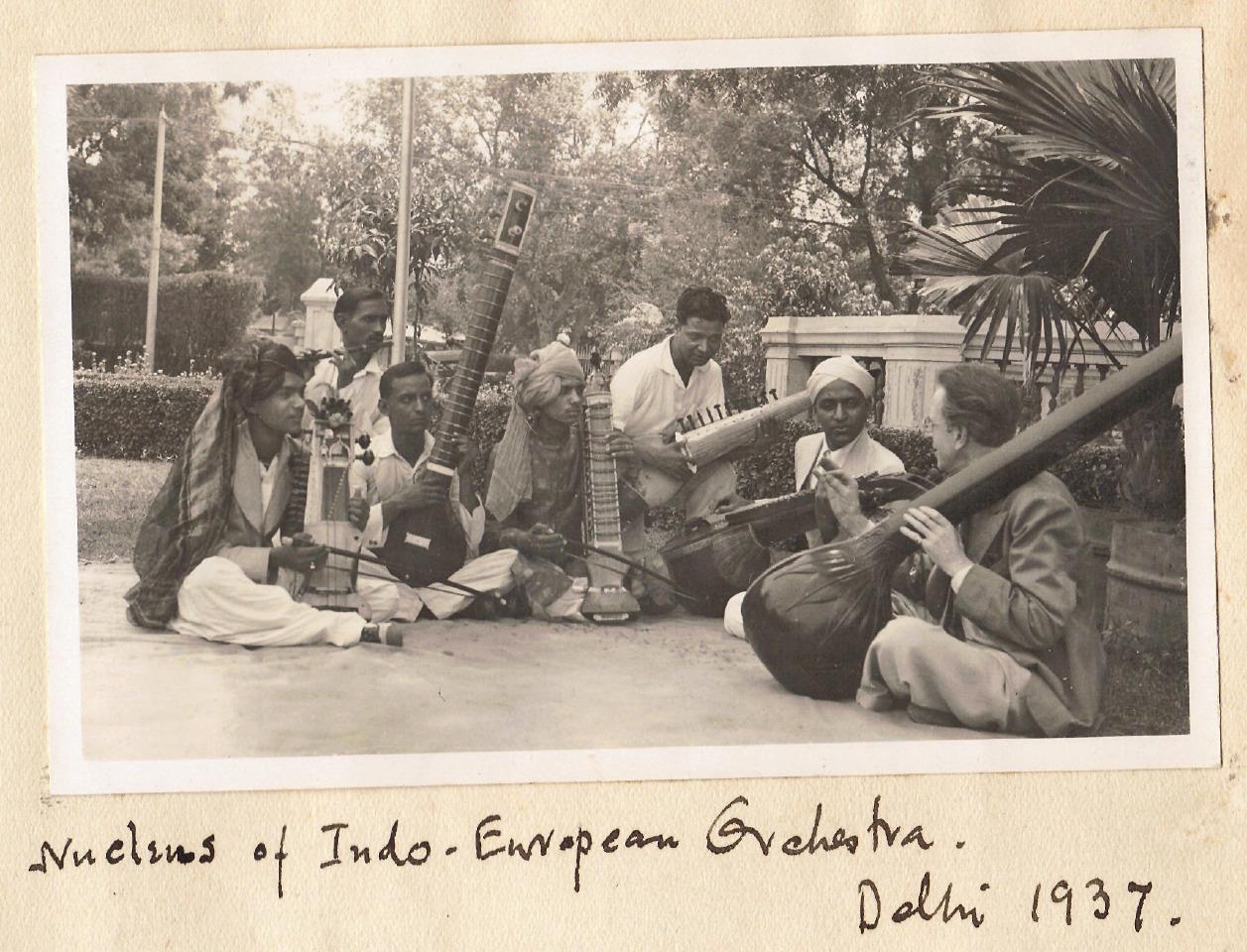
Though steeped in the comparatively conservative milieu of the English Musical Renaissance at the turn of last century, John Foulds (1880-1939) was fascinated with the cultures and music of the East. In particular, he gravitated toward India, first intellectually and spiritually, and at last physically. His second wife, the violinist Maude MacCarthy, was an authority on Indian culture, and the two were very much in sympathy with the tenets of Eastern spirituality.
Foulds moved to India in 1935. There, he collected native folk tunes. He became director of European music for All-India Radio in Delhi, created an orchestra from scratch, and labored tirelessly to fulfill his vision of a synthesis between Eastern and Western music. He also composed works for traditional Indian instruments. His efforts on behalf of the radio were so successful that he was asked to open a satellite branch in Calcutta. Unfortunately, he contracted cholera and died within a week of his arrival, at the age of 58.
Because of the remote location and the fact that a number of the pieces of his maturity have been lost, or the manuscripts extensively compromised by vermin, Foulds’ slight reputation rested for the most part on his “light music.”
But Foulds was definitely ahead of his time, as the gradual rediscovery of his works have revealed, with the composer’s fascination for quarter-tones and, occasionally, a tendency toward an almost proto-minimalism.
Over the span of a decade, from 1919 to 1930, Foulds labored sporadically at a Sanskrit opera titled “Avatara.” The work would remain unfinished, but preludes from each of the acts were assembled into a concert work, “Three Mantras.”
“Mantra I” is subtitled “Of Action and Vision of Terrestrial Avataras;” “Mantra II,” “Of Bliss and Visions of Celestial Avatras;” and “Mantra III,” “Of Will and Vision of Cosmic Avataras.”
Here they are.
Mantra I: https://www.youtube.com/watch?v=fLR21wbcSnU
Mantra II: https://www.youtube.com/watch?v=PCXMNVoRk24
Mantra III: https://www.youtube.com/watch?v=5hxWp5QBN4g
Some enterprising music director could do worse than to program this piece on the first half of a concert featuring Holst’s “The Planets.” Not only are there striking affinities between the two pieces – the virtuosic writing, the colorful orchestration, and the atmospheric use of a wordless chorus – but Holst the man (and occasionally the composer) also happened to share Foulds’ fascinations with mysticism and Indian culture.
Happy birthday, John Foulds!
PHOTO: Foulds (right), sitting in on an Indian jam session
Leave a Reply