We’ve had it better than most this summer in the Trenton-Princeton area, but it’s been an unrelenting scorcher for many. This week on “Picture Perfect,” we’ll think cool thoughts with some chilly scores from world cinema.
“The Snow Storm” (1964) is an adaptation of Pushkin’s “The Tales of the Late Ivan Petrovich Belkan.” The score’s Waltz and Romance enjoyed particular popularity, earning its composer, Georgy Sviridov, two of his greatest hits.
Then Arthur Honegger will take us to higher altitudes with his music for “The Demon of the Himalayas” (1935), complete with the eerie electronic timbre of the ondes Martenot.
Ralph Vaughan Williams will guide us to the South Pole with selections from his score for “Scott of the Antarctic” (1948). The music perfectly reflects the sublime, austere beauty of an unforgiving landscape. The score became the basis for the composer’s seventh symphony, “Sinfonia Antartica” (which is titled in Italian, hence the single “c”).
Finally, the “Battle on the Ice” sequence from “Alexander Nevsky” (1938) provides a textbook marriage of music and film. Director Sergei Eisenstein granted the composer, Sergei Prokofiev, the unusual luxury of having the images cut to suit his music, as opposed to the usual practice, which is the other way around. The result is not only one of the great films, but also one of the great film scores.
Feeling hot under the collar? Chill out with wintry scenes from world cinema this week, on “Picture Perfect,” music from the movies, now in syndication on KWAX, the radio station of the University of Oregon!
Keep in mind, KWAX is on the West Coast, so there’s a three-hour difference for the Trenton-Princeton area. Here are the respective air-times of my recorded shows (with East Coast conversions in parentheses):
PICTURE PERFECT, the movie music show – Friday on KWAX at 5:00 PACIFIC TIME (8:00 PM EDT)
THE LOST CHORD, unusual and neglected rep – Saturday on KWAX at 4:00 PACIFIC TIME (7:00 PM EDT)
One of the pleasures of attending the Bard Music Festival – which focuses on a primary composer and his or her world – is the chance to listen to music by dozens of ancillary figures that in one way or another further illuminate the year’s subject. This makes for some felicitous discoveries. One of these, in this year devoted to Ralph Vaughan Williams, was surely the Piano Sonata No. 1 by Michael Tippett.
I went through a Tippett phase, back in the late ‘80s, early ‘90s, when I first discovered his Concerto for Double String Orchestra, his oratorio “A Child of Our Time,” the “Suite in D (for the Birthday of Prince Charles),” and the opera “The Midsummer Marriage,” which I was lucky to see in a revival at New York City Opera. But then I kind of cooled on him, still liking the pieces I liked, of course, but not going out of my way to revisit the thornier, more perplexing works of his later development. There are exceptions, of course. I’ve always been partial to his Symphony No. 4, for instance, which the composer compares to a birth-to-death cycle, complete with intermittent “breathing” effects. And of course, I have recordings of his piano sonatas, which, if I ever listened to them at all, have sat dormant on the shelf. In the case of No. 1, no longer!
The sonata was composed in 1939, it turns out not long after the Concerto for Double String Orchestra. You would never know it from the music, but at the time the composer was going through quite a lot of turbulence. He’d recently weathered a particularly messy break-up. Tippett was homosexual, so even under the best of circumstances, there would have been a degree of stress at a time when same-sex relationships were viewed as criminal offenses. But the break-up was acrimonious and threw the composer into turmoil. Furthermore, Europe was full to bursting with political and military tension. Tippett always leaned far to the left, which placed him in further jeopardy with the authorities, especially when he not only refused to fight, but to participate in the war effort in any way.
Vaughan Williams always did much to assist and support younger composers, not only as a teacher but as a colleague, even if he didn’t particularly care for the kind of music they happened to be writing. Tippett was one such composer. I don’t believe it ever came up during any of Bard’s panels or pre-concert talks, but Vaughan Williams, as one of the country’s most venerated composers, volunteered himself as a character witness during Tippett’s trial as a conscientious objector.
Tippett admitted to, as a young man, having despised Vaughan Williams and all that he stood for. But probably in part because of the elder composer’s unusual kindness, he came to realize “there was an essential goodness about the man.”
Later, after Vaughan Williams’ death, Tippett began to perceive that it was Vaughan Williams more than anyone else “who had made us free.” After two hundred years of German cultural domination following the death of Henry Purcell, when the most popular composers in England were Handel, Haydn, and Mendelssohn, Elgar brought new hope; but it could be argued, and to Tippett’s way of thinking, it was Vaughan Williams who allowed English composers to be comfortable in their own skins. He had bequeathed to all who followed the freedom to be “English.”
Tippett talks about Vaughan Williams here:
The first movement of Tippett’s sonata is cast in the form of a theme and variations; the second is based on a Scottish folksong, “Ca’ the yowes” (which Tippett also employs in the Concerto for Double String Orchestra); the third movement scherzo, in sonata form, unusually bears the greatest weight (I hear flashes of Beethoven); only to have that weight lifted in the fourth movement by a cakewalk. Tippett was always interested in Black music, with jazz, blues, boogie-woogie, and spirituals frequent influences on his work.
Tippett’s sonata was performed at Bard by Orion Weiss. Here’s a recording with Phyllis Sellick, who introduced the piece, from the 1940s.
And Daniel Harding and the London Symphony Orchestra with the lovely Concerto for Double String Orchestra:
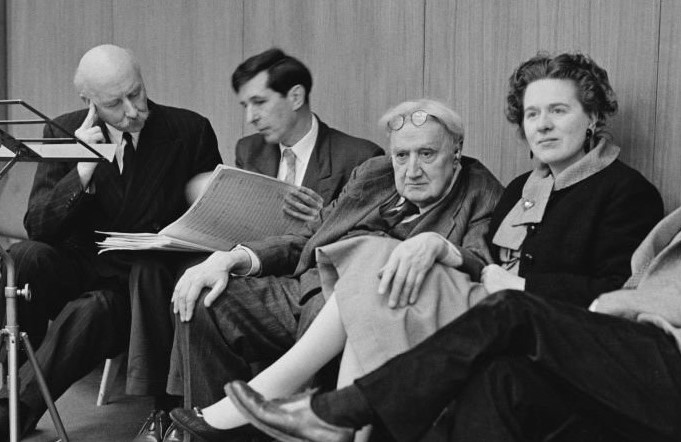
PHOTO (left to right): Sir Adrian Boult, Michael Tippett, Ralph Vaughan Williams, and Ursula Vaughan Williams in 1958. Tippett would be knighted in 1966. Decades earlier, Vaughan Williams declined a knighthood. In 1935, he was awarded the Order of Merit by King George V.
Renata Scotto has died. I saw her at my first opera at the Met, a long, long time ago, as Cio-Cio-San, in a production of “Madama Butterfly” that she directed. In my memory, it was the longest and rowdiest ovation I ever witnessed. I know there have been longer and rowdier, but I wasn’t there for those! The stage was pelted with flowers and confetti and whatever else happened to be at hand, as she curtsied graciously in her kimono, and the applause only intensified. This would have been back in the 1980s.
It was as Butterfly that she made her belated Met debut in 1965. She made her professional debut in 1952 and within months was singing at La Scala. She sang professionally into the new century, as she transitioned increasingly to directing.
She was a giant of the Pavarotti generation and a recurring presence on the “Live from the Met” television broadcasts. For opera lovers, life was good.
Scotto died earlier today. She was 89 years old.
As Mimi
With lucky Luciano
Vintage “Butterfly”
Complete studio recording
The elixir of lovely
Tokyo “Traviata”
When the arts were still on the periphery of the mainstream: on “The Merv Griffin Show” with Ethel Merman, Ann Miller, Lillian Gish, and Myrna Loy!
Profoundest thanks to Leon Botstein, music director of the American Symphony Orchestra, founder and music director of The Orchestra Now (TŌN), and president of Bard College, very generous with his time this morning in discussing the music of Ralph Vaughan Williams, along with a great many other things, in connection with an article I am preparing on this year’s Bard Music Festival.
Botstein is co-artistic director of the festival, which completed its 33rd season on Sunday. He possesses an enviable combination of traits and talents, not least of which include intellectual curiosity, clearness of purpose, and an uncanny ability to trace baroque lines of thought through a network of arabesques while somehow never losing sight of his conclusions. The whole process is rather breathtaking, I must say. He plants his landings like an Olympic gymnast.
He also seems genuinely interested in getting to know his interviewer. It’s not the first time we spoke, but I walk away feeling as if the conversation was nearly as much about me as it was him. Of course, I won’t be appearing in the article.
Thanks again, President Botstein. Looking forward to “Berlioz and His World” at Bard in 2024!
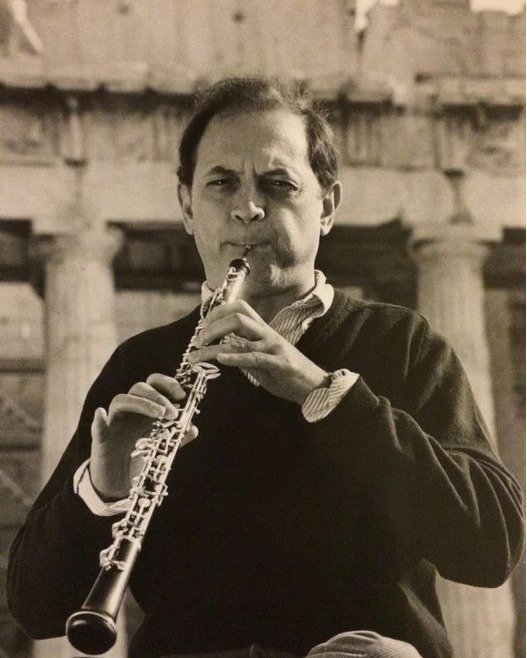
Described by the New Grove Dictionary of Music as “one of America’s most renowned oboists,” Humbert Lucarelli has died. In addition to his excellence as a performer, he was a noted teacher. In the latter regard, among other things, he was Professor of Oboe at the Hartt School of Music in West Hartford, Connecticut, a position he held since 1968.
Lucarelli performed and recorded widely throughout his distinguished career, working with musicians such as Leonard Bernstein, Arthur Fiedler, Kirill Kondrashin, Jean Martinon, George Pretre, Fritz Reiner, Robert Shaw, Sir Georg Solti, Leopold Stokowski, and Igor Stravinsky. He commissioned and gave first performances of many new works, including the Oboe Concerto of John Corigliano.
Those of you in the Lehigh Valley might be interested to know that in 1990 Lucarelli recorded a memorable album with the Lehigh Valley Chamber Orchestra for Koch International Classics. The program includes lovely renditions of Samuel Barber’s “Canzonetta,” Richard Strauss’ Oboe Concerto, Ermanno Wolf Ferrari’s “Idillio-Concertino,” and Ralph Vaughan Williams’ Oboe Concerto. I’ve included it in my on-air playlists often, especially the Barber and the Wolf-Ferrari works, which are still comparatively and puzzlingly “unknown.”
Lucarelli died on August 10 at the age of 87.
R.I.P.
Bach, Sinfonia from the “Easter Oratorio”
Barber, Canzonetta from his unfinished Oboe Concerto