I remember, when I was broadcasting overnight jazz in Philadelphia, I started off the new year once with this curio by Raymond Scott (at the link). That’s film composer John Williams’ dad on drums. Don’t be scared. It’s just the last of 2022!
Category: Daily Dispatch
-
Dance Movie Magic for New Year’s Eve
Slip on your dancing shoes and get ready to welcome the new year! This week on “Picture Perfect,” it’s music from movies with a prominent role for dance.
“The Tales of Beatrix Potter” (1971) was inspired by the popular children’s stories, with anthropomorphized animals in hounds-tooth vests and that sort of thing. Conceived for film by Frederick Ashton, it features a buoyant pastiche score by John Lanchery, drawn from various sources, including works of Sir Arthur Sullivan, Michael Balfe, Leon Minkus and Jacques Offenbach.
Then relive the nightmare vision of “The Red Shoes” (1948). Written, directed and produced by the team of Michael Powell and Emeric Pressburger, this feverish dance film stars Scottish ballerina Moira Shearer. At its center is a story within the story, inspired by the Hans Christian Anderson tale about a girl whose vanity lends demonic power to her ruby footwear, with tragic consequences.
The music is by Brian Easdale, who conducted his own score. However, for the film’s ballet sequence, Easdale specifically requested the services of Sir Thomas Beecham, who leads the Royal Philharmonic Orchestra.
Screenwriter Ben Hecht worked on an astonishing number of Hollywood classics, including “Scarface,” “The Front Page,” “Nothing Sacred,” “His Girl Friday,” and Alfred Hitchcock’s “Spellbound.” Alongside his dozens of screen credits are uncredited contributions for work on films like “Stagecoach,” “Gone with the Wind,” “The Shop Around the Corner,” and “The Thing from Another World.” Because of his versatility, speed, and reliability, he became known as “the Shakespeare of Hollywood.”
Twice, he was given free rein to direct his own projects. One of these was a quirky ballet-noir, called “Specter of the Rose” (1946). The plot concerns an unbalanced ballet superstar, played by Ivan Kirov – who looks all the world like Steve Martin – who is suspected of murdering his first wife, his former dance partner. If so, will history repeat itself, with his new bride? With dialogue stylized to the point of absurdity, it’s a film that has to be seen to be believed. The music is by Trenton-born “Bad Boy of Music” George Antheil.
Much more considered is Luchino Visconti’s adaptation of Giuseppe di Lampedusa’s novel, “The Leopard” (1963). Burt Lancaster stars as a fading aristocrat around the time of Italian unification. The film’s memorable ballroom sequence occupies the last third of its three-hour running time. Nino Rota supplied the music.
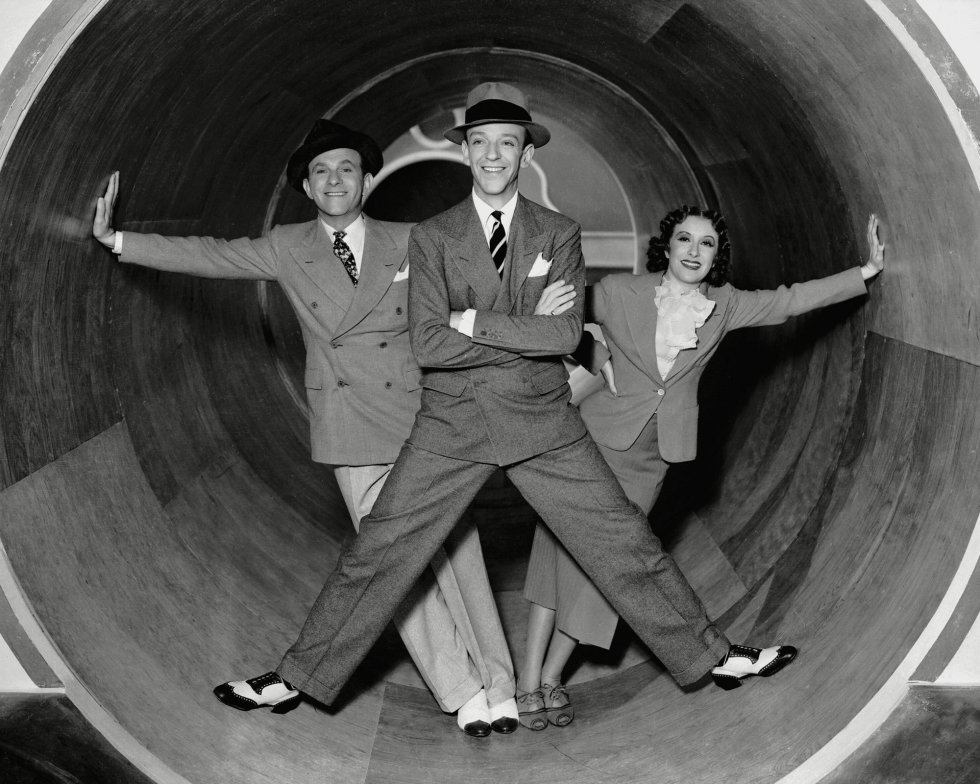
Finally, no show which purports to be about dance in the movies would be complete without music representative of Fred Astaire. Therefore, we’ll conclude with the funhouse dance sequence from “A Damsel in Distress” (1937). No Ginger Rogers in this one – rather Joan Fontaine, George Burns, and Gracie Allen. The energetic score is by George Gershwin.
Set the tone for celebration with tunes from movies with dance, on “Picture Perfect,” this Saturday evening – New Year’s Eve – at 6:00 EST, on WWFM – The Classical Network and wwfm.org!
-
Poseidon Adventure & Star Wars Memories
Bottoms up! Oh, I mean…
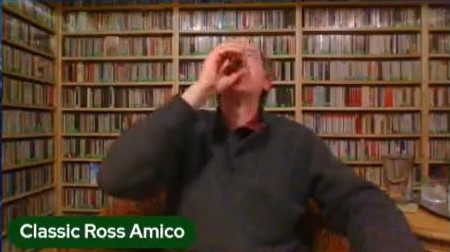
Roy and I toss back a few in our discussion of “The Poseidon Adventure” (1972) here:
Worst New Year’s Eve ever? I’ve had a few that have run it pretty close.
Be that as it may, if “The Poseidon Adventure” (1972) teaches us anything, it’s that there’s got to be a morning after.
To anyone obsessed with the movies and especially to any sci-fi fan who lived through it, the date 5-25-77 takes on an almost totemic significance. That’s the day “Star Wars” was unleashed on an unsuspecting world and, for better or worse, changed everything. Next week, we’ll be talking about a new film, “5-25-77” (2022) – actually two decades in the making – that reflects that first wave of “Star Wars” mania, with its story about a young midwestern filmmaker caught up in the excitement. One of the producers for the project was none other than Gary Kurtz, who produced the original “Star Wars!”
To sweeten the pot, we’ll be joined by my cousin and Roy’s lifelong friend, Joe Metz, as we use this discussion about the film as a springboard for our own personal reminiscences as nascent young filmmakers back in the 1970s and ‘80s, punctuating the conversation with stills and paraphernalia from those early, ambitious projects. Of course, none of us wound up devoting ourselves to making movies, which was probably a good thing, but we had a heck of a lot of fun while it lasted.
Yeah, it was a long time ago, in a galaxy far, far away. I hope you’ll join us in the comments section for what’s bound to be the biggest digression in the show’s history, on the next Roy’s Tie-Dye Sci-Fi Corner. It will be all about us, when we livestream on Facebook, YouTube, etc., next Friday evening at 7:30 EST.
-
Lionel Barrymore Hidden Talents
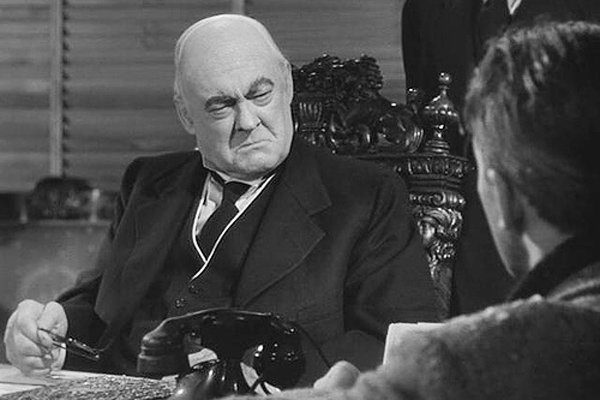
In “It’s a Wonderful Life,” Lionel Barrymore plays heartless Old Man Potter, a modern-day Scrooge, who views his fellow citizens of Bedford Falls as so much grist to be ground for his own profit. Barrymore the man, however, was full of generous human qualities, with a great enthusiasm and aptitude for the arts. I’d long known that he was also a composer, but it is only in doing a YouTube search this week that I discovered a broader cross-section of his output than the last time I checked, now perhaps six years ago.
Barrymore was born in Philadelphia in 1878. He was, of course, part of a venerable acting dynasty that also included his famous siblings, John and Ethel Barrymore. He’s also the great-uncle of Drew Barrymore.
He was especially fine in character roles, playing a variety of them on screen, in retrospect perhaps most memorable for his curmudgeons. He played the irascible Dr. Gillespie in the “Doctor Kildare” movies of the 1930s and ‘40s. He was Ebenezer Scrooge in annual radio broadcasts of “A Christmas Carol.” Of course, he is probably most familiar these days as the soul-crushing capitalist Mr. Potter. He was honored with an Academy Award for Best Actor for his performance in “A Free Soul” in 1931.
Despite his natural aptitude and widely acknowledged success in the field, it had never been his ambition to act. Instead, he was interested in being a visual artist. He even trained in Paris, and his prints and etchings were widely circulated.
As a composer, several of his piano works were published. His “Tableau Russe” was played, in both its piano and orchestral versions, in the film “Dr. Kildare’s Wedding Day.” His orchestral piece, “In Memoriam,” written to the memory of his brother John, was performed by the Philadelphia Orchestra. He also wrote an historical novel, “Mr. Cantonwine: A Moral Tale.”
Barrymore died in 1954. He had suffered from crippling arthritis for decades, which is why you’ll generally see him a wheelchair in most of his later films. He also broke his hip twice. He required morphine and cocaine to get through a shoot and to get to sleep at night. It was only through frequent injections of painkillers that he was able to get through “You Can’t Take It with You” on crutches.
Barrymore’s “Halloween Suite” can be heard here, beginning at the 36-minute mark. Barrymore is the narrator. Mario Lanza also appears on the concert. Miklós Rózsa conducts.
More ambitious is a Piano Concerto, the first movement of which is posted here
Barrymore’s “Fugue Fantasia”
“In Memoriam John Barrymore”
“Tableau Russe,” as heard in “Dr. Kildare”
Barrymore etchings
https://hotcore.info/babki/lionel-barrymore-etchings.htm
Some of his paintings recall classic illustration
https://www.artnet.com/artists/lionel-barrymore/
A sample of his still lifes
https://www.artsy.net/artwork/lionel-barrymore-still-life-in-a-brown-bucket
Artistic renderings of Barrymore, mostly by other hands
http://lionelbarrymore.blogspot.com/2016/12/look-ned-its-lionel-bizarre-barrymorish.html
Music for the ages? Who cares? I would be the first in line if Naxos were to put out such an album.
PHOTOS (counterclockwise from top) As Old Man Potter; as himself; behind the scenes of “Rasputin and the Empress” (1932), the only film he ever made with both his siblings; and at lunch with fellow composers Eugene Zador, Charles Wakefield Cadman, Nat Finston, Mario Castelnuovo-Tedesco, and Daniele Amfitheatrof.
-

Casals Bach Cello Suites Holiday Escape
The holidays are not for the faint of heart. Pablo Casals, take me away!
On Casals’ birthday, I wish you some quiet time with his pioneering, rejuvenating traversal of the Bach cello suites, still sounding great after 84 years.
It’s hard to believe that these cornerstones of the cello repertoire were once commonly regarded as little more than etudes. The truth is, before the 20th century they were not widely known, much less understood. It is Casals who is credited with having rehabilitated them, following his discovery of the music in a Catalan bookshop at the age of 13. He cherished the suites for the rest of his life, not only playing them in public but delving into them privately every morning after a walk and a smoke. There must have been something to it: Casals died in 1973, two months shy of his 97th birthday.
He was the first cellist to record all six suites, already 60 by the time he first played Bach before a microphone.
Tag Cloud
Aaron Copland (94) Beethoven (95) Composer (114) Film Music (151) Film Score (143) Film Scores (255) Halloween (103) John Williams (198) KWAX (233) Leonard Bernstein (105) Marlboro Music Festival (125) Movie Music (166) Mozart (91) Opera (216) Philadelphia Orchestra (91) Picture Perfect (174) Princeton Symphony Orchestra (110) Radio (90) Ross Amico (244) Roy's Tie-Dye Sci-Fi Corner (290) The Classical Network (101) The Lost Chord (269) Vaughan Williams (107) WPRB (397) WWFM (881)