Category: Daily Dispatch

  • Atterberg’s Dollar Symphony and Forgotten Composers

    Atterberg’s Dollar Symphony and Forgotten Composers

    Very few get rich in the arts. But every once in a while, you can score a nice pay day.

    On this date in 1928, Swedish composer Kurt Atterberg entered his Symphony No. 6 into a contest held by the Columbia Record Company in honor of the 100th anniversary of the death of Franz Schubert. For his effort, he was awarded the first prize of $10,000. (Not bad for 1928!) The work became known as Atterberg’s “Dollar Symphony.” It remains the composer’s most-recorded piece, starting all the way back with Sir Thomas Beecham and a recorded broadcast with Arturo Toscanini.

    Though Atterberg was the winner of the international competition, divisional winners (by “zone”) included the now-forgotten English composer John St. Anthony Johnson, for his work “Pax Vobiscum,” and the equally-forgotten American, Charles Haubiel, for a piece called “Karma.”

    Franz Schmidt was recognized in Austria, for his Symphony No. 3. Havergal Brian won second prize in England, for the first three movements of his “Gothic Symphony.”

    You can find all the details here:

    https://en.wikipedia.org/wiki/1928_International_Columbia_Graphophone_Competition?fbclid=IwAR3SBNQYv6WvGRJ383L3o-Xv-2zG-842lDcVuwOOI2A-N-iJwTEBolswZ84

    For a time at least, Atterberg’s “Dollar Symphony” was one of the darlings of Classical 24, a streaming service out of Minnesota used by classical music radio stations around the country to save on the cost of maintaining local announcers. However, characteristically, C24 only ever plays a single movement.

    Whether it’s 1928 or 2022, money makes the world go ‘round. Ka-ching!


    Atterberg, Symphony No. 6 – the whole thing – on YouTube

    John St. Anthony Johnson, “Pax Vobiscum”

    Charles Haubiel, “Karma”

    Franz Schmidt, Symphony No. 3

    Havergal Brian, “Gothic Symphony”

  • CD’s 40th Anniversary Still Spinning Strong

    On the 40th anniversary of the compact disc, here is an interesting discussion – to which, naturally, I’ve contributed. To paraphrase Mark Twain, reports of the format’s death, so far, have been greatly exaggerated.

  • Roque Cordero Panama’s Only Composer

    Roque Cordero Panama’s Only Composer

    He’s not only Panama’s greatest composer. He’s Panama’s ONLY composer. At least according to Roque Cordero, stated half-jokingly in an interview he gave in 1989, when he had just turned 72 years-old.

    Cordero’s music tends to balance Panamanian folklore with more advanced techniques, as exemplified in perhaps his most frequently performed work, the “Eight Miniatures for Small Orchestra” of 1948.
    More challenging is his Violin Concerto from 1962. I only just came across a concert performance of the piece from 2010 with Rachel Barton Pine as soloist – in the work’s Panamanian premiere? – which I’m adding to the links below.

    I was already familiar with the concerto from Paul Freeman’s “Black Composers Series,” which originally appeared on vinyl, on Columbia Records, back in the 1970s (reissued as a box set of CDs by Sony Classical only in 2019). Sanford Allen was the soloist in the world premiere recording. Barton Pine’s performance is distinguished not only by her characteristically superb commitment, but also because the concert actually took place in the composer’s home town of Panama City. Cordero was born there on this date in 1917.

    He won a scholarship to pursue music education at the University of Minnesota. There he studied conducting with Dmitri Mitropolous. It was Mitropolous who introduced him to Ernst Krenek, with whom he studied composition at Hamline University. (Mitropolous, recognizing his promise, paid all his expenses.)

    Back in Panama, Cordero became director of the National Music Institute and was appointed artistic director and conductor of the Panama National Symphony. Later, he was assistant director of the Latin American Music Center, professor of composition at Indiana University, and, from 1972, distinguished professor emeritus at Illinois State University. He died in Dayton, Ohio, in 2008, at the age of 91.

    “I am Panamanian,” he told Bruce Duffie, in the 1989 interview linked below. “I am not an American citizen, simply because I represent something to my country. If I become an American citizen, I would be just one more composer of the United States. I am a composer from Panama. When you read about me, you will find that I am the only composer from Panama, and because I am the only one, I am called the best. If there were two, I wouldn’t be the best [laughs], and I have to be the best. Unfortunately, Panama doesn’t have a musical tradition. How I became a composer is a mystery to me, and to anyone who has studied the music of Latin America.”

    Start with the “Adagio trágico” or “Sonatina Rítmica.” Then move on to “Eight Miniatures for Small Orchestra.” When you feel like your ears are awake, only then, check out Barton Pine’s performance of Cordero’s Violin Concerto.

    Happy birthday, Roque Cordero!


    “Adagio trágico” (1946-55), begun after the death of the composer’s mother; taken up again after the assassination of Panamanian President José Antonio Remón Cantera, whose wife had been one of Cordero’s benefactors

    “Sonatina Rítmica” (1943)

    “Eight Miniatures for Small Orchestra” (1948)

    Symphony No. 2 (1957)

    Violin Concerto (1962)

    Interview with Bruce Duffie

    http://www.bruceduffie.com/cordero.html

  • Lukas Foss 100th Birthday Signed CD Story

    Lukas Foss 100th Birthday Signed CD Story

    For Lukas Foss’ 100th birthday, here’s a CD he inscribed for me in 1989. Pretty good album, by the way.

  • Lukas Foss A Centennial Remembrance

    Lukas Foss A Centennial Remembrance

    Today would have been the 100th birthday of Lukas Foss.

    Foss was a multi-talented musician, who received considerable recognition in his lifetime, certainly, but I wonder if was as much as he deserves. Part of the problem is pinning him down. As a composer, it was always difficult to categorize him, as he drew from so many different styles. With Foss, you never knew what you were going to get. Serialism? Aleatory? Populism? Polystylism?

    He was born Lukas Fuchs in Berlin in 1922. A piano prodigy, he began studies at the age of 6. In 1933, his family moved to Paris, where he also studied composition and flute. He arrived in Philadelphia in 1937. By then, the family had changed its name, and Foss entered the Curtis Institute of Music. At Curtis, he studied piano with Isabelle Vengerova, composition with Rosario Scalero, and conducting with Fritz Reiner.

    Leonard Bernstein, a classmate, described him as an “authentic genius.” Bernstein would conduct first performances of several of Foss’ works. In return, Foss would conduct the premiere of Bernstein’s “West Side Story Symphonic Dances.” He also appeared as piano soloist in two recordings of Bernstein’s Symphony No. 2, “The Age of Anxiety,” both with Bernstein conducting.

    In addition, he was one of four esteemed American composer-pianists on Stravinsky’s recording of “Les noces.” (The others were Aaron Copland, Samuel Barber, and Roger Sessions.)

    Foss pursued further studies in conducting with Serge Koussevitzky, during summers at the Berkshire Music Center (Tanglewood), and composition with Paul Hindemith. He became an American citizen in 1942.

    In 1953, he replaced Arnold Schoenberg as composition professor at UCLA. Later, in 1991, he taught at Boston University. He served as music director of the Buffalo Philharmonic (1963-70) and the Brooklyn Philharmonic (1971-88) and as conductor of the Milwaukee Symphony (1981-86).

    As a young man, he was frequently categorized as one of the “Boston School” of composers. Other notable members included Bernstein, Irving Fine, Arthur Berger, Harold Shapero, Ingolf Dahl, and Louise Talma.

    I met him once at a reception at the Academy of Music in Philadelphia, back in the 1980s, following a concert with the Curtis Symphony Orchestra, a student band, but one of a very high caliber. A significant number of seats in U.S. orchestras, including a disproportionate number of principal chairs, are occupied by Curtis graduates. Nearly half of the Philadelphia Orchestra is made up of Curtis alumni.

    Foss hadn’t been Curtis’ first choice for this particular occasion. Bernstein was originally scheduled to appear, but this was toward the end of Bernstein’s life, and he was canceling concerts like crazy. The original program was to consist of Ives’ “Decoration Day,” Tchaikovsky’s “Francesca da Rimini,” and Sibelius’ Symphony No. 1. Sadly, when Foss took over, the Sibelius was swapped out for Brahms.

    Nevertheless, it was great to have a chance to talk with him. Foss was living history, not least as friend and frequent collaborator of Bernstein, and a significant composer in his own right. Even so, in our few minutes of conversation, he impressed me as modest and low-key. Maybe it was because he had just been conducting for two hours.

    I was a little awed at first and reluctant to approach him. But somebody urged me to go ahead, that he would really appreciate it. And so it proved. He had been lingering in a corner, looking a little aimless and nursing a glass of water. He seemed especially pleased that I knew his Bach record.

    I first discovered Foss all the way back in the infancy of my record collecting, from a Turnabout LP on which he appeared as soloist and conductor of the Jerusalem Symphony Orchestra. The repertoire consisted of Bach’s Keyboard Concertos Nos. 1 & 5. Foss played them on a modern piano. To my knowledge, this has never been reissued on CD, but in my early teens, it sounded pretty good. It was probably among my first five or ten classical LPs.

    Years later, I met his son at the opening of the reconstituted Charles Ives Studio at the American Academy of Arts and Letters in New York City. By then, Foss had already been gone for five years. He died in 2009 at the age of 86.

    On October 3, JoAnn Falletta, music director of the Buffalo Philharmonic Orchestra – Foss’ former group – will honor him with a centenary concert at Carnegie Hall. The program is set to include some of his most attractive music.

    https://www.carnegiehall.org/Calendar/2022/10/03/Lukas-Foss-Centennial-Celebration-0700PM

    Happy birthday, Lukas Foss!


    “Three American Pieces”

    “Renaissance Concerto”

    Bernstein conducts the premiere of Foss’ “Phorion,” including an interview with the composer. The concert is introduced by Milton Cross. The interview begins around the 13-minute mark.

    Foss plays Bach in 1961 (not the same performance as on my LP)

    Stravinsky’s “Les noces,” with Foss, Copland, Barber, and Sessions on pianos

    An early recording of Bernstein’s “The Age of Anxiety”

    In conversation with Bruce Duffie

    http://www.bruceduffie.com/foss.html

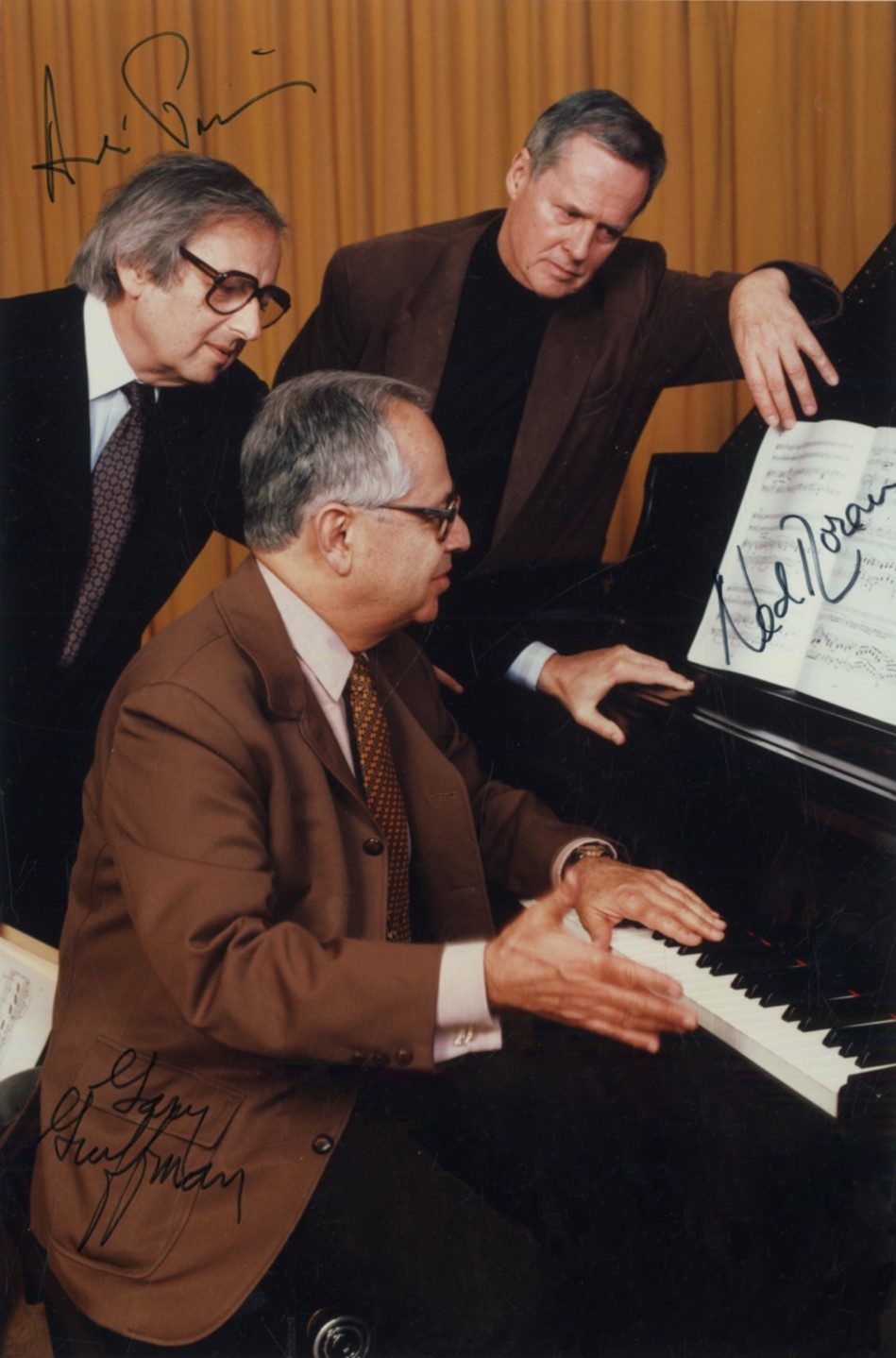
    Check out some additional nifty Foss photos in the comments section!

Tag Cloud

Aaron Copland (93) Beethoven (95) Composer (114) Film Music (136) Film Score (143) Film Scores (255) Halloween (94) John Williams (195) KWAX (229) Leonard Bernstein (103) Marlboro Music Festival (125) Movie Music (151) Mozart (88) Opera (206) Philadelphia Orchestra (89) Picture Perfect (174) Princeton Symphony Orchestra (108) Radio (88) Ross Amico (244) Roy's Tie-Dye Sci-Fi Corner (290) The Classical Network (101) The Lost Chord (268) Vaughan Williams (103) WPRB (396) WWFM (881)

DON’T MISS A BEAT

Receive a weekly digest every Sunday at noon by signing up here


RECENT POSTS