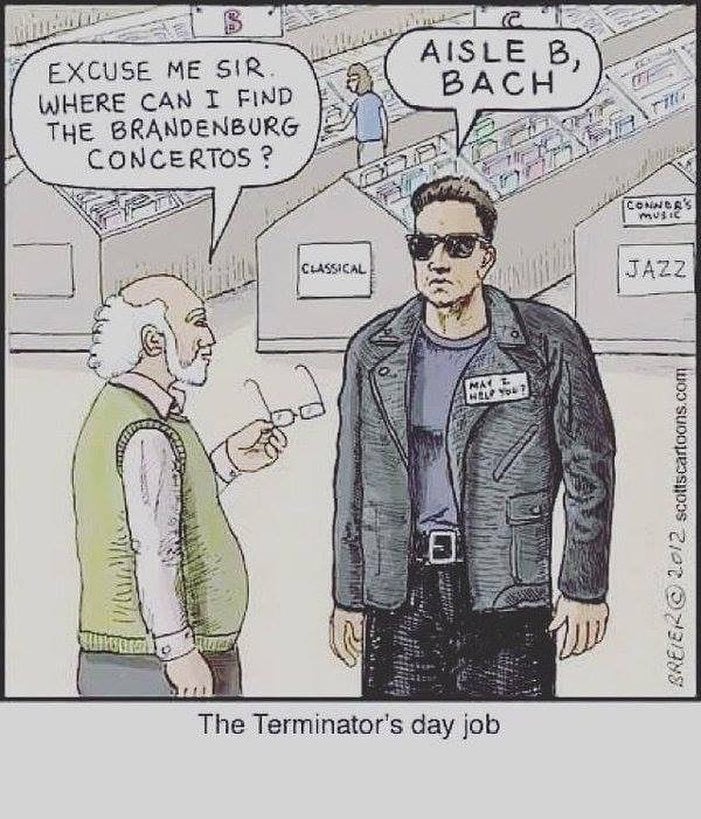
“The Terminator,” the film, may be a little creaky – as it was, even back in 1984 – but there’s something about the Terminator, the character, that defies time. In this case, quite literally.
Roy and I will don our ray-bans to talk about Arnold Schwarzenegger’s career-defining role as a cyborg assassin from the future, as we wrap up our by no means exhaustive series of discussions about time-travel sci-fi.
The music is pretty terrible, the acting is bad, the budget is low, the logic is loopy, and the haircuts are quintessentially ‘80s. But extra points for Stan Winston’s animatronic and Gene Warren Jr.’s stop motion effects, which IMHO really are special, and for the inclusion of so many sturdy cars of the era. (Okay, maybe not the Gremlin.) Those pressed my nostalgia buttons more than anything. The mass shootings, alas, have lost their allure.
An implacable menace is indeed the stuff of nightmares. And no, I’m not speaking about writer-director James Cameron, who is on track to spend the rest of his life filming “Avatar” sequels. You can’t argue with success. But you know I will.
We’ll be providing plenty of ingredients for you to mix up your plastique in the comments section, on the next Roy’s Tie-Dye Sci-Fi Corner. It will be an incendiary encounter with “The Terminator,” when we livestream on Facebook, this Friday evening at 7:00 EDT!
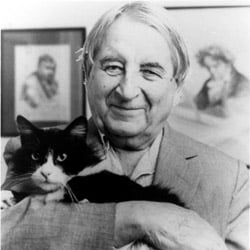
For the birthday of Nicolas Slonimsky (1894-1995), here a few favorites from his sidesplitting 1953 compendium of critical vitriol, “Lexicon of Musical Invective”:
“We recoil in horror before this rotting odor which rushes into our nostrils from the disharmonies of this putrefactive counterpoint. His imagination is so incurably sick and warped that anything like regularity in chord progressions and period structure simply do not exist for him. Bruckner composes like a drunkard!”
(Gustav Dompke, The German Times of Vienna, 1886)
“Heartless sterility, obliteration of all melody, all tonal charm, all music… This reveling in the destruction of all tonal essence, raging satanic fury in the orchestra, this demoniacal, lewd caterwauling, scandal-mongering, gun-toting music, with an orchestral accompaniment slapping you in the face… Hence, the secret fascination that makes it the darling of feeble-minded royalty… of the court monkeys covered with reptilian slime, and of the blasé hysterical female court parasites who need this galvanic stimulation by massive instrumental treatment to throw their pleasure-weary frog-legs into violent convulsion… the diabolical din of this pig-headed man, stuffed with brass and sawdust, inflated, in an insanely destructive self-aggrandizement, by Mephistopheles’ mephitic and most venomous hellish miasma, into Beelzebub’s Court Composer and General Director of Hell’s Music – Wagner!”
(J.L. Klein, “History of the Drama,” 1871)
And of course, who could forget:
“The violin is no longer played; it is pulled, torn, drubbed…. We see plainly the savage vulgar faces, we hear curses, we smell vodka.… Tchaikovsky’s Violin Concerto gives us for the first time the hideous notion that there can be music that stinks to the ear.”
(Eduard Hanslick, New Free Press, Vienna, 1881)
Tchaikovsky could recite from memory every word of Hanslick’s sustained screed, from which this is but an excerpt.
The “Lexicon” is just the tip of the Slonimsky iceberg. Slonimsky conducted first performances of works by Ives and Varèse. He edited “Baker’s Biographical Dictionary of Musicians” from 1940 to 1992. His “Thesaurus of Scales and Melodic Patterns” influenced musicians from John Coltrane to Frank Zappa to John Adams. His sly wit made him a favorite guest on radio and television programs, including “The Tonight Show.” The man had so much vitality, it’s hardly surprising that he lived to be 101.
Happy birthday, Nicolas Slonimsky.
MUST SEE: Slonimsky on “The Tonight Show” with Johnny Carson in 1986, at the age of 92. It was a different world.
His pioneering recording of Varèse’s “Ionisation,” from 1934
Piano improvisation with Frank Zappa in 1981. Zappa introduces him at around 1:50.
“Children Cry for Castoria”
Documentary, “Nicolas Slonimsky: A Touch of Genius,” narrated by Michael York:
“In my lifetime, when I was in the conservatory, in order to hear a Brahms symphony, I had to study the score or actually hear the symphony, because there was no other way! Now, a good Juilliard School student probably knows more about music history than a specialist 100 years ago, because of the availability of recordings and publication of miniature scores. In my time, I would have to go to the library and get a contemporary edition of whatever score I wanted to consult, and the scores were very difficult to obtain. Now, if you want the Haydn Symphony No. 74, it is produced immediately, as are any others!”
A reminder of how fortunate we are, in this modern age, to have so much at our fingertips. And this was before YouTube! Read the rest in Bruce Duffie’s interview, transcribed here:
John Adams’ “Slonimsky’s Earbox,” composed in 1996, after Slonimsky’s death, an attempt to “memorialize his wit and hyper-energetic activity” and to acknowledge Adams’ debt to the scales and harmonies gleaned from Slonimsky’s “Thesaurus.”
If we’re to believe Ali MacGraw and Ryan O’Neal, love means never having to say you’re sorry. And their box office success in “Love Story” (1970) means never having to try very hard to recall the music of Francis Lai.
Lai died in 2018. He would have been 90 years-old today.
Lai started out as an accordionist and songwriter in Marseille. His association with singer Claude Goaty brought him to Paris, where he fell in with Edith Piaf’s circle while still in his 20s. He accompanied her, as she championed some of his 600 songs. His works were also embraced by Juliette Greco and Yves Montand.
After the international success of the film “A Man and a Woman” (1966), director Claude Lelouch made it a practice to send Lai an outline of the story to his subsequent movies before a frame was ever shot. Lai would then come up with a theme – invariably romantic and melancholy – and the films would then be crafted to suit the music. This unusual arrangement worked very well for them. They wound up collaborating on nearly 40 projects.
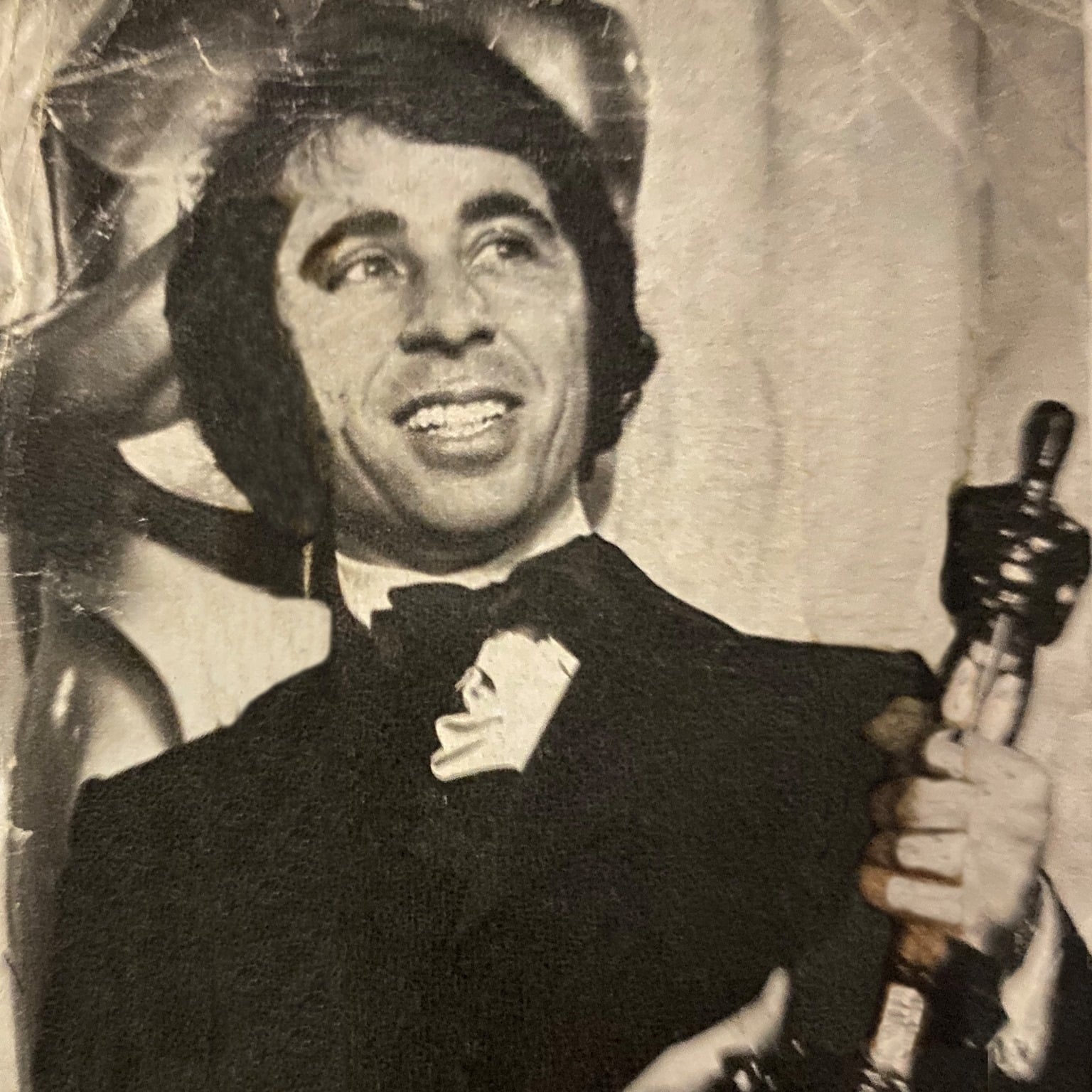
Lai, who spoke no English, twice turned down the opportunity to work on “Love Story.” He was finally persuaded by actor Alain Delain, who flew to Paris in the company of Paramount studio executive Robert Evans and a rough cut of the film. Lai later recalled he was so moved by the movie that he sat down at the keyboard as soon as he got home and composed the haunting theme. “Love Story” was nominated for seven Academy Awards, but Lai was the only one to be recognized with a statuette.
Andy Williams’ vocal spin-off of the tune, as “Where Do I Begin?,” recorded after the film, was a top-10 hit. The “Love Story” theme reached number 2 on the Billboard charts.
In all, Lai’s soundtracks sold over 20 million copies. If nothing else, you’ve probably heard his music when sitting in the dentist’s chair. His poignant melodies continue to be played on easy listening services everywhere.
This Sunday night on “The Lost Chord,” there may not be glorious Technicolor or breathtaking Cinemascope, but what would Cole Porter say, to hear Sir Edward Elgar in stereophonic sound?
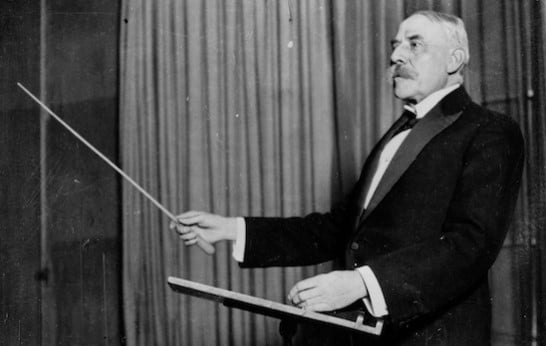
Elgar was one of the first of the great composers to endeavor to set down “definitive” interpretations of his own works on recordings. Or so it has been thought. But did Elgar really regard these performances as definitive? In fact, Elgar took great care to “grade” the various takes from his recording sessions. Some of these, he instructed, were to be destroyed outright; others were held, as the composer took the time to consider.
What emerges, upon listening to a 4-CD set, “Elgar Remastered,” on the SOMM Recordings label, are the impressions that (1) Elgar was fairly meticulous when it came to preserving his legacy, and (2) he also understood that there’s more than one way to skin a cat. Rediscovered alternative takes make clear that the composer was amenable to looking at his own works from a variety of perspectives.
For their parts, the conscientious engineers at EMI employed multiple machines to guard against technological failure. This was back in the late 1920s and early ‘30s. Now, for the first time, the elements have been brought together and skillfully combined to create a kind of “accidental” stereo.
Engineer Lani Spahr has worked wonders with these recordings, from the private collection of Arthur Reynolds, chairman of the North American Branch of the Elgar Society. He also goes into considerable detail in his liner notes – in fact, to a degree that would be impractical to relate here.
A good deal of the set is devoted to recordings and alternative takes of Elgar’s Cello Concerto. As on the composer’s authorized recording, issued on EMI, Beatrice Harrison is the soloist. These include the first complete electrical recording, from 1928 – the one which would ultimately be published, in mono – with previously unissued, alternative takes from the same sessions. There is also an earlier, truncated recording from 1920, set down using the acoustic process, and a performance of the concerto’s Adagio movement alone, with Harrison accompanied at the keyboard by Princess Victoria.
The gem of the set is Harrison’s celebrated 1928 recording, heard here for the first time entirely in stereo, or what passes for stereo.
Harrison was Elgar’s preferred soloist. He lavished praise on her performances, even as she took liberties with the score. At the session for this particular recording, he was overheard to say, “Give it ‘em, Beatrice, give it ‘em. Don’t mind about the notes or anything. Give ‘em the spirit.”
Worlds away from the effusive, heart-on-the-sleeve approach of Jacqueline du Pré, Harrison’s interpretation is nonetheless riveting on its own terms. As with the other recordings in the collection, it is a kind of time capsule of period performance practice – with swooping portamenti (audible slides between notes) – and the musicians’ flexibility in regard to both tempo and phrasing.
And Elgar can be such a volatile conductor! In addition, we’ll hear a cracking rendition of the “Cockaigne Overture” and a performance of the prelude to the oratorio “The Kingdom,” which really takes flight.
Hear Elgar as you’ve never heard him before – in “accidental” stereo – on “Pomp and Happenstance,” this Sunday night at 10:00 EDT, on WWFM – The Classical Network and wwfm.org.
“Is it not strange that sheep’s guts should hale souls out of men’s bodies?”
This week on “Picture Perfect,” on the presumed birthday of William Shakespeare (April 23, 1564), we’ll make much ado about Patrick Doyle, with selections from his scores written for the films of Kenneth Branagh.
In 1987, Doyle joined Branagh’s Renaissance Theatre Company, for which he provided incidental music. Two years later, Branagh – and by extension, Doyle – made a leap to the big screen, where they achieved a remarkable feat, rethinking Shakespeare’s “Henry V.” Remember, this is the play that propelled Laurence Olivier to worldwide fame in 1944, both as a filmmaker and the Bard’s most celebrated interpreter, and William Walton’s score is regarded as one of the best of all time.
Branagh’s version is quite different. Though equally rousing, it doesn’t shy away from Henry’s more complicated nature and the grittier aspects of what it means to go to war. It was a bold gamble, but one that paid off. Not only did this revisionist “Henry” receive nearly universal acclaim, the film was a box office success, and Branagh would be nominated for two Academy Awards, like his predecessor, in the categories of Best Actor and Best Director. Certainly, the film’s score deserved to be recognized – but in the year of “The Little Mermaid,” it failed even to secure an Academy Award nomination.
An interesting footnote: Doyle himself is the baritone who introduces “Non nobis Domine,” a prayer of thanksgiving, following the Battle of Agincourt.
In 2006, Branagh directed an adaptation of “As You Like It.” As has become his custom, he took a celebrity approach to its casting, although perhaps not so widely uneven as some of the cameos in his big screen “Hamlet.” Kevin Kline plays Jacques; Alfred Molina the fool, Touchstone; and Branagh regulars, Brian Blessed and Richard Briers appear, as well.
The most radical liberty taken with the play is that Branagh transplants the action to 19th century Japan. The language remains firmly rooted in Shakespeare’s text, although there are striking cross-cultural elements, including ample kimonos, kabuki theatre, ninjas, and a sumo wrestler. Still, it’s a long way off from the astounding bomb that was Branagh’s American Songbook-interpolated “Love’s Labour’s Lost.”
While Olivier’s “Hamlet” won four Academy Awards in 1948, including those for Best Picture and Best Actor, Branagh’s 1996 version is cinema’s first adaptation of the complete text. It is, perhaps, an uneven interpretation, with some puzzling casting choices – including walk-ons by Jack Lemmon, Robin Williams, and Gerard Depardieu – but there are enough merits, certainly, to make the four-hour trek worthwhile.
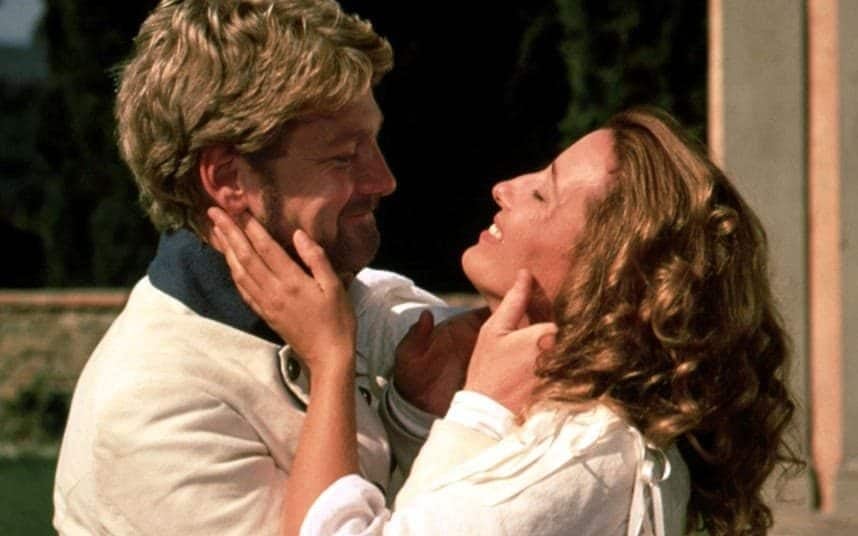
Finally, Branagh teamed with his then-wife, Emma Thompson, for a “merry war” of wits, as Benedick and Beatrice, in his 1993 adaptation of “Much Ado About Nothing.” Again, the film features an eclectic supporting cast of classically trained actors and pop Hollywood phenomena. Briers, Blessed, and Imelda Staunton share screen time with Denzel Washington, Michael Keaton, and Keanu Reeves. Yet, somehow, despite the different nationalities, ethnicities, and accents, the entire enterprise works. There is an exuberance to the over-the-top opening sequence which sets up a momentum that carries through the rest of the film.
Sigh no more, but join me for the Shakespeare scores of Patrick Doyle on “Picture Perfect,” music for the movies, this Saturday evening at 6:00 EDT, on WWFM – The Classical Network and wwfm.org.
How could you not love this opening?
Faith and sheep’s guts in “Much Ado About Nothing”