There’s often been a whiff of pop about Michael Torke’s music, and that’s always been the composer’s intention.
“Modernism in classical music created a lot of music that was hard to listen to… dissonant… atonal… I believe that composers kind of lost their audience. I wanted to do something different. The antidote to that is immediacy… and what kind of music is the most immediate? – Popular music. Of course there’s many different kinds, but the idea of popular music is to be immediately appealing. In the mid 80’s, there was a dance music that was a precursor to hip hop. It would have a really strong beat and a nice bass line. I would transcribe some bass lines and some of the drum beats. Then apply my own pitches and my own procedures, so no one would ever hear the original inspiration. I felt what would be injected was kind of a rhythmic vitality in an in your face kind of thing. I thought it worked out well musically….”
Torke’s saxophone quartet, “July,” was composed in 1995.
“What fascinates me is that this act of translation seems to completely remove the original reference from my music; sometimes I can’t even remember what the original song was that inspired me and, if I do, it’s hard even to hear the connection. But what remains is the energy… Instead of single-mindedly exploring one color, as in earlier pieces of mine, the music now corresponds to an experience of time – the energy and heat we find in the month of July, as well as cooling breezes of repose that come, perhaps, in the evening.”
On the First of July, here’s Michael Torke’s “July.”
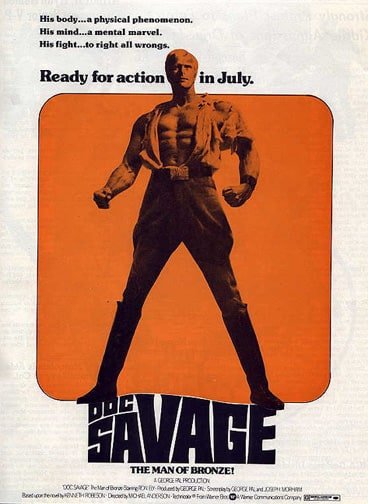
From his arctic Fortress of Solitude (yes, before Superman) to his headquarters on the 86th floor of the Empire State Building, Doc Savage burns through shirts like a squirrel through a bag of peanuts.
Before Steve Zissou, before Buckaroo Banzai, before Jonny Quest, Doc and his brain trust, the “Fabulous Five,” kept the world safe from megalomaniacs and cryptozoological terrors, through a combination of moral righteousness, forward-looking technology, and good old-fashioned fisticuffs. And superheroes weren’t even a thing yet. Furthermore, James Bond and Indiana Jones owe a thing or two to Doc. Would that his sole motion picture, “Doc Savage: The Man of Bronze” (1975), would have been a patch on “Raiders of the Lost Ark.”
TV’s Tarzan, Ron Ely, plays Doc with an animated glint in his eye, in George Pal’s final feature. Pal, you’ll recall, was responsible for the enduring classics “The War of the Worlds” and “The Time Machine.” And director Michael Anderson gave us “The Dam Busters,” “Around the World in 80 Days,” and “Logan’s Run.”
Alas, a compromised budget, a camp tone, and maybe even just plain old bad timing doomed “Doc Savage” to failure. (“Doc” shot out of the gate ahead of “Superman” and “Raiders.”) For all his forthrightness and valor, his movie, sadly, lacks the courage of his convictions.
Nonetheless, it’s a fun Fourth of July flick, what with Frank De Vol’s score adapted from Sousa marches (the composer credited as “John Philip SoUSA” – with the “USA” in red, white, and blue). Heck, the first thing we see is the American Flag, unfurled above Doc’s snowmobile, as our hero makes his entrance. If it was ever your desire to put lyrics to Sousa’s “The Thunderer,” then this is the movie for you!
Doc on horseback, silhouetted against the setting sun, or leaping in slow-motion, feet-first toward the camera, is as good as it gets. Just don’t expect the whole movie to be on that level.
TV’s Tarzan, Ron Ely, plays Doc with blond hair and an animated glint in his eye. Over the decades, there have been rumblings of other attempts to revive one of the pulps’ greatest heroes, with Chuck Connors, Arnold Schwarzenegger, or Dwayne Johnson (The Rock as Doc?) as the lead, but so far, the 1975 version is all we’ve got. Maybe Doc is just too clean-cut for the jaded sensibilities of 2022? If so, more’s the pity!
I hope you’ll join us, as Roy and I flex our muscles, even as we make inroads into rocket science, on the next Roy’s Tie-Dye Sci-Fi Corner. Bring your sheet music to the comments section. We’ll bellow the lyrics to Doc’s march, when we livestream on Facebook, this Friday evening at 7:30 EDT!
The only composer crankier than Carl Ruggles was probably Bernard Herrmann. Everyone recognizes Herrmann as the genius film composer he was, but whenever he was in front of an orchestra, he made it his mission to champion works by neglected composers.
Ruggles, the cantankerous American modernist, was the creator of a handful of meticulously-crafted, uncompromising works. His complete, authorized output can be accommodated on two LPs. We know this, because Michael Tilson Thomas recorded just about everything for the Columbia Masterworks label in 1980.
Ruggles’ method was described by musicologist Charles Seeger as “dissonant counterpoint,” a system wherein all the traditional rules of counterpoint are reversed, so that dissonance, rather than consonance, is the norm. The very practice smacks of contrarianism!
Not surprisingly, Ruggles was beloved by Charles Ives. When someone had the audacity to boo one of Ruggles’ works at a concert given in 1931, Ives berated the critic as a sissy: “Why can’t you stand up before fine, strong music like this, and use your ears like a man?!”
Ruggles also created hundreds of paintings. In contrast to the agonizing process of composition, his paintings were usually tossed off in an afternoon. They were deemed good enough that he was invited to hang shows and even sold many of his canvases.
Ruggles died in 1971, about three months after this Herrmann interview was broadcast. He was 95 years-old.
Herrmann got his start in the medium of radio in 1934, when he was hired as a conducting assistant at CBS. It wasn’t long before he was providing original music and serving as musical director of its resident orchestra. Among his duties there was providing incidental music for Orson Welles’ Mercury Theatre broadcasts. In fact, he was in front of the orchestra for possibly radio’s most notorious hour, Welles’ hysteria-inducing adaptation of “The War of the Worlds.”
As would ever be the case, Herrmann did nothing by halves. Then only in his 20s, he possessed an encyclopedic knowledge of both music and literature, and filled his programs with works by Ives, Henry Cowell, Gian Francesco Malipiero, Alexander Gretchaninov, Nikolai Myaskovsky, Hermann Goetz, Joachim Raff, Niels Wilhelm Gade, Richard Arnell, Lord Berners, Edmund Rubbra, and countless others. Even Schoenberg and Webern could be heard over CBS during those years.
Herrmann had known Ives personally since he was in his teens. He had discovered the composer’s “114 Songs” in the New York Public Library and was instrumental in shopping them around, even introducing them to Aaron Copland.
He was also unfailingly outspoken. Once, when CBS president William S. Paley balked at one of his proposals, Herrmann snapped, “You’re assuming the public is as ignorant about music as you are.” That’s just the kind of guy Herrmann was. Totally tactless, but usually right. After that, he was given near-unlimited freedom over musical programming at CBS.
It had always been Herrmann’s ambition to be recognized as a great conductor. Leopold Stokowski was his hero. While he never realized that ambition, it was not for want of trying.
During the conversation at the link above, Herrmann draws an unexpected connection between Ruggles and “Moby Dick.” Herrmann was an enormous admirer of Melville’s magnum opus, setting it as a cantata in 1936-38, also predating his career in film. It was given its debut at Carnegie Hall in 1940, with Sir John Barbirolli conducting the New York Philharmonic. Herrmann dedicated the work to Ives.
So as to leave you with a bit of Herrmann’s film music, here’s one of the composer’s personal favorites, and another piece that breathes the sea air – his score for the 1947 film “The Ghost and Mrs. Muir.”
Happy birthday, Bernard Herrmann. Would it kill you to smile on your special day?