Watching Roy’s Tie-Dye Sci-Fi Corner makes you feel so brainy. Too bad we forgot to come up with a topic for next week’s show! Stay tuned for the impending announcement.
In the meantime, you can enjoy last night’s stream with special guest Randy Lee, winner of this month’s Viewer’s Choice, and our discussion of Buck Henry’s short-lived 1970s sci-fi parody “Quark.”
Find out which cast member played jazz trombone with stride legend James P. Johnson (of “The Charleston” fame), which wrote 52 novels (when he wasn’t busy serving in the Royal Army or working as a game hunter), and which one actually attempted to put a hit out on series star Richard Benjamin. HINT: It wasn’t the Doublemint Twins.
There are quirks aplenty, even if the “Quark”s were few.
Join us on our continuing mission to patrol the entertainment universe for lingering debris. We’ll reserve your space in the comments section, when we livestream on Facebook, next Friday evening at 7:00 EST!
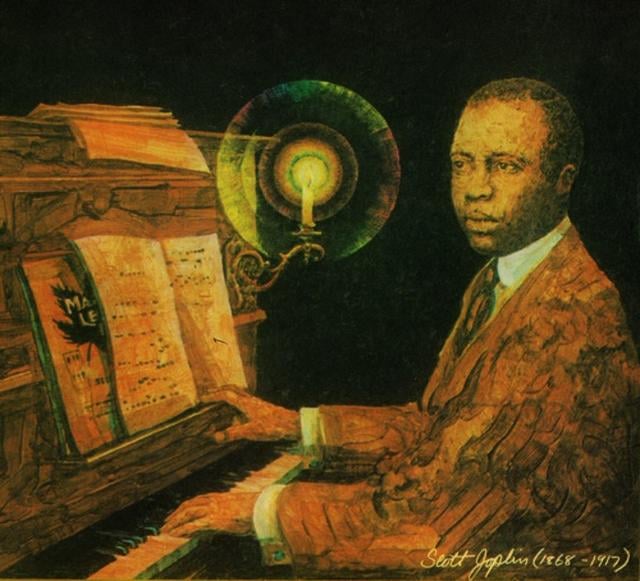
50 years ago today, the most ambitious work by America’s premier Ragtime composer received its belated first performance in Atlanta. Scott Joplin’s “Treemonisha” was presented by the Atlanta Symphony Orchestra and the Morehouse Glee Club, with Robert Shaw conducting. The chorus was prepared Wendell Whalum, and the direction and choreography were provided by Katherine Dunham.
In attendance was Eubie Blake, then a few weeks shy of his 85th birthday. Blake had known Joplin in Washington, D.C.
The plot of Joplin’s opera is set in a rural African American community near Texarkana, Arkansas, around 1884. The protagonist is 18 year-old Treemonisha, who was found under a sacred tree as a baby and raised as the daughter of Monisha and her husband Ned. As the community has no schools, her adoptive parents send her to away for her education. When she returns, she is the only member of her community who can read and write.
As the opera opens, Treemonisha foils the efforts of a conjurer, Zodzetrick, to sell a “bag of luck” to her mother. In retribution, conjurers kidnap Treemonisha and plan to toss her into a wasps’ nest. Happily, she is rescued by Remus, a townsman disguised as a scarecrow. The conjurers in turn are captured by field workers and taken into custody. However, at Treemonisha’s urging, they are forgiven and let go. Treemonisha is acknowledged as the community’s leader, and she and Monisha lead the people in a ragtime dance.
And so, in the contest between ignorance and education, superstition is overcome and grace attained through hard work, sound leadership, commitment to learning, and absolution. All well and good, but the opera also happens to be chock full of good tunes.
Joplin completed “Treemonisha” in 1910 and paid for the publication of a piano-vocal score. He sent a copy to the American Musician and Art Journal, which, in 1911, gave the work a glowing, full-page review. Presciently, the piece was lauded as an “entirely new phase of musical art and… a thoroughly American opera.”
Unfortunately, “Treemonisha” failed to gain traction. Joplin’s original orchestrations were completely lost (along with his first opera, “A Guest of Honor,” composed in 1903), and modern performances have required editing and orchestration by other hands, including T.J. Anderson (in Atlanta), Gunther Schuller (for Houston Grand Opera), and Rick Benjamin (for more intimate forces, akin to the theater pit orchestras Joplin would have known).
The work has often been characterized as a “Ragtime opera” – Joplin was, after all, the king of the rag – but “Treemonisha” encompasses a broader range of influences than such a description would suggest. The composer aspired to write a “serious” stage work in the European tradition, but one propelled by a uniquely New World vitality. As a unified artistic statement, it couldn’t have been written by anyone else. “Treemonisha” is engaging, tuneful, and very, very American.
Sadly, Joplin never lived to see his magnum opus fully staged. The work received its sole read-through in his lifetime in 1915 – two years before his untimely death at the age of 48 – at the Lincoln Theater in Harlem. Joplin himself was at the keyboard. The score then languished in obscurity for decades, until its rediscovery in 1970.
In 1971, selections were performed at the New York Public Library for the Performing Arts, with a group of singers supported by William Bolcom, Joshua Rifkin, and May Lou Williams. Following its Atlanta premiere, the complete work went on to be performed by companies all over the United States, making its Broadway debut in 1975.
In 1976, Joplin received a citation from the Pulitzer Prize committee “for his contributions to American music.” Of course, by then, he had already been dead for 59 years.
In this fascinating, poignant segment, we learn that Joplin’s orchestrations were probably trashed in 1962:
The historic Houston Grand Opera production – in English with Portuguese subtitles!
In Rick Benjamin’s orchestration for pit orchestra, with spoken introduction:
Eubie Blake plays his “Charleston Rag” in 1972 – a work he composed in 1899!
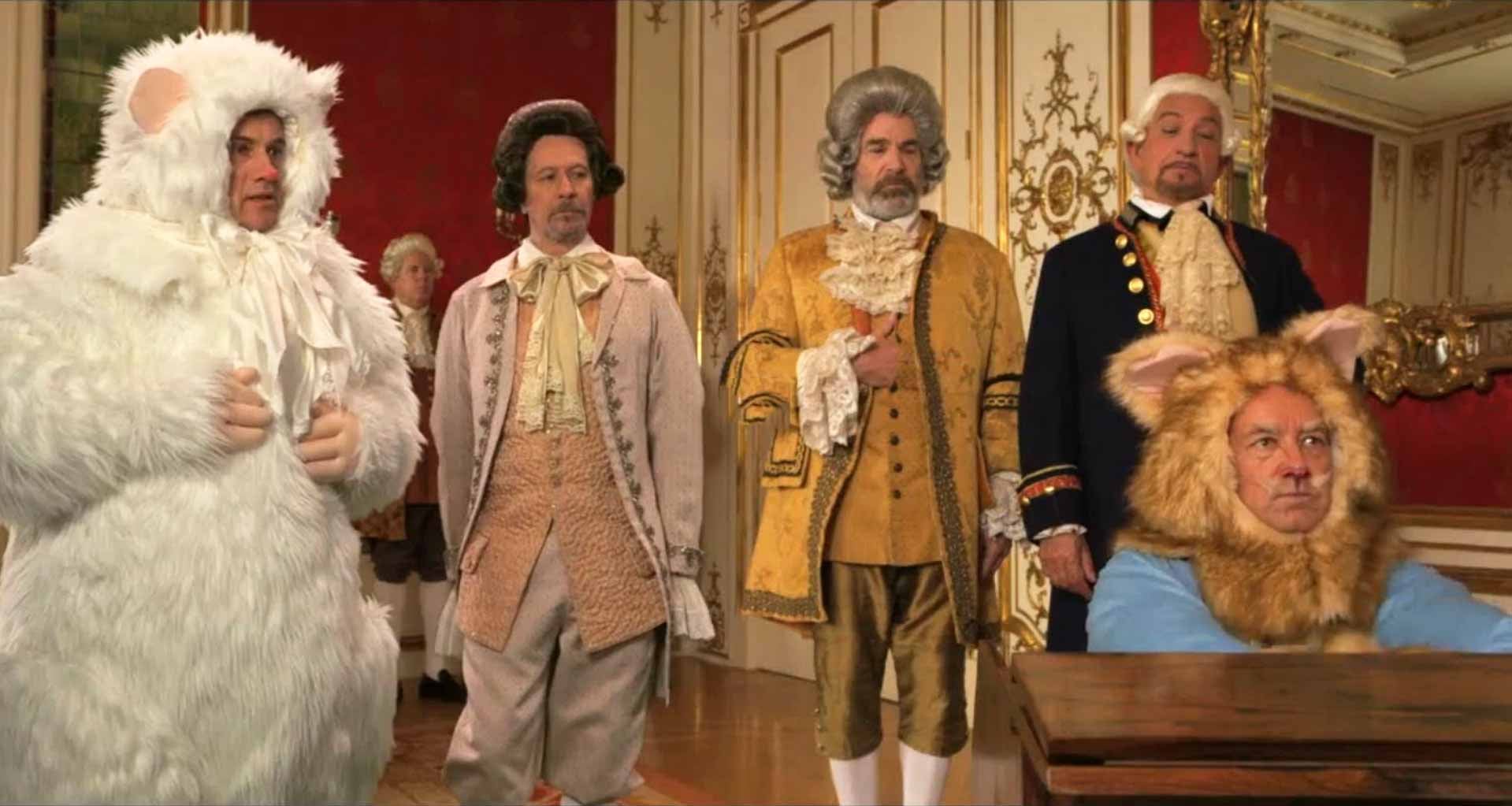
In the wake of yesterday’s marathon Mozart birthday celebration, revisit this star-studded Jimmy Kimmel mash-up of “Amadeus” and YouTube sensation Keyboard Cat.
What’s that, you say? You don’t remember Keyboard Cat?
As if that were not enough to demonstrate the decline of Western civilization over the past 230 years, behold – “Hamster on a Piano.”
By coincidence, I just happened to rewatch “Amadeus” (1984) earlier this week, for the first time in many years. Of course, I’d seen it a bunch of times before.
This was the theatrical cut. With all apologies to Miloš Forman, it has been my experience that directors’ cuts tend to be in most ways inferior, especially when recut so long after the fact. (Forman’s was issued in 2002.) Or maybe George Lucas has just made me skittish.
Unfortunately, once a director’s cut appears on home video, it tends to displace the original in all formats, including streaming.
Thankfully I’ve got my trusty old, double-sided DVD. Yeah, I have to flip it an hour and 50 minutes into the movie, but I grew up during the LP era, so I can take it.
All that aside, has there ever been a staged “Don Giovanni” as cool as this one?
What’s in name? Wolfgang Amadeus Mozart went by many in his lifetime.
He was baptized on January 28, 1756 (the day after his birth), as “Joannes Chrysostomus Wolfgangus Theophilus Mozart.”
Following the custom of the Catholic Church, the first two names represent his saint’s name (“Chrysostomus” meaning “golden mouth”). “Wolfgangus” is the Latin form of “Wolfgang” – “walks with wolves” – the name of Mozart’s maternal grandfather. “Theophilus” is from the Greek – “lover of God.” In German, this would be “Gottlieb,” and in Latin “Amadeus.”
Later in life, Mozart would refer to himself using the Italian (“Amadeo”) or the French equivalent, which is why you will sometimes encounter the pedantic “Amadè” in concert program notes.
Admittedly, after 1777, Mozart himself did seem to have a preference for “Amadè,” although he played a little fast and loose with the French accent (variously “Amadè,” “Amadé,” or just plain “Amade”).
He did use “Amadeus,” albeit facetiously, when signing some of his letters, in mock-Latin (“Wolfgangus Amadeus Mozartus”). But it was only after his death that this form really gained traction, employed even by the composer’s widow. This was taken up by biographers, critics, and musicians and became prevalent by the early 19th century.
In more recent times, Peter Shaffer’s play and its now-classic film adaptation have cemented “Amadeus” in the public consciousness.
But Mozart by any other name would smell as sweet. And with his scatological sense of humor, I’m sure he would have something to say about that!
Enjoy a bouquet of Mozart on his birthday, as WWFM – The Classical Network celebrates one of music’s greatest masters. It will be all-Mozart through 7 pm EST. Support classical music on the air waves and via internet streaming with your gift by calling today at 1-888-232-1212 or contributing online at wwfm.org. Thank you for your generous support!