Category: Daily Dispatch

  • Daniel Day-Lewis’ Surprising Godfather: Vaughan Williams

    Daniel Day-Lewis’ Surprising Godfather: Vaughan Williams

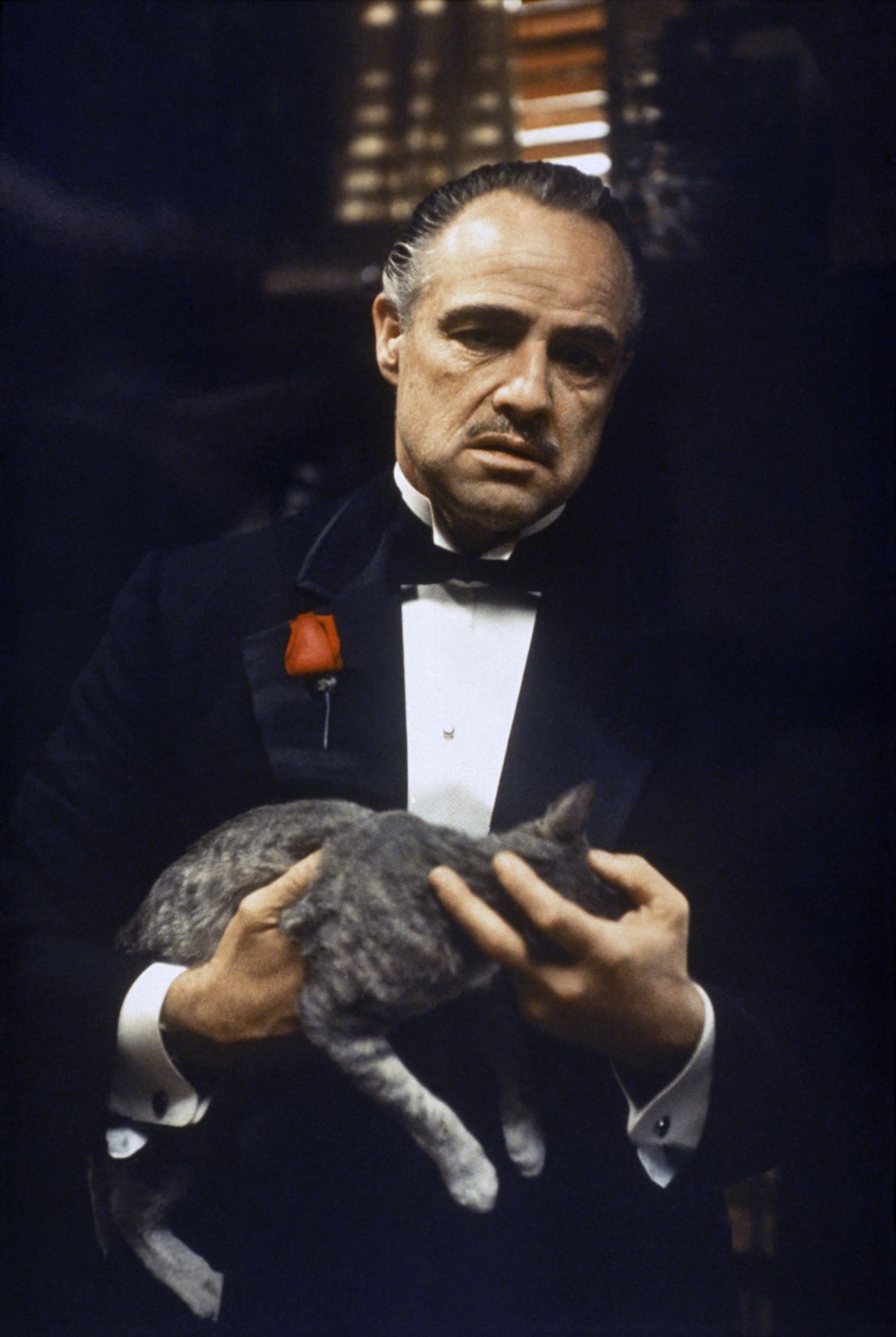
    Sure, Daniel Day-Lewis played a wicked Lincoln, but did you know his godfather was… Ralph Vaughan Williams?

    I was stunned to learn this myself, but it makes perfect sense, as Day-Lewis’ father, Cecil Day Lewis was a friend and associate of the composer.

    He wrote the following letter to Vaughan Williams on the eve of his 80th birthday, October 12, 1952:

    Dear R.V.W.

    Will you accept this, as a very small return for all the pleasure & inspiration your music has given me? If you were ever moved to set the sonnet-sequence here, O Dreams O Destinations, (I’ve often thought it might interest a composer), it would be a wonderful thing for me.

    Yours sincerely

    C. Day Lewis

    It’s speculated the letter accompanied a copy of “The Poems of C. Day Lewis,” in the Penguin Poets series, which Vaughan Williams selected as one of the books of the year for an article in London’s The Sunday Times.

    You’ll find the text of “O Dreams, O Destinations” at the link:

    https://www.poetryexplorer.net/poem.php?id=10006142

    Around the same time, Day Lewis stepped up to take the role of speaker in “An Oxford Elegy” at a Vaughan Williams birthday concert.

    The poet also narrated the belated first performance of Vaughan Williams’ “Epithalamion,” which was composed in 1938-9 (as “The Bridal Day”). With the outbreak of World War II, the work was put away in a trunk, receiving its televised premiere, finally, on June 5, 1953.

    At Vaughan Williams’ 85th birthday celebration, Day Lewis provided the following encomium. I could not find a printed copy (I transcribe from the audio), so the format and punctuation are my own.

    O Prospero,

    You have made for us

    A brave new world of harmony,

    Where discords are resolved by art,

    Born of true magnanimity.

    Ancient Ariel,

    Your music shall fly on,

    As now it flies,

    Girdling with joy our trouble earth,

    From Wenlock to the Antarctic skies.

    Sir,

    You have many friends;

    Accept their birthday wish:

    May God keep safe and bless

    Our 85 year-old Ariel,

    Prospero,

    Uncle Ralph!

    Daniel Daniel Day-Lewis was born in April 29, 1957, 16 months before Vaughan Williams’ death. Cecil Day Lewis served as Poet Laureate of the United Kingdom from 1968 until his own passing in 1972.

    The actor restored the hyphen to his double-barreled surname, originally a pretense on the part of his grandfather, who combined the surnames of his own birth father (Day) and adoptive father (Lewis) in a bid for greater respectability. It is a bid C. Day Lewis symbolically rejected.
  • Abominable Snowman Sci-Fi on Roy’s Tie-Dye Corner

    Abominable Snowman Sci-Fi on Roy’s Tie-Dye Corner

    You think winter in New Jersey is cold? We’ll give you something to cry about.

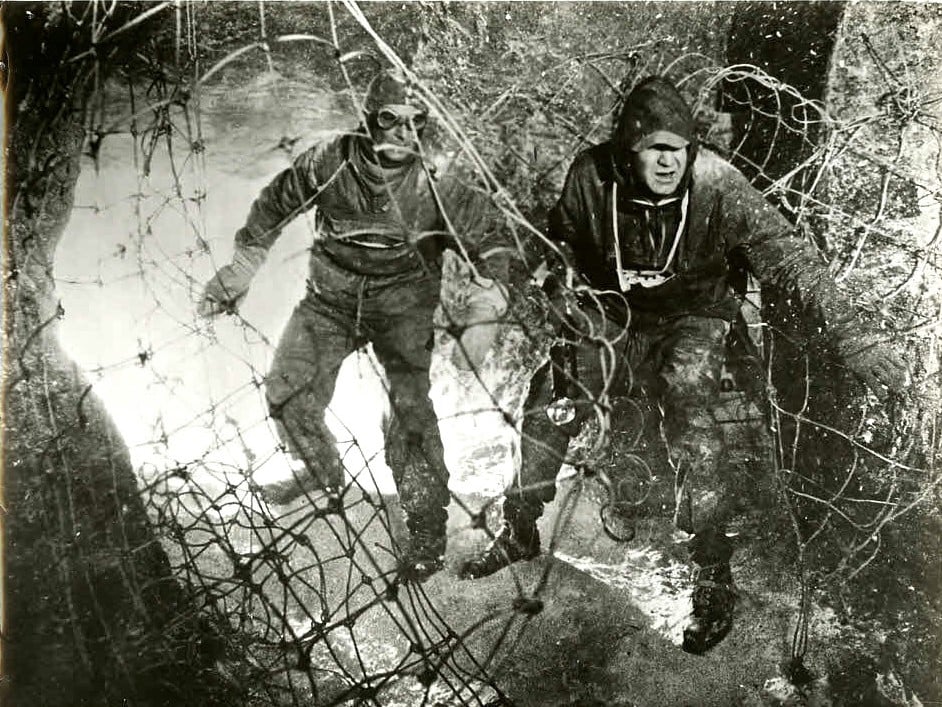
    On the next “Roy’s Tie Dye Sci Fi Corner,” we’re off to the Himalayas with Forrest Tucker and Peter Cushing, in pursuit of “The Abominable Snowman” (1957). This beautifully realized Hammer production was directed by Val Guest, who also helmed the first two films of the apocalyptic “Quatermass” series. Abundant, in-studio polystyrene snow is matched to impressive on-location work shot in the Pyrenees. The film was released the same year as Hammer’s “The Curse of Frankenstein,” which made Cushing an international star.

    The music is by Humphrey Searle, the noted British serialist responsible for the hair-raising score to Robert Wise’s “The Haunting.” Here, he plays comparatively nice, with monastic bells and plenty of Vaughan Williams-style polar music.

    Don’t let it get it inside your head. We’ll be drinking out of our Yetis on the next Roy’s Tie-Dye Sci-Fi Corner. Unpleasant tea will be provided by Tibetan monks in the comments section, when we livestream on Facebook, this Friday evening at 7:00 EST!

    https://www.facebook.com/roystiedyescificorner

  • Stravinsky’s White House Dinner & JFK Tribute

    Stravinsky’s White House Dinner & JFK Tribute

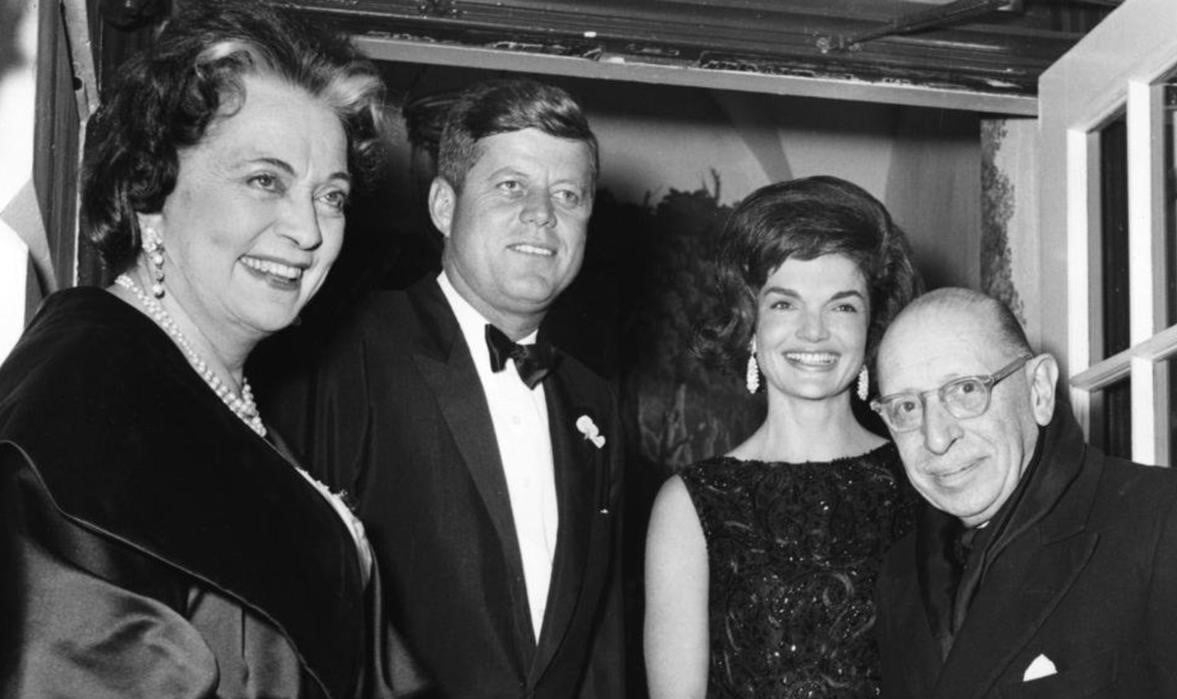
    On this date 60 years ago, Igor Stravinsky went to dinner at the White House. You’ll find an amusing account of the evening here:

    https://www.whitehousehistory.org/igor-stravinsky-at-the-white-house

    “Despite such criticism – which was entirely typical of Stravinsky’s unfiltered personality – he clearly remembered the visit with fondness and gratitude. In January, 1964 he commemorated John F. Kennedy – who had been assassinated on November 22, 1963 – by composing ‘Elegy for J.F.K.,’ a vocal piece with words by W.H. Auden. ‘I felt that the events of November were being too quickly forgotten,’ the composer told The New York Times, ‘and I wished to protest.’”

    Leonard Bernstein was also in attendance at the dinner. Bernstein’s “Fanfare for JFK” was heard for the first time on the eve of Kennedy’s inauguration, also on this date, though one year earlier. It’s only 40 seconds long, so if you blink, you’ll miss it.

    In 1978, Bernstein gave the opening speech at the first Kennedy Center Honors, at which the honorees included Marian Anderson, Richard Rodgers, George Balanchine, Fred Astaire, and Arthur Rubinstein:

    I’ll spare you the entirety of Bernstein’s “Mass,” commissioned by Jacqueline Kennedy for the opening of the Kennedy Center in 1971, but here’s the piece’s hit tune, “A Simple Song”

    Where are our Bernsteins and Stravinskys – or for that matter our Marian Andersons, Richard Rodgerses, George Balanchines, Fred Astaires, and Arthur Rubinsteins – and provided they can be identified, why are they not honored at the White House, or even on television?

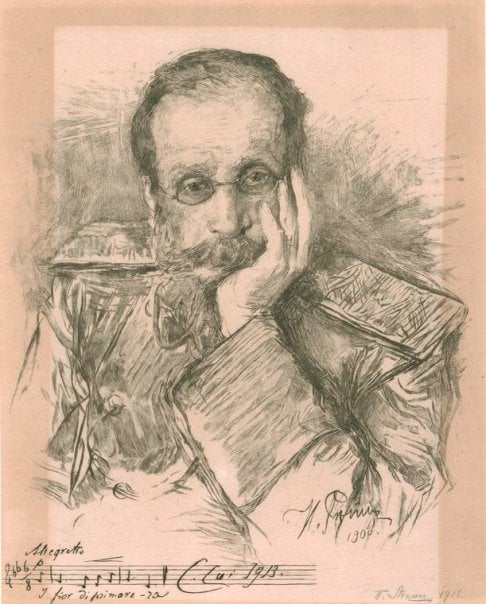
  • César Cui Birthday Rediscovering the Forgotten Five

    César Cui Birthday Rediscovering the Forgotten Five

    It’s January 18. Get queasy on Cui, for his birthday!

    Among the followers of Mily Balakirev that collectively came to be known as “The Mighty Handful,” or “The Five,” unquestionably the least well-known is César Cui (1835-1918). Nikolai Rimsky-Korsakov, Modest Mussorgsky, and Alexander Borodin all went on to attain a kind of immortality in Russian music, each having left his indelible mark.

    Cui wrote 15 operas, believe it or not – one of them, “William Ratcliff,” earning the highest praise from Franz Liszt – but today, he is remembered, if at all, as a miniaturist, or perhaps as a composer of art song, and at that, the least Russian-sounding of the five.

    He shared in common with the others the fact that for him music was an avocation. He paid his bills as a military engineer. Beyond that, however, he was a bit of an outsider – born in Vilnius (now in Lithuania) to a father who had been a general in Napoleon’s army, who stayed and married a local. In addition to Russian, Cui grew up speaking French, Polish and Lithuanian. Perhaps this broader cultural perspective led to a more cosmopolitan approach to music.

    As a critic, he was prolific, and he could be blistering in his sarcasm. Perhaps most notorious was his reception of Rachmaninoff’s First Symphony:

    “If there were a conservatory in Hell, and if one of its talented students were to compose a program symphony based on the story of the Ten Plagues of Egypt, and if he were to compose a symphony like Mr. Rachmaninoff’s, then he would have fulfilled his task brilliantly and would delight the inhabitants of Hell. To us this music leaves an evil impression with its broken rhythms, obscurity and vagueness of form, meaningless repetition of the same short tricks, the nasal sound of the orchestra, the strained crash of the brass, and above all its sickly perverse harmonization and quasi-melodic outlines, the complete absence of simplicity and naturalness, the complete absence of themes.”

    His assessment plunged Rachmaninoff into a two-year depression, during which he was unable to compose until lifted out of his funk by hypnotic therapy. Of course, today everyone knows Rachmaninoff’s music (if not his First Symphony). How many, I wonder, know Cui’s?


    2 Morceaux for cello and orchestra, Op. 36

    3 Morceaux for piano duo, Op. 69 (with Yakov Flier and Emil Gilels)

    Orchestral Suite No. 3, Op. 43, “In modo populari”

    Mischa Elman plays “Orientale”

    “A Feast in Time of Plague” (which has gotten a lot of play, suddenly, since 2020)

    Rachmaninoff, Symphony No. 1 (which Cui compared to the 12 plagues of Egypt)

    https://www.youtube.com/watch?v=hOzcmIQ37Qw

    Cui, “Everywhere Snow”

  • Old Twelfth Night Wassailing Traditions

    Old Twelfth Night Wassailing Traditions

    Just in case you missed out on this year’s Twelfth Night revels on the 6th (or the 5th, depending on the tradition), you’ve got one more chance tonight!

    January 17th is Old Twelfth Night, a time of joyous celebration, marking the last day of the medieval Christmas festivities and the end of Twelfthtide, the Twelve Days of Christmas, which follows on the heels of Christmas Day.

    What’s that, you say? Christmas is on December 25th? This Anglo-Saxon custom pre-dates the Gregorian calendar. Charmingly, it is still observed in parts of the United Kingdom, particularly in southwest England.

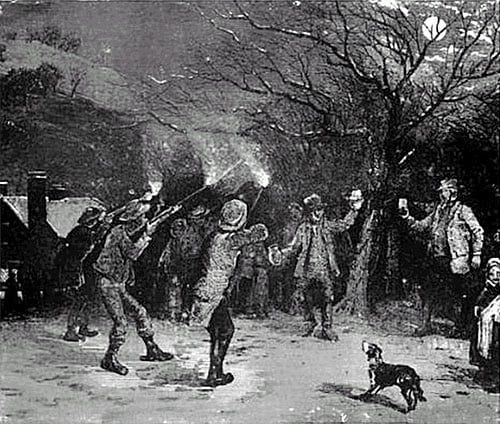
    Families feast on cakes and cider and ale. When they’ve imbibed enough, they go out and wassail the trees. They sing and dance and maybe fire off a few guns (loaded with powder, but no shot), in the certitude that the racket will wake the trees for the coming season and drive off any bad energy.

    Of course, to make the most of it, you’ll have to assemble a gang of folks as steeped in arcane Christmas lore as yourself, unless your idea of a good time is banging pots and pans in the woods alone while wearing yellow stockings and cross-garters.

    A final Merry Christmas to you, until November 27th!

    The resurgence of wassailing in Sussex:

    https://www.youtube.com/watch?v=TezVYpojqSQ

    Wassailing the apple trees in Somerset:

    By the way, according to tradition it’s bad luck to leave your Christmas decorations up beyond Twelfth Night. In order to avert misfortune, if you forget, you’ll need to leave them in place all year. Horrors!

    Perhaps of interest, I found this article in praise of wassailing:

    https://www.theguardian.com/lifeandstyle/2012/feb/08/wassailing-weird-folk-rituals

    And an explanation of Old Christmas Day:

    http://www.christmas-time.com/cp-old.html


    IMAGE: Wassailing the apple trees in Devonshire (1902)

Tag Cloud

Aaron Copland (93) Beethoven (95) Composer (114) Film Music (136) Film Score (143) Film Scores (255) Halloween (94) John Williams (195) KWAX (229) Leonard Bernstein (103) Marlboro Music Festival (125) Movie Music (151) Mozart (88) Opera (207) Philadelphia Orchestra (89) Picture Perfect (174) Princeton Symphony Orchestra (108) Radio (88) Ross Amico (244) Roy's Tie-Dye Sci-Fi Corner (290) The Classical Network (101) The Lost Chord (268) Vaughan Williams (103) WPRB (396) WWFM (881)

DON’T MISS A BEAT

Receive a weekly digest every Sunday at noon by signing up here


RECENT POSTS