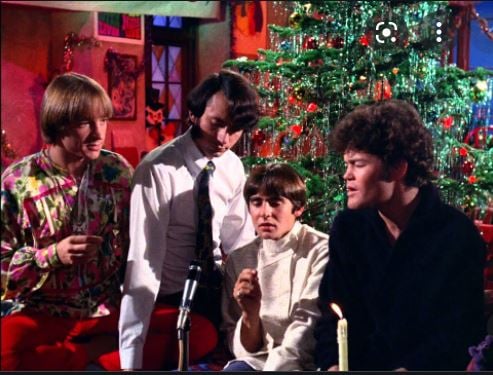
With the passing of Michael Nesmith on December 10th, I can’t believe I only just remembered this this morning. Maybe it’s because of a sudden “Latin” orientation, brought on by last night’s discussion of the Mexican underground classic “Santa Claus Versus the Devil” and this morning’s post about Venezuelan Christmas Eve. At any rate, here The Monkees perform the Spanish carol “Riu Riu Chiu.”
Category: Daily Dispatch
-

Venezuelan Christmas Traditions & Culture
As Americans, our concept of Christmas tends to be rather Northern-centric. Even the practice of calling ourselves “Americans” is a bit presumptuous, seeing as there are all these other folks living around the Equator and in lands south – roughly 40 percent of the population of the Eastern Hemisphere – who are also Americans, though not citizens of the United States.
The people of Venezuela may never know what it is to enjoy a white Christmas, but they have developed their own seasonal traditions to compensate for a lack of “dashing through the snow.” On Christmas Day in the capital city of Caracas, the streets are closed to traffic, fireworks shatter the silence before dawn, and those youngsters who can sleep through anything are awakened by a tug on the toe.
Children go to bed on Christmas Eve with a string tied to their piggies. One end is dangled out the window to be tugged – gently, one would hope – by passersby, as a reminder that it is time to get up and strap on the skates. For in the city of Caracas, it is customary for anyone who is able-bodied to roller skate to Christmas Mass. If the kids are good, they have received gifts in the night, not from Santa, but from Baby Jesus himself.
After Mass, everyone goes out for tostados and coffee. The big meal is enjoyed on Christmas Eve (actually the wee hours of Christmas morning), following Midnight Mass, or Misa de Gallo. “Gallo,” if you don’t know, is Spanish for “rooster.” Nobody gets any sleep on Christmas in Venezuela. That’s one aspect of the holiday Americans in both hemispheres pretty much share in common.
A Venezuelan favorite: “Mi Burrito Sabanero” (“My Little Donkey of the Savannah”)
-
Santa vs Devil a Festivus Airing of Grievances
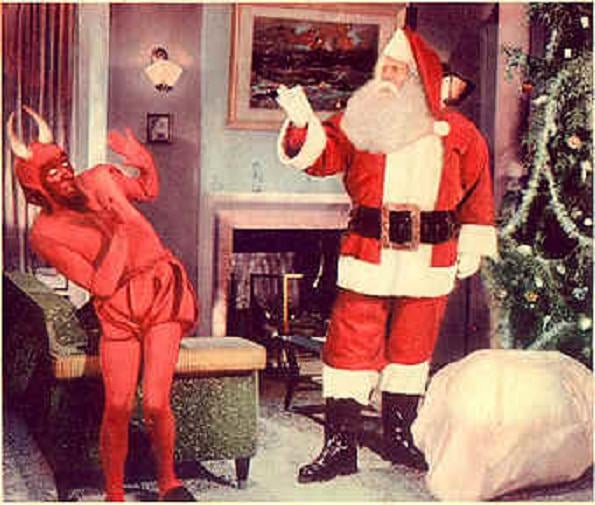
Roy’s intense dislike of “Santa Claus Versus the Devil” (he didn’t even watch the entire movie) threw me a little bit – or maybe it was just the spiked eggnog – so last night’s discussion probably never blossomed quite the way it should have done. The film’s many surreal delights were left to wither on the vine. I never even got around to talking about Krampus, the Christmas demon, and the dark underbelly of Christmas!
But even if it took all the air out of the room, in terms of not being able to actually delve very deeply into the film – beyond what I was able to get out about the director, the composer, the American importer, and one of the child actors, now doing hard time – it did allow a platform for the airing of grievances, as any Festivus broadcast should.
If you can’t bear to do your last-minute Christmas wrapping to yet another recording of “The Nutcracker,” put us on in the background. If our combative spirit fails to entertain, you could always just spend Christmas Eve at the local mall.
https://www.facebook.com/watch/live/?ref=watch_permalink&v=1789868367889508
We’ll be back on New Year’s Day, with another “Twilight Zone” double-header, and a conversation about the classic episodes “Walking Distance” (1959, written by Rod Serling, and starring Gig Young and Ron Howard), and “Nick of Time” (1960, written by Richard Matheson, and starring William Shatner and Patricia Breslin). This one is being curated by Roy, so don’t blame me if we begin 2022 in “the middle ground between light and shadow.”
What’s that signpost, up ahead? It’s Roy’s Tie-Dye Sci-Fi Corner! Leave your best Rod Serling impressions in the comments section, as we livestream on Facebook, this January 1 at 7 PM EST.
https://www.facebook.com/roystiedyescificorner
Stay safe, and Happy New Year!
-

Festivus Karolju a Holiday Music Treat
December 23rd. Happy Festivus! Let the airing of grievances begin.
Then enjoy this postmodern, pandenominational, mid-winter concoction by Christopher Rouse, called “Karolju.” The title, fabricated by the composer, puts an Old World spin on the word “carol.” The “ju” is merely because, as Rouse states, he happens to like words that end in “u.” The text is totally pidgin, and the musical allusions to Orff, Tchaikovsky, Vaughan Williams, Prokofiev, and others only add to the fun.
To hear the complete piece, click the link and allow the videos to play continuously. (There are eleven movements.) The album also contains Witold Lutoslawski’s “Polish Christmas Carols” and Joaquin Rodrigo’s “Retablo de Navidad.”
-
Puccini’s Birthday: La Bohème & Bohemian Life
Happy birthday, Giacomo Puccini!
The first two acts of “La bohème,” of course, are set on Christmas Eve – Act I in a chilly but cheery artists’ garret, and Act II on the festive streets of Paris’ Latin Quarter.
The world premiere of Puccini’s opera took place at the Teatro Regio in Turin on February 1, 1896. On the podium was a 28-year-old Arturo Toscanini.
Allegedly, the opening night reaction was a subdued one, and critics were divided. But it wasn’t long before Rodolfo’s kindling gave rise to a flame that would engulf all of Europe and the New World.
Though audiences quickly grew to love it, “Bohème” and its composer have always been regarded with a degree of suspicion – condescension even – by critics and Puccini’s envious colleagues. The music lacks sophistication, we are told, and the opera’s lyricism and pathos are calculating – emotional pandering. Whether or not that’s the case, music lovers can’t get enough of it and Puccini cried all the way to the bank.
Prior to his years of success, Puccini and his friends, mostly writers and artists, would gather at a roadside shed in Torre del Lago to drink and play cards. They referred to the structure as “Capanna di Giovanni delle Bande Nere” (“Cabin of Giovanni of the Black Stripes”), after its owner, a local cobbler. When the cobbler struck out to seek his fortune in America, the artists bought the shack and continued to meet under the banner “La Bohème Club” (as stated on a sign they painted on the roof).
Further signs were posted on the walls inside, in faulty Latin and ungrammatical Italian. Its members pledged themselves under oath to be well and eat butter.
The following were the club’s by-laws:
- Poker faces, pedants, weak stomachs, blockheads, puritans and other wretches of the species are not admitted and will be chased away.
- The President acts as conciliator but undertakes to hinder the Treasurer in the collection of the subscription money.
- The Treasurer is empowered to abscond with the money.
-
The lighting of the locale is provided by a petrol lamp. Failing the fuel, the “moccoli” of the members are to be used [a pun on “moccolo,” meaning either “candle stump” or “blockhead”].
-
All games permitted by law are forbidden.
-
Silence is prohibited.
-
Wisdom is not permitted, except in special cases.
One can imagine the carefree bohemians, Rodolfo’s companions, rollicking in their garret. After the triumph of “Bohème,” the opera, no one was having to burn their plays for fuel, or hock their coats for medicine.
There’s nothing like a little success to take the worry out of “bohemian life.”
André Kostelanetz (also born on this date) conducting a purely orchestral suite of highlights from “La bohème”
The bohemians in their garret
Mimi’s hands are cold, so Rodolfo goes to work (the old smoothie)
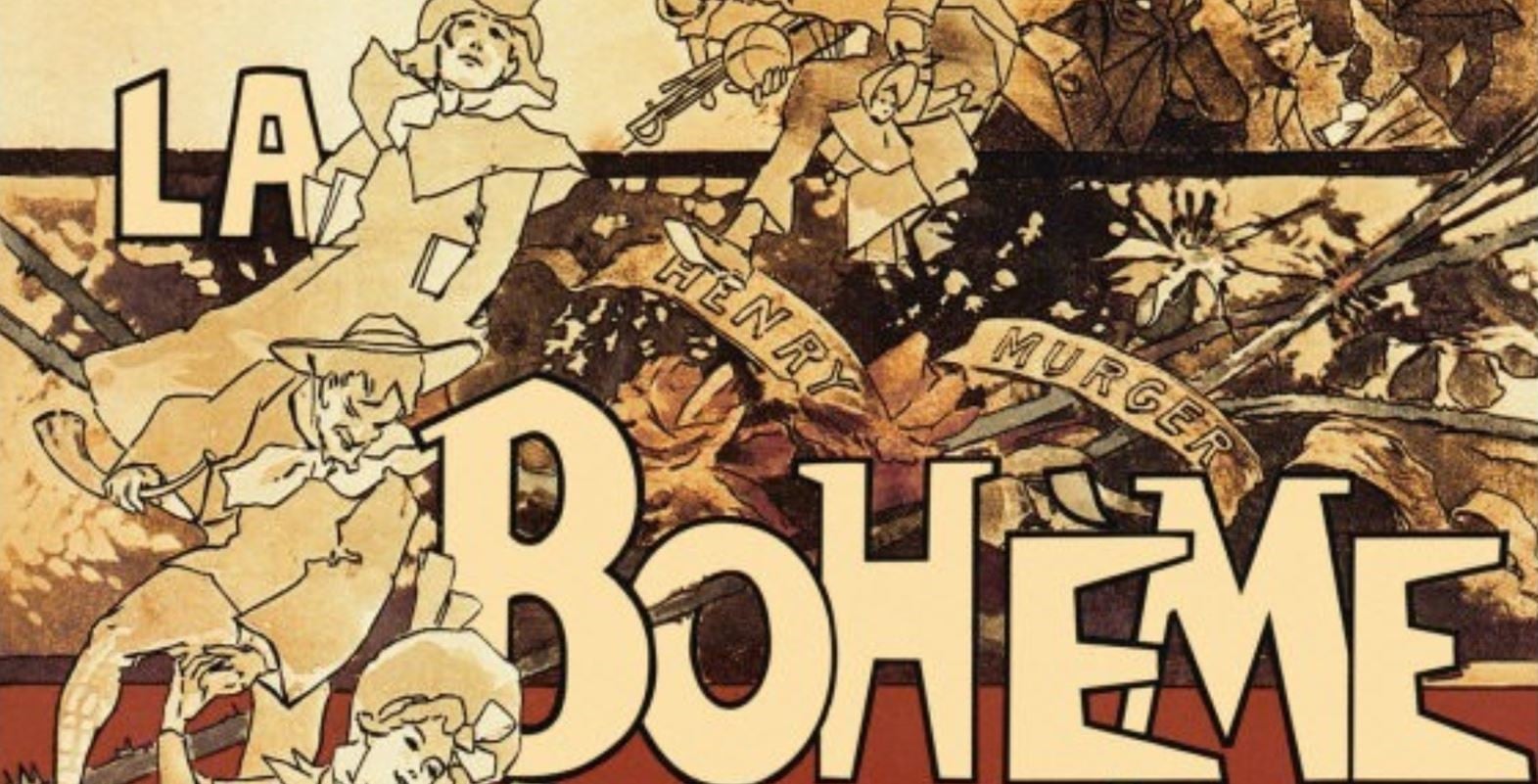
IMAGES: From an 1896 poster of the opera, and an 1897 photo of the club
Tag Cloud
Aaron Copland (93) Beethoven (95) Composer (114) Film Music (136) Film Score (143) Film Scores (255) Halloween (94) John Williams (195) KWAX (229) Leonard Bernstein (103) Marlboro Music Festival (125) Movie Music (151) Mozart (88) Opera (207) Philadelphia Orchestra (89) Picture Perfect (174) Princeton Symphony Orchestra (108) Radio (88) Ross Amico (244) Roy's Tie-Dye Sci-Fi Corner (290) The Classical Network (101) The Lost Chord (268) Vaughan Williams (103) WPRB (396) WWFM (881)