Category: Daily Dispatch

  • Pablo Casals: Beyond the Cello Great

    Pablo Casals: Beyond the Cello Great

    Pablo Casals is remembered primarily as one of the great cellists. But did you know he was also a composer? Casals’ most ambitious piece must be his Christmas oratorio “El Pessebre,” or “The Crib” (once commonly translated as “The Manger”).

    The text, by Catalan poet Joan Alavedra, was conceived in response to questions posed by his five-year-old daughter. She asked him, as he was setting up his crèche, what each of the figures at the Nativity – including the animals – said.

    The project provided something of an escape for both artists. The work was begun while they were under house arrest in 1943. The folk-like simplicity of the oratorio is disturbed only occasionally by intimations of a troubled world. Casals added a prayer for peace to the concluding “Gloria” and refused to allow the work to be performed in Franco’s Spain. Instead, it was given its premiere in Acapulco, Mexico, in 1960.

    As long as you don’t go into it expecting Christmas music of the caliber of that written by Casals’ idol, Johann Sebastian Bach, the oratorio makes for a charming and disarming musical experience. Said Casals, “The figures in a crèche are folk figures. Why, they can’t sing twelve-tone music!”

    Casals’ performance of the piece, to my knowledge, has never been released on CD. Even so, this one, with Lawrence Foster conducting, is probably about as good as it’s going to get.

    Less of an investment is Casals’ arrangement of a traditional Catalan carol, “The Song of the Birds.” It was he who popularized the carol internationally in a version for solo cello, which he would sometimes include on his recitals as an encore.

    On October 24, 1971, when Casals was awarded a Peace Medal from the United Nations, at the age of 94, he played it before the General Assembly. This is what he said on that occasion:

    “I haven’t played in public for nearly 40 years. I have to play today. This piece is called ‘The Song of the Birds.’ The birds in the sky, in the space, sing, ‘Peace! Peace! Peace!’ The music is a music that Bach and Beethoven and all the greats would have loved and admired. It is so beautiful and it is also the soul of my country, Catalonia.”

    You can actually hear him speak at the link.

    If you’ve already had your fill of Christmas, Casals’ traversal of the Bach cello suites still sounds great after 80 years. It’s hard to believe that these cornerstones of the cello repertoire were once commonly regarded as little more than etudes. In fact, before the 20th century, they were hardly known.

    It is Casals who is credited with having rehabilitated them, following his discovery of the music in a Catalan bookshop at the age of 13. He cherished the suites for the rest of his life, not only playing them in public, but delving into them privately every morning after a walk and a smoke. There must have been something to it: Casals died in 1973, two months shy of his 97th birthday.

    Casals was the first cellist to record all six suites. He was already 60 by the time he first played Bach before a microphone.

    Happy birthday, Pau!


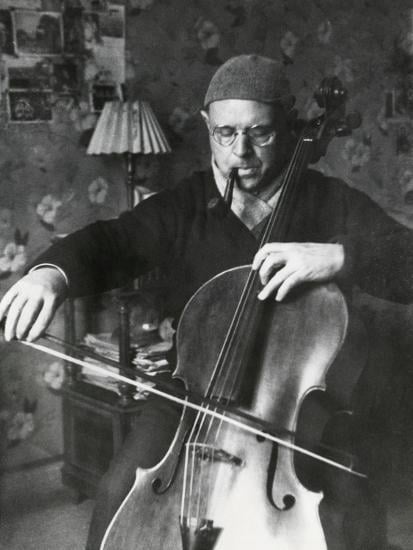
    PHOTO: Casals at home in Barcelona
  • Gremlins Movie Discussion Livestream This Week

    Gremlins Movie Discussion Livestream This Week

    I will not be participating in the last Roy’s Tie-Dye Sci-Fi Corner of 2021 – for one thing, it will past my bedtime – but if you don’t mind risking your mogwai getting fed after midnight, consider joining Roy and his son Ryan for a discussion of “Gremlins” (1984).

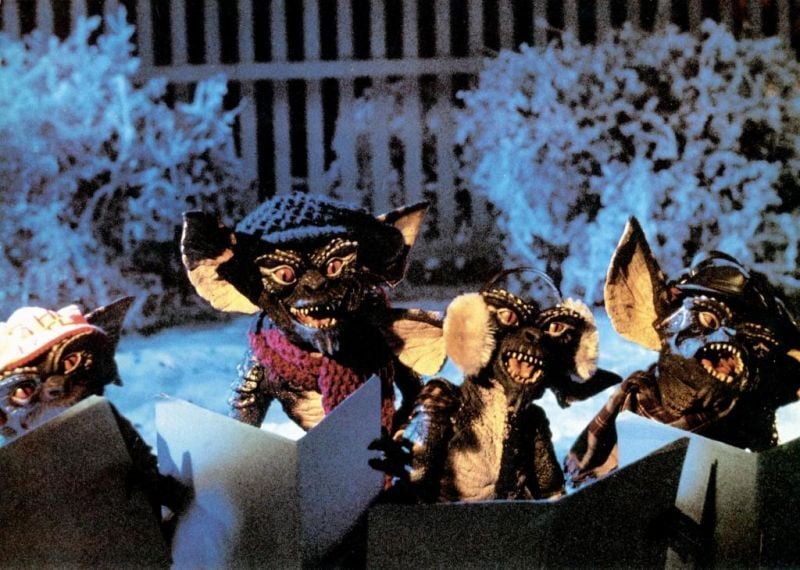
    The Steven Spielberg-produced, Joe Dante-directed black comedy is technically a Christmas movie. Whether or not it gives you the warm fuzzies depends on how much you cotton to cuddly Gizmo and the softer edges of Jerry Goldsmith’s score (his biggest bait-and-switch since Carol Anne’s theme from “Poltergeist”).

    Otherwise, it’s pretty nasty business. Sharpen your teeth in the comments section, as Roy and Ry talk about “Gremlins.” The cross-generational mayhem will be livestreamed on Facebook, at a special day and time, this Thursday night at 10:00 EST. (UPDATE, 12/20/21! Just received word that the show will now air at 8 PM!)

    https://www.facebook.com/roystiedyescificorner

    PLEASE NOTE: I haven’t thrown in the towel altogether. Roy and I will reteam to kick off 2022 with a “Twilight Zone” doubleheader – a conversation about classic TZ episodes “Walking Distance” (1959) and “Nick of Time” (1960) – on New Year’s Day, this Saturday evening at 7:00 EST.

    Stay healthy, and have a Happy New Year!

  • Hating the Twelve Days of Christmas

    Hating the Twelve Days of Christmas

    “The Twelve Days of Christmas” is easily my least favorite Christmas carol. Fun to sing, maybe, but maddening to listen to. Like “99 Bottles of Beer on the Wall,” with the beer replaced by wassail and eggnog. Maybe that would take some of the sting out. But to have to listen to anyone sing it? Sinatra, Crosby, The Chipmunks, I don’t care – it’s torture.

    Be that as it may, it was part of the season’s rituals to sing it as a kid. It was only much later that it became clear that this Twelve Days of Christmas business doesn’t really start until December 25. In fact, many seem to be oblivious to the fact that the twelve days run through January 6, or Epiphany – the Feast of Three Kings.

    By then, for most, the gifts are already put away, and for plenty, the trees, the stockings, and other Christmas trappings are already snug in the attic. But really, everything is supposed to stay up until Twelfth Night.

    On the other hand, if you’re superstitious, you don’t want them up any longer than that, or it will bring bad luck. The only way to avert it, then, would be to leave all the decorations in place for another year. Which wouldn’t exactly be horrible – I’m sure that’s what Santa does – but your neighbors would beg to differ.

    Today, then, is the Fourth Day of Christmas, which I single out for the gift of “four calling birds.” Apparently, it was originally “colly birds,” “colly” being archaic for “black as coal” (think “collier”). So, blackbirds is what you would get, if you were a recipient of this peculiar Christmas largesse.

    The carol has been around forever, appearing in print for the first time in 1780, but as a fun “memory song” from an era before recording artists, it’s the kind of thing that probably reaches back further into the primordial ooze of oral tradition.

    What’s really interesting to me, as a classical music nut, is that so many of the familiar carols are so closely connected with the great composers. “Hark! The Herald Angels Sing” was set to music of Mendelssohn. “Joy to the World” leans on Handel. “O Holy Night” was written by Adolphe Adam (composer of “Giselle”), and so on.

    In the case of “Twelve Days,” its origins are traditional, but it was English composer Frederic Austin who gave us its modern form in 1909. He codified the melody and lyrics, replacing “colly” with “calling,” and – the masterstroke – extending the cadence of “five go-old rinnnnnnnnngs.” That’s the part of the song any singer really likes, isn’t it?

    Now, Austin is not the best-known of English composers, but I’ve always been a bit of a musical Anglophile, so I do have some of his concert works in my collection.

    Here’s Austin’s “The Sea Venturers,” from 1935:

    I know of two treatments of this insufferable carol that manage to make it somewhat interesting, and I try to play them every year. The first is “Partridge Pie,” by English composer Richard Rodney Bennett. It’s a piano suite, consisting of wholly original music for each of the twelve days. Thankfully, unlike in the carol as it is sung, the material is not repeated from verse to verse.

    Book I

    Book II

    The other is “A Musicological Journey Through ‘The Twelve Days of Christmas,’” by American composer @Craig Courtney Craig Courtney. Courtney arranges each of the verses in the style of a different composer or historical era, reaching back to Gregorian chant and culminating in a pseudo-Sousa march. It tickles the ear as no recording of the traditional “Twelve Days” ever does. Here’s my preferred recording, with the Bach Choir of Pittsburgh and the Pittsburgh Brass. Each of the movements is posted separately, so you have to let the playlist run through to enjoy each of the twelve days.

    Let the gratuitous gift-giving continue! Still eight days of Christmas to come!

  • Toy Symphonies a German Musical Quirk

    Toy Symphonies a German Musical Quirk

    Yet another interesting cultural quirk, to rank alongside the German fairy tale opera, the toy symphony (or “kindersinfonie”) seems to have been all the rage in Germany for well over a century, at least since Leopold Mozart’s cheeky lark, long attributed to Haydn, which includes plenty of drums, toy trumpets, and bird whistles. Depending on whether or not you have little ones congregating at your house, this may or may not be the escape from Christmas you’re looking for. Click on the links at your own risk.

    Leopold Mozart, Cassation in G major, “Toy Symphony” (1760s)

    Bernhard Romberg, Symphonie burlesque, “Toy Symphony” (1852)

    “Kinder-Symphonie,” a late addition to the genre by Carl Reinecke (1897)

  • British Light Music for Post-Holiday Relaxation

    British Light Music for Post-Holiday Relaxation

    The dishes are clean, the guests are on the road. At last, a little “me” time.

    This Sunday night on “The Lost Chord,” pour yourself something medicinal, kick back in front of the tree, and prepare to get reacquainted with the insides of your eyelids. The recovery from Christmas begins with a playlist of British Light Music classics.

    Take a load off, with vintage recordings of works by Albert Ketèlbey, Samuel Coleridge-Taylor, Sir Edward Elgar, Richard Addinsell, George Scott-Wood, Haydn Wood, Billy Mayerl, and Eric Coates.

    There’s light at the end of the tunnel. The time draws nigh for “Distant Light,” this Sunday night at 10:00 EST, on WWFM – The Classical Network and wwfm.org.

Tag Cloud

Aaron Copland (93) Beethoven (95) Composer (114) Film Music (136) Film Score (143) Film Scores (255) Halloween (94) John Williams (195) KWAX (229) Leonard Bernstein (103) Marlboro Music Festival (125) Movie Music (151) Mozart (88) Opera (207) Philadelphia Orchestra (89) Picture Perfect (174) Princeton Symphony Orchestra (108) Radio (88) Ross Amico (244) Roy's Tie-Dye Sci-Fi Corner (290) The Classical Network (101) The Lost Chord (268) Vaughan Williams (103) WPRB (396) WWFM (881)

DON’T MISS A BEAT

Receive a weekly digest every Sunday at noon by signing up here


RECENT POSTS