Category: Daily Dispatch

  • Vienna Philharmonic New Year’s Concert 2022

    Vienna Philharmonic New Year’s Concert 2022

    What better way to treat your New Year’s Day hangover than with a celebratory concert of bright Strauss waltzes and raucous galops?

    The Classical Network presents its annual live broadcast of the New Year’s Day Concert from Vienna. This year, the Vienna Philharmonic is conducted by Daniel Barenboim.

    Load up your ice pack, pour yourself a hair of the dog, and tune in for this New Year’s tradition, this morning at 11:00 EST. 2022 gets off to a fizzy start on WWFM – The Classical Network and wwfm.org.

  • Baby New Year History Traditions and Art

    Baby New Year History Traditions and Art

    HAPPY NEW YEAR!

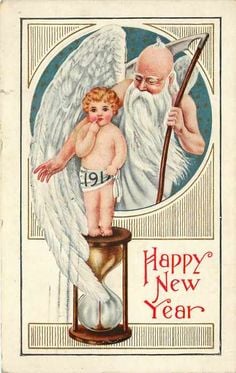
    I love that Father Time is derived from the Roman god Saturn (equated with the Greek agricultural deity Cronus – hence the scythe). It delights me to imagine Old Man Time devouring the Baby New Year, as in the Goya painting.

    It turns out that the concept of Baby New Year has been around a loooooong time, since about 600 B.C. In Ancient Greece, parading a baby through the streets in a basket was supposed to represent the arrival of the newborn Dionysus, god of wine and fertility.

    Of course, the Baby would also become a popular midwinter symbol with Christians. By the 1400s, images of Baby Jesus began to be bear inscriptions like “I bring a good year.”

    In the 19th century, Baby New Year was secularized by newspaper cartoonists. But his golden age must have been the first half of the 20th century, which coincided with the golden age of illustration. In particular, J.C. Leyendecker – he of “Arrow collar” fame – rendered Baby New Year annually for the Saturday Evening Post, from 1907 to 1943. His popularity led to lots of unfortunate impersonations by half-naked men. In 1936, when the economy began to show signs of recovery, Leyendecker gave the Baby a top hat and turned him into a symbol of prosperity (a mite prematurely, it turned out).

    Here’s a gallery of Leyendecker’s Baby New Year illustrations for the Post. As you can see, what starts out as a somewhat cherubic portrayal is soon colored by current events (the birth of flight, women’s suffrage, World War I, the Armistice, and so on).

    https://www.saturdayeveningpost.com/2014/12/new-years-babies/

    But I’m a traditionalist. For me, Baby New Year is best served tartare, with perhaps a glass of chilled champagne.

  • Phantom Carriage A New Year’s Ghost Story

    Phantom Carriage A New Year’s Ghost Story

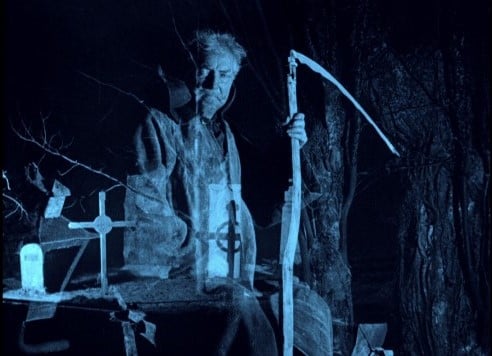
    If you can’t stand the whole, stupid Times Square thing – which promises to be even stupider this year, in the middle of a pandemic – you could do a lot worse than to watch “The Phantom Carriage” (1921).

    Based on a novel by Selma Lagerlöf (of “Gösta Berling’s Saga” fame), this New Year’s Eve ghost story is like a Swedish cousin to Charles Dickens’ “A Christmas Carol.” The director, Victor Sjöström, plays what must be one of the least sympathetic antiheroes in all of cinema. His character, David Holm, is vindictive and mean-spirited – alcoholic, abusive, and a destructive influence on everyone around him. If there’s one character who’s beyond redemption, you figure it’s got to be Holm, who makes Ebenezer Scrooge look like a charm school graduate.

    Holm hits the bottle with a couple of his drinking buddies in a cemetery a few minutes to midnight on New Year’s Eve, as saintly Salvation Army sister Edit calls for him on her deathbed. She’s dying of the consumption she contracted caring for Holm for the first time exactly one year ago. But she clings to life, waiting for confirmation of her belief in Holm’s inherent goodness.

    Holm dismisses Sister Edit’s messenger and relates a story to his companions about a former acquaintance, university-educated Georges, who started him down the path of dissolution. It was Georges who introduced him to, among other things, the legend of the Phantom Carriage. The last person to die each year, we’re told, is fated to drive Death’s carriage. In this capacity, very dreary work, the departed must collect all the souls of the dead for the following year. With a sense of foreboding, Georges, the bon vivant, blanches every New Year’s Eve, climbs into his bunk, and stares at the wall.

    Wouldn’t you know it, his premonition comes to pass. Georges was the last to die the previous year. And now selfish, belligerent Holm takes a fatal crack on the head just at the stroke of 12:00. Thus begins a strange reunion between master and disciple, with Georges directing Holm’s spirit to the sites of all the misery he’s caused. The rest of the story plays out like the Ghost of Christmas Yet to Come, without the laughs.

    The film is fascinating in a way only silent movies are – especially dreamlike in its double-exposure effects of the Phantom Carriage – but the human story is also surprisingly absorbing. There’s one Holm freakout that seems to anticipate Stanley Kubrick’s “The Shining.” For my money “Häxan” (1922), by Danish director Benjamin Christensen, is still the benchmark for silent lurid thrills. “The Phantom Carriage” isn’t really about that. There are no witches’ sabbaths or children being hurled into cauldrons. The power of Sjöström’s film is in its ability to reach across 100 years to engage us with its humanity.

    The film opened in Scandinavia on New Year’s Day, 1921. Ingmar Bergman loved this movie, and it’s easy to see parallels between Holm’s conversations with the Grim Reaper and the iconic chess match between the Knight and implacable Death in “The Seventh Seal.” Sjöström himself would later play the lead in Bergman’s “Wild Strawberries.” Bergman first saw “The Phantom Carriage” at the age of 15 and claimed to watch it at least once every year.

    It’s not a film that will bring a smile to your face on New Year’s Eve. But then, I never smile on New Year’s. Take that, you filthy Mummers.

    https://www.inquirer.com/news/mummers-parade-philadelphia-returns-2022-costumes-brigades-20211230.html
  • David Willcocks Birthday RVW Carols Hodie

    David Willcocks Birthday RVW Carols Hodie

    Remembering Sir David Willcocks on his birthday, directing two favorite Christmas carols arranged by Vaughan Williams.

    “Yorkshire Wassail Song”

    “Wassail Song”

    Of course, Willcocks also conducted my favorite recording of RVW’s “Hodie,” which I got to enjoy this year on Christmas Day. Here it is again, a few days late.

    Willcocks died in 2015, at the age of 95.

  • Kabalevsky F Troop and Soviet Music Anniversaries

    Kabalevsky F Troop and Soviet Music Anniversaries

    The guy who taught me basic music theory was a nut for Dmitri Kabalevsky (1904-1987). In particular, he was crazy for Kabalevsky’s piano sonatas. It was a rare instance in which he introduced me to something I hadn’t heard (I would have been 19 at the time), as opposed to the other way around. That’s the thing about musicians. They’re so busy performing that they have no time to laze around and listen to records!

    In any case, of course I knew Kabalevsky from his “Colas Breugnon Overture” (from his opera after the novel of Romain Rolland) and the ubiquitous Galop from “The Comedians,” which I believe I first heard on Bob McAllister’s “Wonderama,” if you remember that show.

    Am I the only one who detects Kabalevsky in the theme to “F Troop?”

    “The Comedians: Galop”

    “Colas Breugnon Overture”

    “F Troop”

    Interesting choice, to allude to a Soviet composer in a sitcom about the Wild West. Happy birthday, Dmitri Kabalevsky!

    Vladimir Horowitz plays Kabalevsky’s Piano Sonata No. 3


    It’s quite a day for the Soviets. This date also marks the anniversaries of the first performances of Aram Khachaturian’s Symphony No. 2, in Moscow, in 1943, Dmitri Shostakovich’s Symphony No. 4, also in Moscow, in 1961 (the work was originally scheduled to be performed in 1936, but was prudently withdrawn by the composer after he was denounced in Pravda for his “formalist” opera “Lady Macbeth of Mtsensk”), and – one hundred years ago today – Sergei Prokofiev’s opera “The Love for Three Oranges,” in Chicago, of all places, with the composer in attendance.

    Finally, according to the Julian calendar, Reinhold Glière was born on this date in 1875!


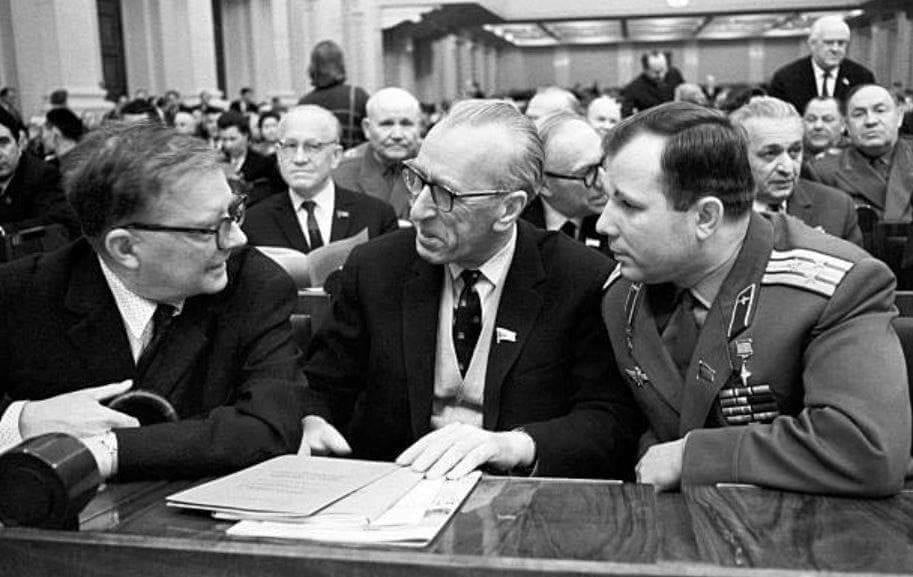
    TOP PHOTO: Kabalevsky with Shostakovich (left) and cosmonaut Yuri Gagarin at the Kremlin, 1966

    BOTTOM PHOTO: Union of Soviet Composers plenum in Moscow, 1946

    Standing (left to right): Yuri Shaporin, Dmitri Kabalevsky, Ivan Dzerhinsky, Maran Koval, Vano Muradelli

    Sitting (also left to right): Aram Khachaturian, Uzeyir Hajibeyli, Dmitri Shostakovich, Reinhold Glière, Sergei Prokofiev

Tag Cloud

Aaron Copland (93) Beethoven (95) Composer (114) Film Music (136) Film Score (143) Film Scores (255) Halloween (94) John Williams (195) KWAX (229) Leonard Bernstein (103) Marlboro Music Festival (125) Movie Music (151) Mozart (88) Opera (207) Philadelphia Orchestra (89) Picture Perfect (174) Princeton Symphony Orchestra (108) Radio (88) Ross Amico (244) Roy's Tie-Dye Sci-Fi Corner (290) The Classical Network (101) The Lost Chord (268) Vaughan Williams (103) WPRB (396) WWFM (881)

DON’T MISS A BEAT

Receive a weekly digest every Sunday at noon by signing up here


RECENT POSTS