Category: Daily Dispatch

  • 7 Facts About Dvořák: Cello Concerto & More

    7 Facts About Dvořák: Cello Concerto & More

    Over the years, I’ve written a number of program notes for Sinfonietta Nova, a community orchestra based in West Windsor, New Jersey (on the outskirts of Princeton). In 2015, I was asked by its artistic director and conductor, Gail Lee, to submit seven interesting facts about Antonin Dvořák, to be shared on the orchestra’s Facebook page, as kind of a countdown to a performance of his Symphony No. 7. On the first half of the concert was Dvořák’s Cello Concerto. I reproduce those Facebook contributions here, for the occasion of the 180th anniversary of the composer’s birth. Happy birthday, Antonin Dvořák!

    DVOŘÁK FACT #1

    It’s hard to believe, but before writing his famous Cello Concerto in B minor, Dvořák wasn’t particularly fond of the cello as a solo instrument. He disliked its nasal high register and rumbling bass. However, after he heard a performance of the Cello Concerto No. 2 in E minor by his colleague at the National Conservatory of Music, Victor Herbert, Dvořák changed his mind. Herbert, best-remembered for his operettas, including “Babes in Toyland” and “Naughty Marietta,” was principal cello at New York’s Metropolitan Opera. He also led the cello section of the New York Philharmonic at the world premiere of Dvořák’s “New World” Symphony, when it was played at Carnegie Hall in 1893.

    Victor Herbert’s Cello Concerto No. 2:

    DVOŘÁK FACT #2

    The slow, wistful passage just before the Cello Concerto’s triumphant conclusion was added by Dvořák as a tribute to his sister-in-law, Josefina Kaunitzova, who died during the work’s composition. Dvořák was actually in love with her for many years. When she refused his proposal, the composer married her younger sister, Anna, instead. The passage quotes from the composer’s Four Songs, Op. 82, of which Kaunitzova was particularly fond.

    “Kéž duch můj sám” (“Leave Me Alone”), Op. 82, No. 1:

    Transcribed for cello:

    DVOŘÁK FACT #3

    The Cello Concerto in B minor, completed in 1896, is Dvořák’s final concerto for solo instrument and orchestra. Previously, he had written a Violin Concerto in A minor and a seldom-performed Piano Concerto in G minor, both published in 1883. The Cello Concerto is widely regarded as one of the greatest – if not THE greatest – ever written for the instrument.

    Of the three, the Piano Concerto has been the poor stepchild. This has been blamed in large part on the writing for piano. Pianist and Liszt authority Leslie Howard notes, “… there is nothing in Liszt that is anywhere near as difficult to play as the Dvořák Piano Concerto – a magnificent piece of music, but one of the most ungainly bits of piano writing ever printed.” Rudolf Firkušný was the work’s greatest champion. He recorded the piece three times.

    Firkušný performs Dvořák’s Piano Concerto:

    Dvořák’s Violin Concerto performed by his great-grandson, Josef Suk:

    DVOŘÁK FACT #4

    Like William Shakespeare, Antonin Dvořák was the son of a butcher. He was the first of fourteen children, eight of whom survived infancy. As a violist in the Bohemian Provisional Theater Orchestra, he performed under Bedřich Smetana and visiting conductor Richard Wagner. It was Johannes Brahms who was the first outside of Bohemia to recognize Dvořák’s genius as a composer. Brahms labored on his behalf to secure a grant, so that Dvořák could rise above impoverished circumstances and devote himself to composition full-time. In gratitude, Dvořák dedicated his String Quartet No. 9 to his new friend and champion. Brahms also provided an introduction to his publisher, Simrock, who commissioned Dvořák to compose something in the vein of Brahms’ “Hungarian Dances.” The resulting “Slavonic Dances” became an international smash.

    Dvořák’s “Slavonic Dances”

    String Quartet No. 9 in D minor, Op. 34

    DVOŘÁK FACT #5

    Dvořák was crazy for trains. During his tenure at the National Conservatory of Music in New York, he was frequently seen “trainspotting,” and when at home he took daily walks to the train station in Prague. So perhaps it is hardly surprising that on one such walk the first subject of a brand-new symphony flashed into his mind. The impetus was the arrival of a festive train full of countrymen returning from Pest. He sketched the first movement of his 7th Symphony in only five days. It was Dvořák’s intention for the work to reflect the political struggles of the Czech nation and his own feelings of patriotism. An atmosphere of obstinate defiance seems to hang over the piece. It is the most cosmopolitan of his last three great symphonies, with the composer keeping the reins tight on his penchant to bubble over into folk-inflected rhapsody. The work’s classic formal structure makes it arguably the greatest of his symphonies, though it has never achieved the popularity of the 8th or 9th, which wear their charms like the vibrant colors and patterns of Bohemian traditional dress.

    Dvořák’s Symphony No. 7:

    DVOŘÁK FACT #6

    Earlier in his career, Dvořák composed another concerto for cello, in the key of A major. He wrote it for Ludevit Peer, a fellow musician in the Bohemian Provisional Theatre Orchestra (with which Dvořák played viola). It didn’t go anywhere, and in fact it lay undiscovered until 1925. Its existence remains obscure enough that whenever anyone refers to “the Dvořák Cello Concerto,” they mean the famous concerto in B minor – which, in fact, is the Cello Concerto No. 2!

    Dvořák’s “forgotten” cello concerto:

    DVOŘÁK FACT #7

    “God grant that this Czech music will move the world,” Dvořák said of his 7th Symphony. He was riding high on the euphoria of composing at white heat. He completed the sketch of the symphony’s first movement in five days.

    Ten days later, he finished the second. It is said that the sadness of the passing of his mother and possibly the recent death of his eldest child are reflected in this music. However, he also intimated to a friend, “What is in my mind is Love, God and my Fatherland.”

    He completed the third and fourth movements over the next month or so. Dvořák suggested that the fourth movement enshrines the capacity of the Czech people to display stubborn resistance to political oppressors.

    With the publication of his Symphony No. 7 in 1885, it could be said that Dvořák experienced the struggle for Czech independence in a deeply personal way.


    PHOTOS (left to right): Well-trained composer Antonin Dvořák, Victor Herbert, and Josefina Kaunitzova

  • Shofar Concerto for a Sweet New Year

    Shofar Concerto for a Sweet New Year

    The Jewish High Holy Days snuck up on me this year. As the sun set on Labor Day, Rosh Hashanah was only just getting underway, kicking off the Jewish new year. 5782! How time flies. I hope it’s a happy, healthy, and sweet one for all of you who observe it.

    In searching for something unusual to share, I happened across this Concerto for Violin, Horn, Shofar and Orchestra by Brazilian-born, Vienna-based composer Miguel Kertsman. Kertsman is a multidisciplinary musician. He founded the Amazonica Universal Orchestra, a Brazilian jazz ensemble, in 1989. He’s also interested in progressive rock, electronica, theater, film, and interactive video games. And of course, classical concert music. One thing’s for sure, he knows how to call up some colorful orchestrations.

    I wouldn’t say the concerto is a festive-sounding one, necessarily, but it is romantic and evocative, incorporating plaintive tekiot on the ram’s horn (or perhaps the antelope’s), heard so prevalently on Rosh Hashanah and at the close of Yom Kippur. Three tuned shofarot are played during the course of the concerto.

    Enjoy the music, and L’shana tova!

    The composer’s website:

    https://miguelkertsman.com/

    By merest coincidence, today is also Brazilian Independence Day!


    PHOTO: Soloist Gergely Sugar sounds the shofar

    At his home in Budapest:

  • “Cradle Will Rock”: Welles & Blitzstein’s Labor Day Coup

    “Cradle Will Rock”: Welles & Blitzstein’s Labor Day Coup

    For Labor Day, Marc Blitzstein and Orson Welles stick it to the Man – or Mr. Mister, as the case may be – with “The Cradle Will Rock.”

    The Philadelphia-born Blitzstein is probably best remembered for two things: for supplying the fine English translation/adaptation of Kurt Weill and Bertolt Brecht’s “The Threepenny Opera;” and for being the composer of this incendiary entertainment.

    Not long before “Cradle”s scheduled premiere, on June 16, 1937, the Brechtian, pro-labor musical was shut down by the Works Progress Administration, allegedly due to budget cuts. However, the padlocks on the theatre, the security guards, and the unwillingness to release props or costumes seemed to bolster assertions that the play was censored for being too radical.

    One must never toss a bone like that to Orson Welles. Welles turned it into a publicity coup by leading a 21-block march to a much larger theatre, where “The Cradle Will Rock” skirted union restrictions by scrapping the orchestra and having the actors perform their parts from the audience, while Welles and Blitzstein presided from the stage.

    The stunt worked so well that the show was able to secure a private backer and all subsequent performances were done in the same manner, with the actors in the audience. The producer, John Houseman, was elated that such a practical solution should prove to be the key to the show’s success.

    “There has always been the question of how to produce a labor show so the audience feels like it is a part of the performance,” he commented. “This technique seems to solve that problem and is exactly the right one for this particular piece.”

    The success of “The Cradle Will Rock” led Welles and Houseman to form the Mercury Theatre.

    But don’t take my word for it. Blitzstein tells the story himself in this reminiscence of the first performance of “The Cradle Will Rock.”


    PHOTO (left to right) Blitzstein, Welles, and Lehman Engel in 1937

  • Moon Zero Two & Space 1999 Sci-Fi Talk

    Moon Zero Two & Space 1999 Sci-Fi Talk

    For Labor Day weekend, Roy and I discuss the groovy space western “Moon Zero Two.” James Olson plays a down-on-his-luck explorer – the first astronaut on Mars – now busting his hump collecting salvage around the moon. The film also stars Catherine Schell (“Space: 1999”).

    Check out “Moon Zero Two” the movie here:

    https://www.youtube.com/watch?v=IEftsDL4Shc

    Then eavesdrop on our conversation here:

    https://www.facebook.com/watch/live/?v=2085501458271267&ref=notif&notif_id=1630883235301760&notif_t=live_video

    On Friday, our focus will be on the “Space: 1999” episode “The Black Sun,” in anticipation of the “Space: 1999” virtual convention, Destination: Moonbase Alpha, scheduled to stream all day on September 12. For more information, look here:

    http://www.destinationmoonbasealpha.com/

    Roy and I will be taking our show on the road, with appearances at Trekonderoga, hosted by the Star Trek Original Series Set Tour in Ticonderoga, New York, September 24-26. The weekend’s star attraction will be Mr. Sulu himself, George Takei. More information about the three-day event here:

    Star Trek Original Series Set Tour

    In the meantime, we’ll be playing in a nuclear waste dump on the far side of the moon, as we recollect the “Space: 1999” episode “The Black Sun,” on the next Roy’s Tie-Dye Sci-Fi Corner. What could possibly go wrong, when you join us in the comments section, as we livestream on Facebook, this Friday evening at 7:00 EDT?

    https://www.facebook.com/roystiedyescificorner

  • 9/11 Trinity Requiem Moran’s Consoling Masterpiece

    9/11 Trinity Requiem Moran’s Consoling Masterpiece

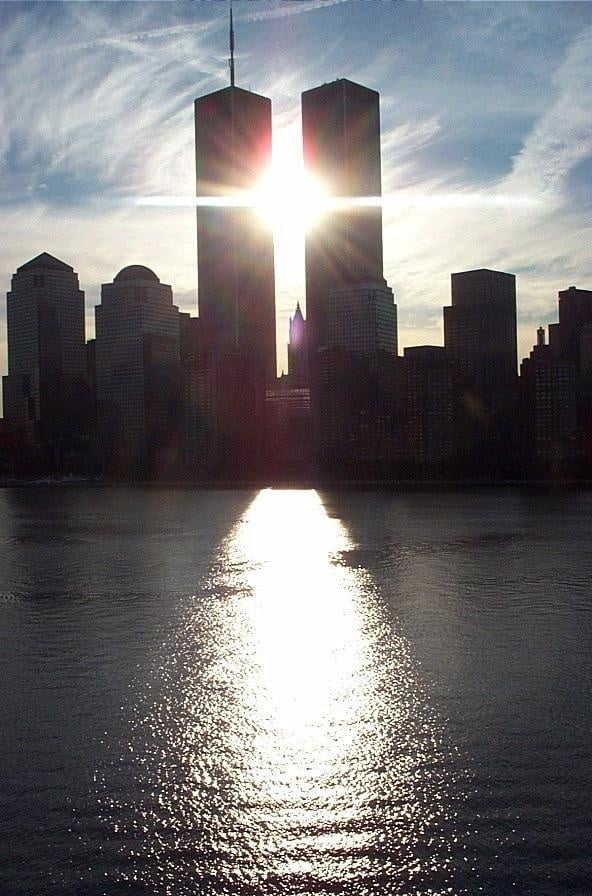
    For the tenth anniversary of the surreal, unforgettable events of September 11, 2001, Philadelphia composer Robert Moran wrote his “Trinity Requiem” for the youth chorus of Trinity Wall Street, the so-called “Ground Zero church” in Lower Manhattan. This Sunday night on “The Lost Chord,” we’ll revisit this beautiful, consoling work and reflect on that September morning of twenty years ago – a morning that still feels like yesterday.

    Moran may not be the first artist that would spring to mind for anyone seeking musical solace. The merry prankster ethos runs deep in this pupil of Hans Erich Apostel, Darius Milhaud, and Luciano Berio. Moran gained early notoriety for his compositions on a grand scale, incorporating entire cities (including San Francisco, Graz, Austria, and Bethlehem, Pennsylvania), their automobiles, airplanes, skyscrapers, radio and television stations, marching bands, dancers, theatrical groups, and tens of thousands of performers.

    He’s written works for harpsichord and electric frying pan, and any number of performance art pieces, including one, archived on YouTube, that involves musicians walking around a financial district with slide whistles inside giant paper bags.

    Flirting with respectability, he collaborated on an opera, “The Juniper Tree,” perhaps the grimmest of Grimm fairy tales, with Philip Glass, and he has composed a number of other works for the stage, including “Desert of Roses” (after Beauty and the Beast), for Houston Grand Opera, and “Alice” (after Lewis Carroll), for the Scottish Ballet. He’s currently at work on a monodrama about God.

    Given Moran’s freewheeling reputation, I thought it only appropriate to title this week’s show after one of Salvador Dali’s most famous paintings, “The Persistence of Memory” – both for its surreal associations (a dreamscape of melting watches) and for the deep psychological scars left by the deadliest attacks ever perpetrated on American civilians.

    Moran rises to the occasion to provide an ethereal masterpiece, a 30-minute journey to Paradisum, worthy to stand alongside the transcendent Requiem of Gabriel Fauré.

    “Trinity Requiem” received its first performance at Trinity Wall Street on September 7, 2011. The second performance took place in St. Paul, Minnesota, on the actual anniversary of the attacks. Locally, it was performed by Mendelssohn Club, at the Basilica of Saints Peter and Paul, on Logan Square in Philadelphia, in 2012.

    A compact disc was released on the innova Recordings label, with the Trinity Youth Chorus and members of the Trinity Choir, Trinity Wall Street, under the direction of Robert Ridgell.

    Among the handful of miracles that occurred on a day of unthinkable tragedy, a hundred-year-old sycamore tree preserved the church’s St. Paul Chapel, constructed in 1766, from destruction by debris from the World Trade Center, including what would have been a direct hit from a falling I-beam.

    On tonight’s broadcast, “Trinity Requiem” will be prefaced by a conversation with the composer. In the time remaining we’ll also hear Moran’s dreamlike “Notturno in Weiss” (“Nocturne in White”), on an aphoristic text by Christian Morgenstern.

    Find solace in the purity of music, as we continue to grapple with the legacy of 9/11, this Sunday night at 10:00 EDT, on WWFM – The Classical Network and wwfm.org.

Tag Cloud

Aaron Copland (93) Beethoven (95) Composer (114) Film Music (136) Film Score (143) Film Scores (255) Halloween (94) John Williams (195) KWAX (229) Leonard Bernstein (103) Marlboro Music Festival (125) Movie Music (151) Mozart (88) Opera (207) Philadelphia Orchestra (89) Picture Perfect (174) Princeton Symphony Orchestra (108) Radio (88) Ross Amico (244) Roy's Tie-Dye Sci-Fi Corner (290) The Classical Network (101) The Lost Chord (268) Vaughan Williams (103) WPRB (396) WWFM (881)

DON’T MISS A BEAT

Receive a weekly digest every Sunday at noon by signing up here


RECENT POSTS