Category: Daily Dispatch

  • Them! Giant Ants Invade Roy’s Sci-Fi Corner

    Them! Giant Ants Invade Roy’s Sci-Fi Corner

    This Memorial Day weekend, I hope you’ll join us at a special time, as the U.S. brings all its might and intelligence to bear against invading giant ants. Now that’s one hell of a picnic!

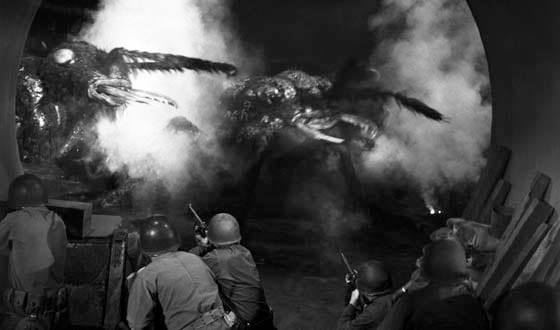
    The Army, FBI, top scientists, and local law enforcement all coordinate to save our bacon without a single rumble of conspiracy. Furthermore, the citizenry accepts lockdown with a degree of maturity and responsibility inconceivable in 2021. Temporarily deferred freedoms are always most easily assimilated when the sewers are flooded with giant ants. For once, it’s all of us against “Them!” (1954).

    Easily the best and most intelligent of the nascent Atomic Age giant bug movies, “Them!” manages to get everything right: a solid cast, good pacing, pitch perfect tone, and truly crawly animatronics. Keep a sharp eye out for walk-ons by fresh faces soon to become weekly regulars in living rooms across America, actors like Leonard Nimoy, Dick York, Richard Deacon, and William Schallert. Basically, anyone wearing an Army helmet is on the cusp of fame. Fess Parker makes the most memorable impression in a single scene that supposedly secured his casting as Davy Crockett.

    Of the principals, Academy Award nominee James Whitmore bands together with James Arness (the extraterrestrial menace in “The Thing,” soon to embark on the gig of a lifetime as Marshal Matt Dillon on “Gunsmoke”) and everyone’s favorite Kris Kringle, Academy Award winner Edmund Gwenn. Gwenn plays a somewhat absentminded, but wholly authoritative and respected myrmecologist. In the 1950s, apparently, people still believed in science. A film that could very easily have turned into “Santa Claus Conquers the Giant Ants” instead winds up being probably one of the top-five science fiction movies of the decade.

    Furthermore, its influence can still be felt in everything from the “Alien” franchise to any number of CGI giant bug fests of the past 25 years. This is one movie that really has legs!

    Nevermind those Brood X cicadas – there will be plenty of high-frequency, outsized shrieking, as we chat about “Them!” on the next Roy’s Tie-Dye Sci-Fi Corner. Leave your songs and whistles in the comments section, as we livestream on Facebook, this Sunday evening at 7:00 EDT!
    https://www.facebook.com/roystiedyescificorner/

  • Sibelius Rediscovered Avanti Orchestra Concert

    Sibelius Rediscovered Avanti Orchestra Concert

    Earlier this week, the Avanti Chamber Orchestra shared the modern premiere of a rediscovered Sibelius “Concert Overture” on its Facebook page.

    Today the complete concert will stream at 12 pm (EDT). Also on the program will be other Sibelius rarities (a suite from his incidental music to “Belshazzar’s Feast” and the melodrama “The Countess’ Portrait”) and the “Conte fantastique” for harp and string orchestra by André Caplet, after Edgar Allan Poe’s “The Masque of the Red Death.” If you miss it, I assume the concert will be archived on Avanti’s Facebook page.

    For more information:

    Avanti! conducted by Tuomas Hannikainen resurrects Sibelius work dormant for 120 years

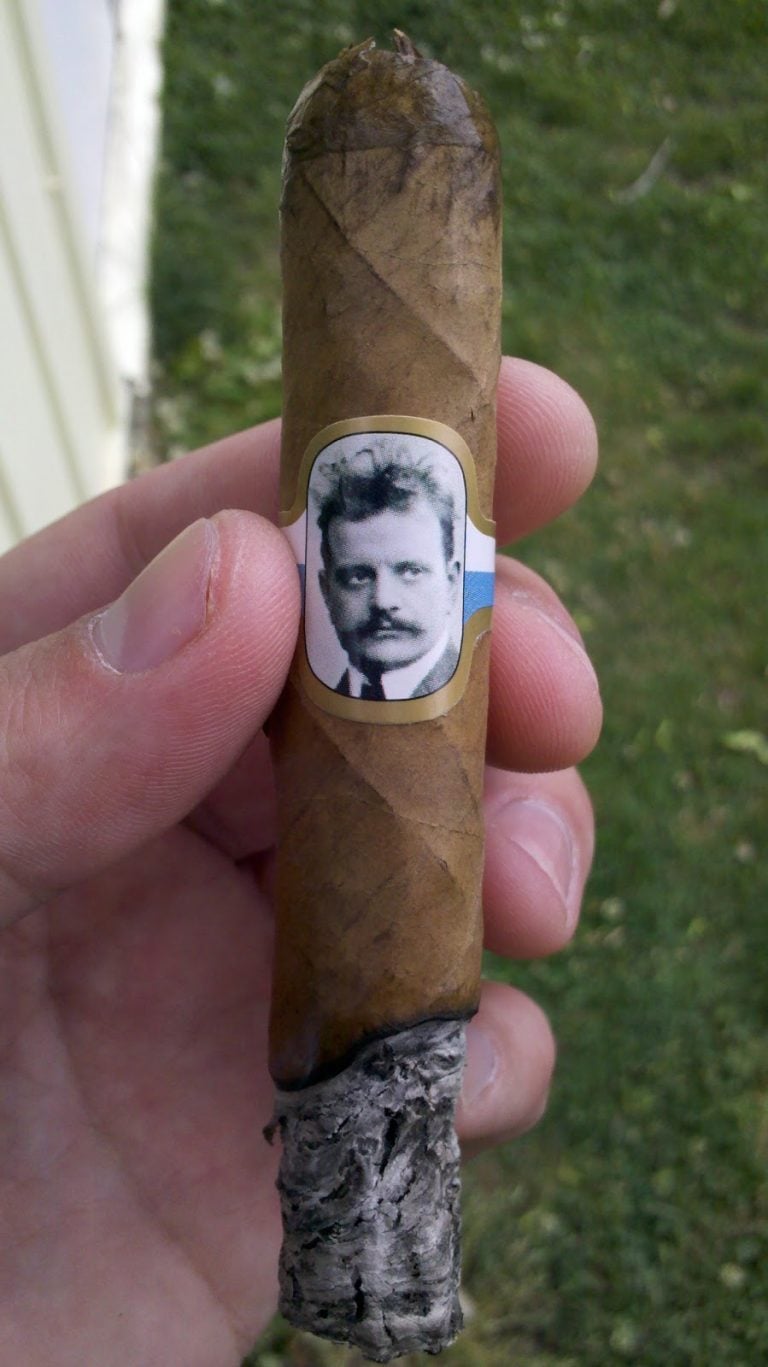
    While you’re waiting, enjoy this brief review of a Sibelius cigar by Zack the Stogie Man!

    http://zackthestogieman.blogspot.com/2012/04/jean-sibelius-review.html

  • Memorial Day Symphonies on WWFM

    Memorial Day Symphonies on WWFM

    This Sunday night on “The Lost Chord,” get ready for Memorial Day with two symphonies composed for the armed forces.

    Morton Gould wrote his Symphony No. 4, his first large scale piece for symphonic band, in 1952, for the United States Military Academy at West Point. The score calls for a “marching machine,” but on the recording we’ll hear, now a classic on the Mercury label, the feet are those of the 120 musicians of the Eastman School Symphony Band. Frederick Fennell directs the Eastman Wind Ensemble.

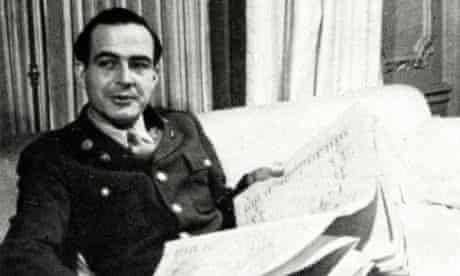
    Samuel Barber composed his Symphony No. 2 in 1943, while he was serving in the U.S. Army Air Force. 20 years later, he revised and published its slow movement as a separate piece, titled “Night Flight.” He then jettisoned – and actually tried to destroy – the rest of the symphony. The work was reconstituted only after the composer’s death, from rediscovered parts in a warehouse in the UK. We’ll hear a recording with Marin Alsop and the Royal Scottish National Orchestra.

    Reflect on the sacrifice of Americans at war, on “Orchestrated Maneuvers” – American military symphonies for Memorial Day – this Sunday night at 10:00 EDT, on WWFM – The Classical Network and wwfm.org.


    PHOTO: Corporal Samuel Barber with the score of his Second Symphony

  • Korngold Errol Flynn Hollywood Composer

    Korngold Errol Flynn Hollywood Composer

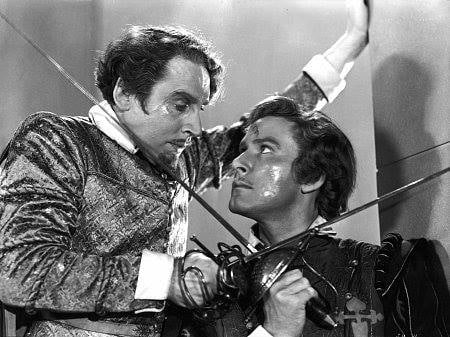
    May 29 marks the birthday of one of my favorite composers: Erich Wolfgang Korngold (1897-1957). Thanks to a steady diet of Errol Flynn films, Korngold will forever be a part of the soundtrack to my life.

    Korngold went from being one of Europe’s most astounding musical prodigies – his works admired by Mahler, Strauss and Puccini, and championed by Schnabel, Weingartner and Klemperer – to becoming one of Hollywood’s transformative film composers. He is a link from Old World opulence to New World fantasy, his music gracing a number of Warner Brothers’ classic historical adventures.

    The best ones starred Flynn, and this week on “Picture Perfect,” we’ll hear music from “The Sea Hawk” (1940) and “The Adventures of Robin Hood” (1938), as well as the mostly forgotten “Another Dawn” (1937). Flynn stars alongside Kay Francis and Ian Hunter (who would go on to play Richard the Lionheart in “Robin Hood”) in this love triangle involving pilots in a British desert colony.

    The film may be an obscurity to all save classic movie buffs, but Korngold thought enough of his music that he salvaged the main title as the opening theme of his Violin Concerto, premiered by Heifetz in 1947.

    It was an invitation from theatrical impresario Max Reinhardt that brought Korngold to Hollywood in the first place, for a cinematic adaptation of “A Midsummer Night’s Dream” (1935). The film stars James Cagney, Dick Powell and Olivia de Havilland, in her big screen debut, with Mickey Rooney an irrepressible Puck.

    For the project, Korngold adapted the famous incidental music of Felix Mendelssohn, interweaving material from Mendelssohn’s symphonies and orchestrating some of the “Songs without Words.” Even so, the music bears the composer’s unmistakable stamp, as you’ll hear in the opening number, lifted from the “Scottish Symphony,” but infused with plenty of Korngoldian swagger.

    I hope you’ll join me, as the playlist is all-Korngold this week, on “Picture Perfect,” music for the movies, this Saturday evening at 6:00 EDT, on WWFM – The Classical Network and wwfm.org.

    Happy birthday, EWK!

  • Sibelius Rediscovered: Maiden in the Tower Overture

    Sibelius Rediscovered: Maiden in the Tower Overture

    Yesterday’s modern premiere of a Sibelius overture, said to have been rediscovered in the manuscript of the composer’s one-act opera, “The Maiden in the Tower,” sent me back to a complete recording of the stage work.

    At 35 minutes, Sibelius’ grandiose music is too much for the slight libretto – a simple story about a damsel in distress, a lecherous bailiff who abuses his authority, the maiden’s devoted lover, ready to defend her to the death, and a deus ex machina in the form of the castle’s justice-loving chatelaine. As a secular cantata, I can see how this might be regarded as something of an action-packed potboiler, a pre-Raphaelite painting in sound; but as “opera,” there’s no way. The whole thing just buckles. How I wish the composer had followed through on his earlier design of a grand opera after the Kalevela.

    What I didn’t understand until today’s reencounter with a work I have not listened to in years is that the resurrected overture – not to be confused with the opera’s brief orchestral prelude – is basically a compilation of material that already exists within the larger piece. It doesn’t, however, explain away the overture’s potpourri character, since the prelude and first scene are presented, as near as I can tell, as is, within the “new” work. It rather puts me in the mind of the overture to Vaughan Williams’ “The Poisoned Kiss,” in form rather than character, since both are basically constructed on tunes from the opera.

    It was the conductor of yesterday’s modern premiere, Tuomas Hannikainen, who, as a doctoral candidate, discovered not a separate score, but rather handwritten clues left by the composer on the opera itself suggesting a new orchestral work, or “overture,” hidden within the piece. So basically, that’s the story behind this Sibelius rediscovery. The composer is said to have conducted a couple of performances of the work back in 1900. The 12-minute overture should not be confused with the three-minute prelude to the opera.

    Sibelius suppressed “The Maiden in the Tower” after a few early performances in 1896, with the intention of revising the entire work, which he never got around to addressing. Indications for the new overture may have been the composer’s attempt to salvage some of the best bits from the opera. After all, material from an earlier, incomplete opera, “The Building of the Boat,” was recycled in his “Four Legends from the Kalevala” – with “The Swan of Tuonela” forming the opera’s original prelude – and his symphonic poem “The Wood Dove.”

    Yesterday’s performance of the overture reconstructed from “The Maiden in the Tower” is now posted on the YouTube channel of the Avanti Chamber Orchestra. If I understand correctly, a complete concert will be made available there on May 30, which will include not only this “premiere,” but also Sibelius’ melodrama “The Countess’ Portrait” and a suite from his incidental music to “Belshazzar’s Feast.” Also featured will be André Caplet’s “Conte fantastique” for harp and string orchestra, after Edgar Allan Poe’s “The Masque of the Red Death.”

    For more information, visit the Avanti website.

    Avanti! conducted by Tuomas Hannikainen resurrects Sibelius work dormant for 120 years

    Whatever this overture is, I am glad to have heard it!

    A complete recording of “The Maiden in the Tower”


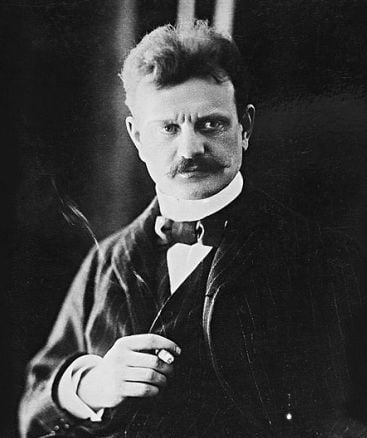
    Sibelius, enjoying a smoke, circa 1900

Tag Cloud

Aaron Copland (93) Beethoven (95) Composer (114) Film Music (136) Film Score (143) Film Scores (255) Halloween (94) John Williams (195) KWAX (229) Leonard Bernstein (103) Marlboro Music Festival (125) Movie Music (151) Mozart (88) Opera (208) Philadelphia Orchestra (89) Picture Perfect (174) Princeton Symphony Orchestra (108) Radio (88) Ross Amico (244) Roy's Tie-Dye Sci-Fi Corner (290) The Classical Network (101) The Lost Chord (268) Vaughan Williams (103) WPRB (396) WWFM (881)

DON’T MISS A BEAT

Receive a weekly digest every Sunday at noon by signing up here


RECENT POSTS