Category: Film Reviews

  • “Frankenstein”: It’s Alive

    “Frankenstein”: It’s Alive

    From some of the computer-generated chaos at the start, I was afraid I wasn’t going to like Guillermo’s del Toro’s “Frankenstein.” I guess I’m still smarting from Robert Egger’s remake of “Nosferatu.” But here my concerns were misplaced. As writer and director, Del Toro definitely puts his own spin on the source material, yet he manages to honor Mary Shelley’s 1818 classic. More importantly, the movie is full of heart. I don’t want to get anyone’s hopes up, but I wound up actually really liking it.

    I hasten to add, Del Toro’s approach is more Shelley than Karloff, even though he turns a lot of the original novel on its head. Don’t go into it expecting any “scares.” This is a movie that explores the nature of humanity and man’s overweening desire to push into the unknown without considering the morality of doing so or assuming responsibility for the consequences. It is, after all, “Frankenstein.”

    But these underpinnings are not simply brushed aside so that the filmmakers can get on with the killings, as is the case with so many of the movies. It has one of two gruesome moments, for sure, but the lens doesn’t linger. Rather, it is a thoughtful, literary, even philosophical movie, with layers of allusions and symbols that fit hand-in-surgical glove with the narrative.

    Oscar Isaac plays the haughty, frustrating scientist, Shelley’s “modern Prometheus,” as maddening as he is mad. His rearing of his creation proves here to be the product of cyclical abuse. The theme is skillfully assimilated and has a nice payoff. Tragedy is woven right into the story, of course, but this is one Frankenstein movie that actually leaves one with a glimmer of hope. Del Toro has loved this story – and “the creature” – since childhood, and clearly he’s internalized everything. Like Victor Frankenstein himself, he’s discovered the source of its life; but unlike Victor he also recognizes its soul.

    I have no idea who Jacob Elordi, who plays the creation, is, but he is a wonder. His performance makes the movie. I note he’s also going to be playing Heathcliff in an impending, overheated adaptation of “Wuthering Heights,” with Margot Robie trading on her “Barbie” good will. From the trailer, it looks as if it totally misses the point of Emily Bronte’s novel. But here, Elordi is excellent. As with “The Shape of Water,” Del Toro proves that he can be much more than simply a technical director, eliciting fine performances from his leads.

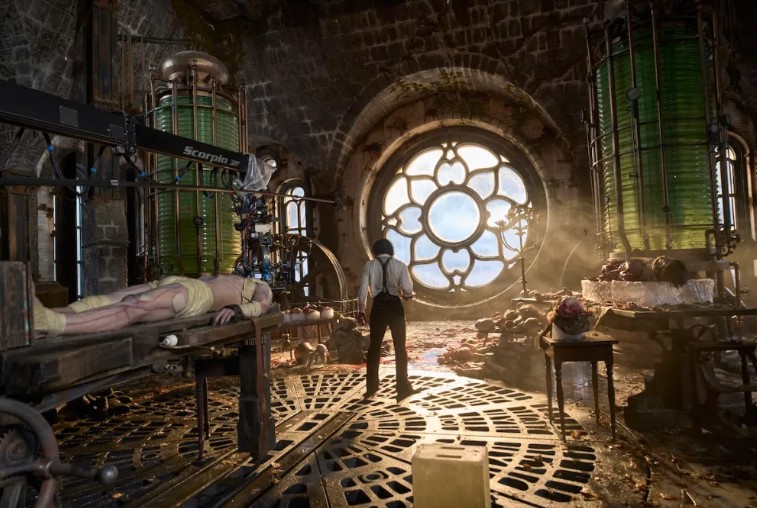
    That said, I would be remiss if I didn’t also mention how sumptuous a production this is. Every detail is fully realized, from the vibrant costumes to the outrageous and eyepopping sets, digital or otherwise. The lavish estates, the streets of Edinburgh, the frozen battlefields, the Thomas Eakins medical theater, the steampunk lab, and the arctic wastelands all look fabulous, often operatically stylized, but all of a piece. The production design more than compensates for a few moments of shaky CGI, with cartoonish flying bodies and pouncing wolves.

    Why, oh why, aren’t they making it easier for people to see this in a theater? This practice of showing a film for a very limited run in just a few venues so that it qualifies for Academy Awards consideration before consigning it to streaming on Netflix as “content” is more monstrous than anything in the movie.

    Beyond the all-too-rare experience these days of enjoying the film on a big screen with an engaged audience, it was such a pleasure to be able to sit there during the end credits and to be able to ruminate on what I had just witnessed to Alexandre Desplat’s evocative score. That is a part of the moviegoing experience that is so tragically undervalued in the streaming age. So much of a movie’s impact is cemented in those few minutes at the end, when you just allow it all to sink in.

    I hope you will follow my advice and don’t google anything about it, if you haven’t done so already. It’s best to experience it fresh. It’s a beautiful movie, visually and emotionally alive, with good performances, and I highly recommend it.

    “Frankenstein” comes to Netflix tomorrow, but if you can see it in a theater, go.

  • “The Sonata”: Mr. Horror’s Opus

    “The Sonata”: Mr. Horror’s Opus

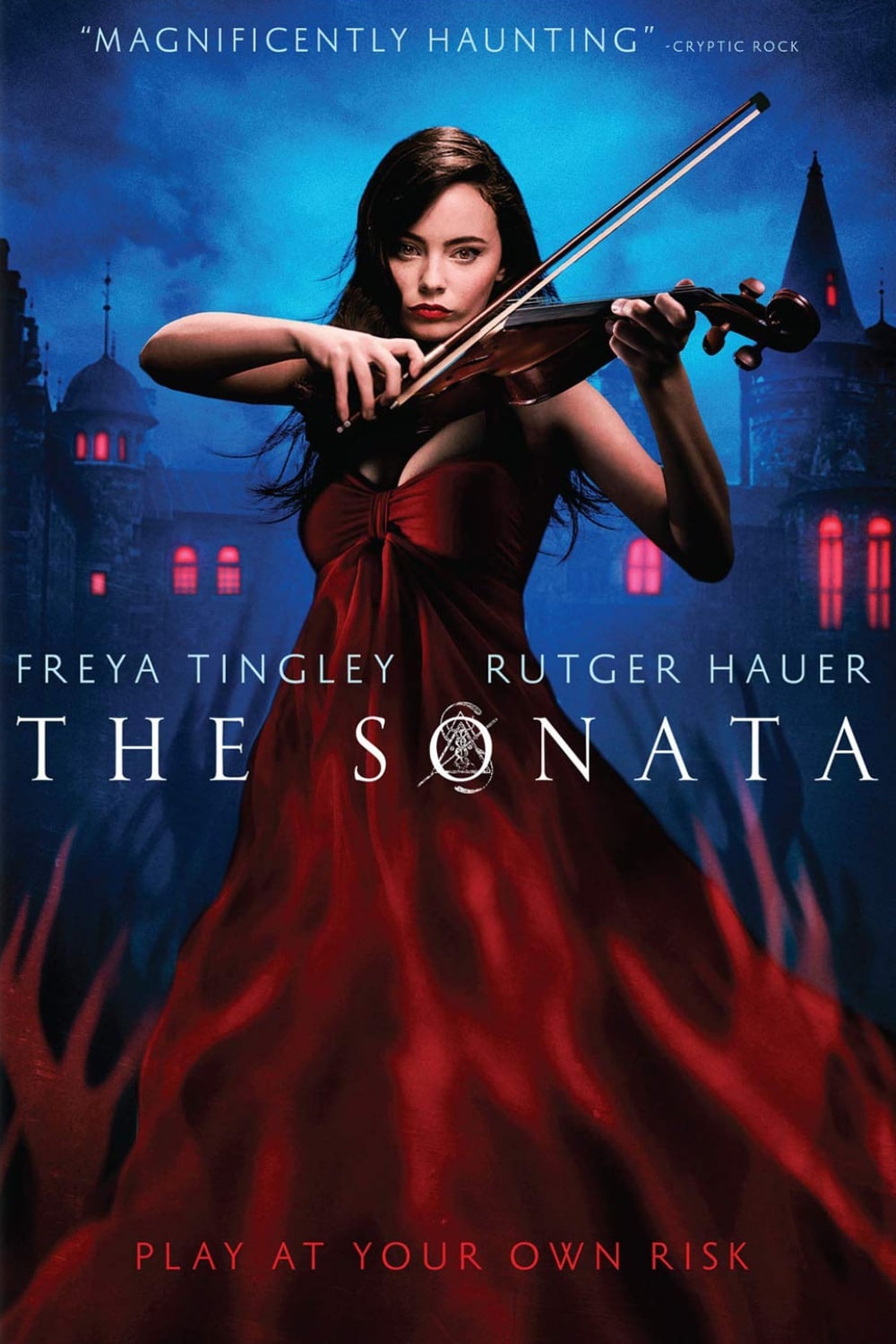
    Paganini. Liszt. Warlock. Classical music has plenty of sulfur for anyone looking for Faustian inspiration. If longhair music is your thing, chances are you’ll find “The Sonata” (2018) a hoot. Especially for Halloween.

    The film opens with Tartini’s “The Devil’s Trill,” naturally – Satan’s most infamous gift to the field. (It came to the composer in a diabolical dream.)

    Rutger Hauer plays a reclusive, disproportionately revered, and somewhat sinister British composer by the name of Richard Marlowe (surely named for Christopher Marlowe of “Doctor Faustus” notoriety). When Marlowe dies by his own hand, we learn from the story’s heroine, violinist Rose Fisher (Freya Tingley), of their secret bond, which sends her to France to leisurely poke around his 11th century château. Discovered in his desk, under lock and key, is his final composition, a violin sonata, that sets Rose’s manager, Charles (Simon Abkarian), salivating.

    And here’s where we take one step further into some unintentionally bizarre alternate reality, as Charles actually believes that this discovery is the “big break” he has been dreaming of his entire career. “Rose,” he says, “you do know, if this is your father’s final work, it could be a huge sensation.”

    If you’re not scratching your head yet, “The Sonata” is set in a modern world where haunted mansions and medieval grimoires coexist with a widely-relevant classical music culture – where major record labels are still subsidizing recordings by important artists and the discovery of an unknown manuscript by a contemporary composer is enough of a windfall to ensure fame and fortune for those who inherit the copyright and control its promotion. It’s a world where Shostakovich is name-dropped and Yehudi Menuhin is used as a comparative is newspaper headlines. A world where composers are still interviewed on television talk shows. In short, a world that hasn’t existed since the 1980s.

    Furthermore, disulfiram hasn’t commonly been used to treat alcoholism since the 20th century. Yet this clearly is not intended as a period piece. In fact, it may be the first film I’ve seen with someone talking on a cell phone in a haunted house.

    Director Andrew Desmond, whose first feature this is, evidently picked up a trick or two from Robert Wise, who helmed, for my money, the most chilling of haunted house thrillers, “The Haunting,” made all the way back in 1963. There are low-angle shots of the house, gloomy close-ups of portentous statuary, disembodied children’s laughter, and creepy turning doorknobs. It also reminds me a bit of “The Legend of Hell House” (1973), with the spirit of a departed sadist – in the former, played by Christopher Plummer; in this one, Hauer – looming spookily over the proceedings.

    Hauer, whose last completed film this is, only has a minute or two of screen time, but he’s never out of our consciousness, thanks in large part to audio and video recordings (cassette tape… really?) and a portrait that dominates the mansion library. Is anyone really surprised when the old man turns out to be a modern-day Gilles de Rais? Thankfully, Marlowe’s misdeeds are conveyed by way of suggestion, which is more than enough, thank you. And you just know that the sonata, with its arcane symbols sprinkled in amidst the standard notation, is going to be used to conjure the Antichrist.

    The film is well-made, with good production values, and on the whole, good acting. James Faulkner is especially fine as an authority on Baroque music and the occult. He does a lot with his one or two scenes, and I wish he had played a larger part, with his authoritative voice and forked goatee. The movie doesn’t go into it, but there really were a lot of artists, writers, and composers tied up in the occult in the U.K. in the late 19th and early 20th centuries. I know I’ve written about it. I’ll link one of my posts about the Hermetic Order of the Golden Dawn below.

    Abkarian is good too, skillfully navigating a role that requires some spackling over of the cracks in what could have been a much flimsier suspension of disbelief.

    A few quibbles from a classical music perspective:

    Why is Rose recording Wieniawski’s Violin Concerto No. 1 without an orchestra? If it’s supposed to be at a separate session – for a patch, perhaps? – shouldn’t she at least be wearing headphones?

    When Rose discovers Marlowe’s sonata, why does she try it out at the piano instead of picking up the violin that is precariously propped on a chair right next her? Beyond setting us up for a M. Night Shyamalan moment, that is?

    How is the violinist Charles consults to assess the unknown sonata able to surmise so much about its content and structure from merely flipping through the score?

    Finally, would a professional violinist really allow a taxi driver to unpack her instrument from the trunk of his car?

    Fortunately, in a film that places so much emphasis on music, Alexis Maingaud’s score is of a considerably higher caliber than what is usual in movies today, serving as more than just sound design, with an 80-piece orchestra – although at times electronically modified – and actual melodies. (Olivier Leclerc plays Rose’s violin solos.) Amusingly, the composer receives a cameo of sorts: look sharp for his name on the digital display of a sound system as Charles unwinds to some jazzy saxophone music. (Relatedly, the director’s voice can be heard as Marlowe’s interviewer on an archival videotape.)

    Best of all is the selection from one of Marlowe’s compositions (played from CD), “The Double Life of Persephone,” which is spot-on for a post-romantic concert piece. If the music isn’t lifted from an actual concert composer, it is wholly convincing, and I for one would like to hear more! The title suits the film thematically, of course, as Persephone, the Queen of Hades, spends half her time in the underworld.

    In an interview I turned up (an actual interview this time, as opposed to a fictional one), Maingaud confesses his admiration for Jerry Goldsmith. Bernard Herrmann too is mentioned. So his head is in the right place. A former classmate of the director at Sorbonne University, he is also fairly close to the start of his career. I hope to hear more from him and that he doesn’t just disappear the way his compatriot, the French composer Ludovic Bource, seems to have done, in this country anyway, after winning an Academy Award for his music for “The Artist” (2011).

    By now, we all know the Gothic tropes and trappings of the old, dark house. The fixtures are mahogany, the keys are iron, and the lofty staircases navigated by candelabra. How many times does the heroine have to soak in a leisurely bath, in a clawfoot bathtub by candlelight, in a big “empty” manor, or wander the stairs in a silk peignoir? There are a few scenes, especially one in which Rose explores a grotto by striking matches that make me wonder why she doesn’t simply use the flashlight function on her cell phone.

    To his credit, Desmond leans into slow-burn mystery and atmosphere, which personally is what I really value in a ghost story. But horror cliches abound and the manufactured jump scares become more risible (with the exception of one or two) as the film progresses. Most of them seem as if they might have been afterthoughts, dreamed-up in post-production and achieved by inserting musical stings and sound effects.

    Then, just when I fully believed Desmond had learned his lesson well – that the less seen, the scarier the unfathomable becomes – he drops his cards to the floor and blows it in a climactic scene that must be the biggest letdown in a movie of this sort since “The Ninth Gate” (1999). This is one film that could have done without the CGI. I was hoping for something a little less literal and a little more… uncanny.

    But hey, if your flawed film is being compared to Roman Polanski, it’s still something to be proud of. If you don’t remember, “The Ninth Gate” dealt with Satan and rare books. It’s been a quarter century since I’ve seen it, but I think I like this movie better.

    With a stronger ending, “The Sonata” could have become a wink-and-a-nudge Halloween classic for classical music folk. Still, I’d be lying if I were to say I didn’t enjoy being seduced into this fantasy world where books and music are treated as matters of life and death.

    I got an additional chuckle out of it, as there is also the grave revelation of a secret society devoted to the dark arts that calls itself the Famulus Order. Famulus was the name of the book business I ran in Philadelphia for 13 years. (I’m only just now noting the numerical significance!) And yes, my logo was ripped from a 17th century woodcut of some guy in Elizabethan breeches swapping books with the Devil.

    Unfortunately, after leading us down a lot of compelling, creepy corridors, “The Sonata” drops us at a dead end. With the big build-up and weak fizzle, I couldn’t help but think of another film, one starring Richard Dreyfuss, from about 30 years ago, that pretty much did the same thing, teasing the audience and building expectations for a climactic musical masterpiece, the protagonist’s life’s achievement, which in the end turns out to be a three-minute wet noodle. In the case of “The Sonata,” they might just as easily have called it “Mr. Horror’s Opus.”

    “The Sonata” is streaming free on Amazon Prime and Tubi and, for all I know, elsewhere. It’s a fun movie for classical music fans; just not the enduring genre favorite it could have been.


    Interview with composer Alexis Maingaud

    TALKING TO COMPOSER ALEXIS MAINGAUD.

    One of my posts on occultism and English music

    https://www.facebook.com/photo/?fbid=1193772614875133&set=a.883855802533484
  • Jane Goodall Good for All

    Jane Goodall Good for All

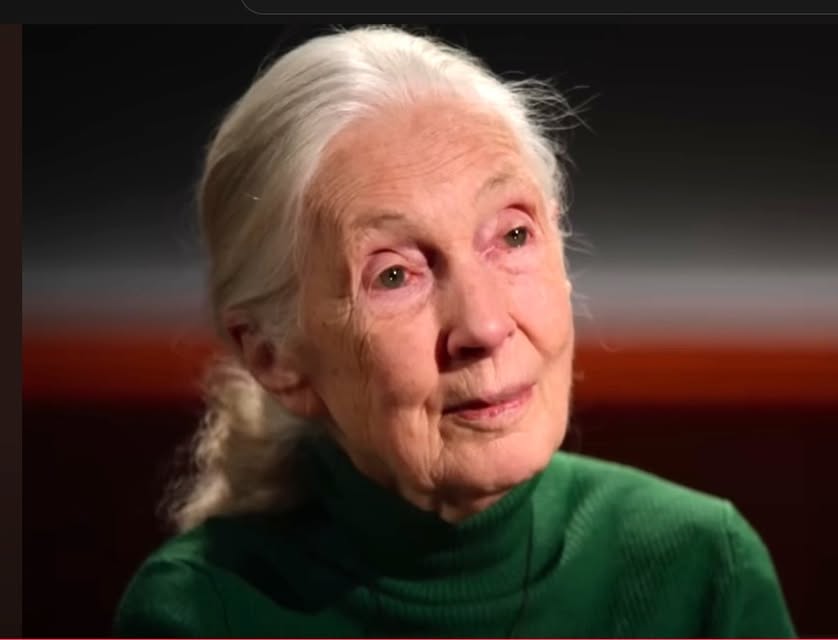
    If you have Netflix and you haven’t watched this yet, you should. It’s 55 minutes very well spent. The interview was recorded with the specific intention to offer it for streaming after Jane Goodall’s death.

    There are few surprises – she was a genuinely good person, and a wise one – but she’s magnetic in her serenity and honesty and insight. In particular, her true last words, after the interviewer gets up and leaves the room at the end and she’s left alone with the remotely-operated cameras, are important for everyone to hear. I don’t care what political axe you may have to grind, if any. If you aren’t touched by her humanity, I am sorry for you.

    I’ve refrained from saying anything about her death, because it’s outside the arts and not really in my wheelhouse – but it is, really, since her mission was always a holistic one and what happens to any of us affects all of us, human or animal.

    Don’t react to anything you may have read in the press or on social media about what she says in the interview. There’s too much tendency in the modern world to have kneejerk reactions to soundbites. Real life isn’t tabloid news, and Jane encourages us to really listen to one another. I hope you will watch and listen and really take it all in.

    There’s no questioning that hers was a life well-lived. I hope her vision of what the Hereafter may hold for her spirit has come to pass. If anyone has earned it, she has.


    Just a clip from “Famous Last Words: Dr. Jane Goodall”:

    On Netflix here:

    https://www.netflix.com/title/82053197

  • Perceptive, Gorgeous, and Deeply Moving, “Billy & Molly: An Otter Love Story”

    Perceptive, Gorgeous, and Deeply Moving, “Billy & Molly: An Otter Love Story”

    I confess, at first I was a little hesitant to watch the documentary “Billy & Molly: An Otter Love Story,” given its National Geographic TV premiere earlier this month (now with other streaming options). Anything to do with animals always gets me right in the heart. Even if there’s not death, there’s bound to be separation, and nothing has the potential to devastate me like separation from an adorable otter. I was taken to see “Ring of Bright Water” when I was a kid, and I think it must have traumatized me for life. If the film doesn’t end with an otter wearing a houndstooth vest having tea with a guy, chances are I probably won’t be able to handle it.

    I am proud of myself, then, that, the likelihood of sobbing be damned, I committed to viewing it. This artistically-framed, gorgeously-shot, deeply-moving film not only delivers on the promise of love, but is full of wonder and wit and, yes, depending on your level of sensitivity, pretty much guaranteed to have you furtively wiping away a few tears as it quietly restores your faith in humanity.

    A lost otter turns up on a man’s dock outside his home in the Shetland Islands (the northernmost region of the United Kingdom). It’s undernourished and unsteady and wrestling to get meat out of a crab. The man, Billy, quickly deduces this must be the pup of a mother otter he had seen dead at the side of the road. He has no idea what to do, but he decides to name the pup Molly, and his little, loving gestures deepen into a kind of paternal bond. They also have evident effect, as Molly begins to regain her health and, in her way, repay the investment. Soon Billy and the otter are inseparable.

    What follows is a parallel revivification of both their lives, and also a revitalization of the lives of Billy and his wife, Susan. The movie is as much about the human couple, who take turns narrating the film, as it is about the otter who changes them. Seesawing between patience and exasperation, Susan assists with the installation of a second freezer, as the first has been packed solid with haddock for Molly. At the same time, she shrewdly observes the transformative effect this unusual friendship is having on her husband. A later wrinkle, concerning the installation of WiFi, is hilarious.

    The film’s tone is simple, occasionally wry, and unsentimental, as stoic as Billy is, in fact, understanding that all the warmth and emotion is inherent in the story itself. At points, narrative is stripped away entirely, and we are left only with the beauty of loving interaction. Okay, there are one or two places where you may be overwhelmed by cuteness. I don’t want to ruin anything for you, but just imagine what kind of shelter Wes Anderson might create if he were to befriend a wild otter.

    There’s also an unflappable sheepdog named Jade, who just loves her ball so much, carrying, catching, and headbutting it everywhere (including in a highly-amusing, fabricated dream sequence).

    Director Charlie Hamilton-James finds beauty everywhere. What could be less prepossessing than the idea of winter in sub-arctic Shetland, you might think? But Hamilton-James discovers poetry in raging black seas and austere crags, and amusement and philosophical reflection in a local ceremony involving the ritualistic construction and destruction of a Viking longboat.

    It might be tempting to dismiss Billy’s job at a utility plant as soul-crushing. But again, Hamilton-James frames his visuals such as to imbue the hard hats, the file boxes, the blast furnaces, and the grapple claws with an appealing dignity. There’s organization and purpose to be found even in Billy’s tendency to fold his empty crisps bag into what any American school kid would recognize immediately as a triangular “football.”

    Billy and Susan text back and forth during the course of his workday, as he checks in on Molly. In the meantime, Susan puts together the puzzle pieces of the widening scope of the otter’s freewheeling adventures.

    The human race as a whole may be a lost cause, but every once in a while, one of us exhibits a little grace. That’s certainly the case here with Billy, and God bless him for it. I don’t care what this man’s politics are, how he worships, or what goes on in his bedroom. As Susan observes, “I would rather have a man who cares than one who doesn’t.” What’s important is that Billy cares about the right things.

    He’s so laconic, he would never say so, but his love for Molly is evident from the start. She awakens his paternal instincts, as he does the best he can in the roles of protector and teacher. Ultimately, however, the dynamic flips, and it is Molly who opens Billy’s eyes to the expansive beauty of the world around them – there’s a point where he recognizes a dead animal as another being, “just like us,” as opposed to simply gull food – and he learns the important lesson that the supposed barrier between man and nature is, in the end, a fiction.

    The film makes a powerful conservationist argument while at no point lecturing about conservation. What words are there to equal the persuasive impact of the sublime drone aerial footage and underwater photography? The images, the narrative, the moving simplicity of this love story between man and animal, all speak for themselves.

    “Billy & Molly: An Otter Love Story,” at 1 hour and 17 minutes, is a lesson in trust and the appreciation of simple things and how powerful and transformative they can be. Human and animal, we’re all in the same boat – in this case, quite literally! – and everything is so exquisitely beautiful and fragile.

    I can’t even make it through the trailer now without getting choked up. If you want to feel hopeful about people, our place in the world, and what it means to be alive, watch this movie.

  • No, Giorgio!

    No, Giorgio!

    How could it miss?

    In the run-up to Ron Howard’s documentary about Luciano Pavarotti (release date: June 7), I got to thinking about “Yes, Giorgio” (1982). The most charismatic tenor of his day made his non-operatic, big-screen debut in this Franklin J. Schaffner-directed film. You know, the same Franklin J. Schaffner who directed “Patton?”

    Franklin, you magnificent bastard, I saw your movie…

    Here’s the premise: Operatic superstar Giorgo Fini (Pavarotti) is on tour in the U.S., when the unthinkable happens – he loses his voice! Naturally his manager engages a throat specialist, played by Kathryn Harrold (Giorgio thinks she is a nurse, ha ha), leading to much risible “repartee.” Not at all believably, the two fall in love. But of course there are complications. Giorgi IS Italian, after all.

    Okay, so the premise is creaky. Is there any opera? Oh yes there is, including Luciano, as Calaf, belting out “Nessun dorma” at the peak of his powers. But to get there you have to slog through countless scenes of Pavarotti, with a face as open and as ingratiating as that of a golden retriever, trying to compensate for a horrible script by charming the socks off everyone in the room. Let’s face it: he may have had a voice from the heavens, but Pavarotti is no dramatic actor. Fortunately, there is also comic relief, courtesy of “Green Acres’” Eddie Albert (just to keep it real). And not to worry, there is a pie fight.

    I guess there was no room in the $21 million budget – or his schedule – for John Williams to provide a complete music score (Michael J. Lewis does the dishonor), but Williams does contribute an Oscar-nominated song, “If We Were in Love,” with lyrics by the legendary Alan & Marilyn Bergman. Williams is in his element, and turns in a buoyant set-piece. In theory, this should have been a real showstopper.

    Alas, for all his lyrical gift, Williams is not a song composer, and even with (or perhaps because it is) Pavarotti singing, it turns out to be kind of embarrassing. It would be perfectly fine if it weren’t a song, but let’s face it, the balloon ride over Napa Valley ranks up there – or down there, as it were – with Margot Kidder reciting poetry to Superman.

    This was the same year as “E.T.,” by the way.

    Ironically, the original soundtrack is now a collector’s item. The belated domestic CD reissue was shorn of the Oscar-nominated song. Williams, the Bergmans, and the Pavarotti estate must want this one buried deep.

    “Yes, Giorgio” sank like a stone. Taking into account promotional and distribution costs, it lost MGM an estimated $45 million. Siskel and Ebert selected it as one of the worst movies of the year, and the film was nominated for multiple Razzies. Ebert claimed that Pavarotti utters the line, “I will sing this aria just for you!” a dozen times. The film opens with the following dedication: “This story is dedicated to lovers everywhere.” Oy vey.

    There’s so much talent squandered on this movie that I could easily be fooled into thinking I would like to watch it again. This is the most dangerous kind of bad.

    No, Giorgio!

    I am, however, very much looking forward to seeing Ron Howard’s documentary.

Tag Cloud

Aaron Copland (92) Beethoven (94) Composer (114) Film Music (116) Film Score (143) Film Scores (255) Halloween (94) John Williams (185) KWAX (228) Leonard Bernstein (99) Marlboro Music Festival (125) Movie Music (131) Opera (197) Philadelphia Orchestra (86) Picture Perfect (174) Princeton Symphony Orchestra (106) Radio (86) Ralph Vaughan Williams (85) Ross Amico (244) Roy's Tie-Dye Sci-Fi Corner (290) The Classical Network (101) The Lost Chord (268) Vaughan Williams (99) WPRB (396) WWFM (881)

DON’T MISS A BEAT

Receive a weekly digest every Sunday at noon by signing up here


RECENT POSTS