Life has gone so far over the top recently that even Puccini’s “Tosca” no longer seems farfetched. Once scathingly dismissed by musicologist Joseph Kerman as a “shabby little shocker,” this tale of love, politics, and the world’s most melodramatic diva is now so meta that the characters threaten to leap from the stage. If you’ve never seen it, well, never mind. Now’s your chance! One of the world’s most popular operas will be given three performances at The Princeton Festival, this Friday at 8:00, Sunday at 4:00, and Tuesday at 7:00.
Soprano Toni Marie Palmertree will sing the title role of the fiery opera singer who has a peculiar idea of what constitutes a kiss, tenor Victor Starsky her lover, the luckless artist Cavaradossi, and baritone Luis Ledesma, the slimy chief of police Scarpia. Puccini’s spinetingling score contains some of his most ardent, shattering music. And that is saying something!
The Princeton Symphony Orchestra, Princeton Festival Opera Chorus, and student singers of Princeton Middle School will be conducted by music director Rossen Milanov.
The opera will be presented in the state-of-the-art festival pavilion on the grounds of Morven Museum & Garden at 55 Stockton Street/Rte. 206.
Prior to the Sunday performance, Westminster Choir College’s Margaret Cusack and stage director Eve Summer will discuss the production in a special presentation at Morven’s Stockton Education Center at 2:15.
Of course, opera is not the only thing to look forward to this week. Tonight, Kentucky-born, classically-trained violinist Tessa Lark will introduce “Stradgrass” to Princeton. Lark went from playing in her father’s gospel bluegrass band to studies at the New England Conservatory and Juilliard. Her festival program will meld music by Telemann, Bach, and Ysaÿe with Appalachian and bluegrass licks. The concert will take place at Trinity Church Princeton at 33 Mercer Street (across the way from Morven Museum), beginning at 7 p.m.
Back under the Morven pavilion, and in between this weekend’s performances of “Tosca,” American Repertory Ballet will execute “An Evening of Pas de deux” accompanied by members of the PSO, again conducted by Milanov. On the program will be selections from Tchaikovsky’s “Swan Lake” and Minkus’ “Don Quixote,” along with Ethan Stiefel’s “Delibes Duet.” The dancing will begin this Saturday at 7 p.m.
Yet to come, next week: “Baroque Brilliance” with The Sebastians, Motown with Masters of Soul, “Viva Vivaldi” with violinist Daniel Rowland and cellist Maja Bogdanović, and “ARRIVAL from Sweden: The Music of ABBA!”
CLOCKWISE FROM LEFT: Tessa Lark (“Stradgrass,” tonight at 7:00 at Trinity Church), Toni Marie Palmertree (“Tosca,” Friday at 7:00, Sunday at 4:00, and Tuesday at 7:00 at Morven Museum), inside the Festival Pavilion, and American Repertory Ballet (“An Evening of Pas de deux,” Saturday at 7:00 at Morven)
Tim Keyes’ day job is that of Pastoral Assistant of Music and Liturgy at the Catholic Church of St. Charles Borromeo in Skillman, NJ. But he’s also a prolific composer of oratorios, symphonies, concertos, film scores, chamber music, instrumental works, and choral pieces. His most recent work, “The Pool,” completes a triptych of sacred oratorios inspired by episodes from the Gospel of John. With its first performance at Princeton University’s Richardson Auditorium this Saturday at 8 p.m., the group of musicians Keyes directs, the Tim Keyes’ Consort, will celebrate 30 years.
The orchestra and chorus are made up of professional and amateur musicians. Mentorship is central to the Consort’s mission. Saturday’s concert will open with a work by Rutgers Mason Gross student Amelia Cunningham, “Irish Overture,” and Ithaca graduate Kathryn Dauer will return to conduct Keyes’ “Adagio.” Read more about it in my article in the Princeton weekly U.S. 1, out today.
Few have done more to rehabilitate neglected Strauss, especially neglected Strauss opera, than Leon Botstein. But after all, rehabilitating the neglected is what Botstein does. He’s made a career of it, on record, in concert, and as part of the mission of the Bard Music Festival, a kind of music mecca that attracts the curious to Bard College every summer for total immersion in a composer’s work and world. (This year’s festival, which will take place largely over two weekends, August 8-10 and 14-17, will be devoted to the sleeping giant of Czech music, Bohuslav Martinů.) Botstein is the festival’s founder and co-artistic director. In that capacity he conducts the operas and most of the orchestral programs, serves on panels, writes illuminating essays, and delivers pre-concert lectures. At 78, he’s still an intellectual dynamo. His lumbering gait and considered speech belie a seemingly inexhaustible well of energy. Botstein has served as Bard’s president since 1975. Yes, you read that correctly. He assumed the office at the age of 29.
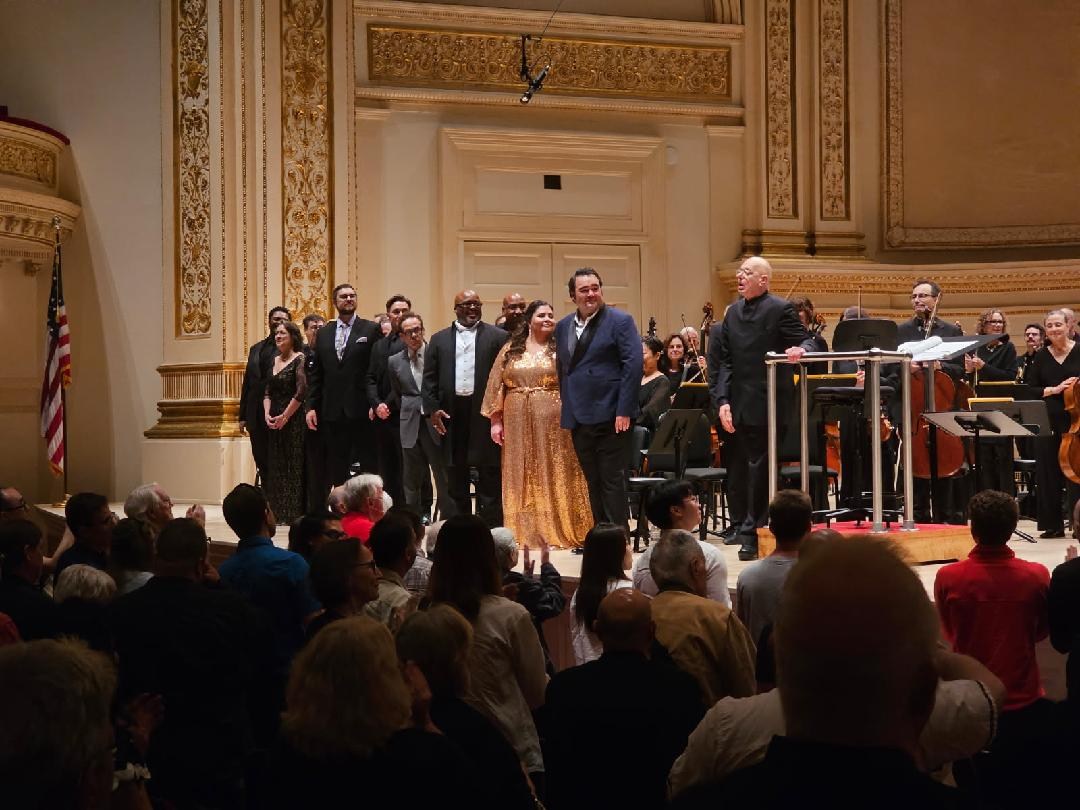
On Friday, Botstein took the stage of Carnegie Hall to guide the American Symphony Orchestra (a group he has directed since 1992) through the resurrection, in concert, of Strauss’ first opera, the problem child “Guntram.” The work was tepidly received at its premiere in Weimar in May 1894. Basically, everyone thought it was fine, if not particularly special. Pauline de Ahna sang the role of Freihild. Four months later she would become Strauss’ wife. (He announced their engagement on the day of “Guntram’s” premiere.)
In November, Strauss brought the work to his hometown of Munich, where he was serving as music director. Its reception there might be charitably characterized as brutal. So poorly did its single performance go down that the orchestra walked out on strike under the direction of its concertmaster (Strauss’ cousin). The two leads refused to reprise their roles, and a third singer was adamant about not returning until a better pension was negotiated. Ouch!
By then, Strauss had already tasted success with his tone poems “Don Juan” and “Death and Transfiguration.” “Till Eulenspiegel’s Merry Pranks,” “Also sprach Zarathustra,” “Don Quixote,” and “Ein Heldenleben” were yet to come. He was a decade away from “Salome,” the work that would change his operatic fortunes forever. (But first, he would have his revenge on conservative Munich with his scandalous opera “Feuersnot.”) He would go on to become perhaps the most successful opera composer of the 20th century.
Still, you know how it is. One never forgets the sting of rejection. Strauss just couldn’t get over “Guntram’s” failure. He tried to put it behind him with a humorous gesture, figuratively burying the pain with a symbolic gravestone erected on his property that bore the inscription:
“Here lies the venerable, virtuous young Guntram—
Minnesinger, who was gruesomely slain by the symphony orchestra of his own father
May he rest in peace!”
Strauss would enjoy wealth and celebrity, but that early humiliation stayed with him. In 1940, when he was in his mid-70s, at the other end of a very fruitful career, he revised “Guntram,” making some cuts and hoping its merits would finally be recognized. But its fortunes did not improve.
“Guntram,” then, is right in Botstein’s wheelhouse. “Salome,” “Elektra,” and “Der Rosenkavalier” don’t need his help. Rather, he’s been working his way through Strauss’ lesser-known efforts, including the aforementioned “Feuersnot,” “Die ägyptische Helena,” “Die schweigsame Frau,” “Friedenstag,” “Daphne,” and “Der Liebe der Danae.” He and the ASO recorded “Die ägyptische Helene” and “Der Liebe der Danae” at Avery Fisher Hall in 2001 and 2003, respectively, for Telarc Records.
Before I forget: it is essential that you get there early for any Leon Botstein performance. I guarantee his insightful pre-concert talks will enrich your experience of the music. On this occasion, had I missed his remarks, it would have gone right over my head that this was no mere Wagner knockoff, but rather a sly subversion of the Wagnerian aesthetic it would seem to embrace. I would have missed out on the entire social and historical context that allowed me to take vicarious pleasure in knowing that “Guntram” pissed off Strauss’ contemporaries. Of course, the music itself also happens to contain passages of great beauty, especially when heard live.
Botstein conducted “Guntram” from that 1940 revision of the work, the only performance edition. While the opera may not be a world-beater, we’re far enough along from the prejudices and animosities that pummeled it in the 1890s to at least give it a fair and objective hearing.
Strauss wrote his own libretto, which is full of the turgid Teutonic iconography familiar from so many German Romantic operas. A corrupt ruler, high-minded minnesingers, civil unrest, a saintly woman, thwarted love, and heavy swords that in my opinion never get enough use. Strauss further emulates Wagner through the employment of leitmotifs – musical snippets associated with certain characters or ideas that undergo transformation as they recur throughout the opera. Guntram’s is insistently memorable, helped no doubt by the fact that it’s basically the first three notes of the Enterprise fanfare from the original “Star Trek” television series. A leitmotif associated with Freihild’s love anticipates a similar one in Strauss’ “Die Frau ohne Schatten.”
Certainly, “Guntram” has got its share of castles and pageantry and lofty-minded singing societies – in this case, a pacifist rebel alliance united against a tyrannical duke. Too bad Guntram kills him. If it were Wagner, you would expect the hero, or any rate the self-sacrifice of the heroine, to change the world. But there is no redemption in “Guntram.” Instead, the protagonist retires, like Strauss’ vision of the Hero at the end of his epic tone poem “Ein Heldenleben” – which actually quotes “Guntram” in the section celebrating “The Hero’s Works of Peace.” The climactic moments of the opera also put one very much in the mind of “The Hero’s Retirement from this World and Completion.”
There are intimations of other Strauss works, as well. “Death and Transfiguration,” already written, finds its way in. There’s no question as to the identity of the composer. Strauss was already a master orchestrator, and his thumbprints are easily detectable without a magnifying glass. But the ghost of Wagner is forever lurking behind a column. One thing I forgot to mention is a dance that Strauss includes twice, which to my ears is a Romantic gloss on the same Tielman Susato dance Peter Warlock used as the basis for the last movement of his “Capriol Suite.” Can that be possible? How well known would Susato have been in the 19th century? Perhaps the similarity is just a coincidence? A chorus of monks also gets to intone some faux Gregorian chant. Great fun!
Despite all the music’s feints at “Tristan und Isolde,” especially in the third act, “Guntram” is an opera without any sense of Wagnerian transcendence or redemption. It’s more like there’s the POSSIBILITY of redemption, perhaps, someday, I’ll have to get back to you, as Guntram wanders off into a life of renunciation, reflection, and seclusion; but before he goes, he exhorts Freihild, who clearly reciprocates his attraction, to devote herself to charitable works. What a guy.
According to Botstein, this subversion of Wagnerian ideals would have been seen as heretical by his contemporaries. Read Alex Ross’ “Wagnerism: Art and Politics in the Shadow of Music” for a better understanding of just how pervasive Wagner’s influence was. No exaggeration, it permeated just about every aspect of human existence and thought – philosophy, fashion, architecture, politics, and of course the arts – apparently so much so that Strauss’ teacher, Alexander Ritter, an ardent Wagnerian, totally cooled on their friendship in the wake of “Guntram.” (On the other hand, Strauss’ rival, Gustav Mahler, respected its merits enough to include two of its preludes on a concert – at Carnegie Hall, as a matter of fact.) To mess with Wagner would have been to rock the pillars of the earth.
A frequent criticism leveled against Botstein, a prolific scholar who has published in multiple disciplines (in multiple languages, for that matter) and is the head of a liberal arts college, is that as a conductor he conducts like a hell of an academic. It’s his curiosity that drives the performances as opposed to penetrative insight. I can’t say that has always been my experience, and in fact more often than not, I have attended Botstein concerts that have left me juiced – often in both senses, as in electrified AND drained, as those Bard concerts can attain epic dimensions. On the other hand, an Ives’ Second Symphony I heard Botstein conduct at Carnegie last season lacked any suggestion, in its execution, of a work that can live and breathe in a unique, vital, and even transcendent way. Under Botstein’s direction, it was just there. Like John Knowles Paine on a bad day. That’s the risk you take, with the vagaries of live performance.
On Friday, I can attest, Botstein was like a surfer harnessing the energy of one bitching wave. I had been totally ignorant of John Matthew Myers, but he had a ringing heldentenor that rang effortlessly over the orchestra and carried out to every corner of the hall, gliding on Carnegie’s legendary acoustics. In fact, the acoustic flattered practically everyone. There was a lot of very good and attractive singing from a diverse cast. Katharine Goeldner sang with passion and commitment in the supporting role of the Old Woman. I was amused to recall Rodell Rosel, who sang the Duke’s Fool, as the Jester in Botstein and the ASO’s performance last season of Schoenberg’s “Gurre-Lieder.” When in need of motley antics, they must have him on speed dial. To keep it short, I could pretty much dole out praise across the board. Myers was the revelation, but for as stunning as he was, in the end anyone present would have had to concede the laurels should be cast at the feet of Angela Meade, who stunned especially at the end of Act II, when her character, Freihilde, the kind wife of the evil duke, was finally given something more to do than swoon. When she belts, “Ich liebe dich!,” that’s pretty much that. All you can do is go to intermission.
Strauss famously characterized himself as “a first-class second-rate composer.” You can practically detect the twinkle in his eye when he said it. The performance of “Guntram” on Friday night certainly bore out his assessment. In all, I found the opera worked marvelously well in concert – I found it rewarding and even revelatory – although I can imagine the challenges for anyone attempting an actual staging. For one thing, all three acts are hampered by dramatically-stagnant monologues (three for Guntram and one for Freihild), making it a textbook park-and-bark. Any staging is bound to come off seeming like a series of tableaux, with the other singers waiting around for long stretches, holding poses, or doing their best to look natural. But with voices like these, who cares? Sometimes all you need are big voices and a powerful orchestra. Anyway, I happen to groove on ersatz Wagner.
I must say, it was instructive, if perhaps a little foolhardy, to listen to this on the same weekend as the Philadelphia Orchestra’s performance of Wagner’s “Tristan und Isolde.”
Thank you, Leon Botstein, the American Symphony Orchestra, and the men of the Bard Festival Chorus. It was a wonderful evening!
Strauss was the focus of the Bard Music Festival in 1992. In 2011, Bard offered a series of staged performances of “Die Liebe der Danae” (“The Love of Danae”). In 2022, the opera was “Die Schweigsame Frau” (“The Silent Woman”). These can be viewed, with a number of other Bard opera productions, on YouTube.
At the conclusion of Sunday’s marathon performance of Wagner’s “Tristan und Isolde” by the Philadelphia Orchestra, after having been stretched on the rack for five hours, the elastic finally snapped. Spine and scalp were atingle with the thrilling Romantic sublimity of it all, as Isolde clears that final, hysterical hurdle to ecstasy and death with the Liebestod.
But that’s the magic of “Tristan,” surely the most extreme example of deferred gratification in the repertoire. And by the time that gratification is achieved, most everyone is dead. And the audience is not spared. It’s classical music’s equivalent of making love to a praying mantis. No matter how flippant I can be about “Tristan,” it exists on a very high plain, perhaps the highest. The greatest works of art can tear a hole in the fabric of the world and reveal the emotional truth of existence. They tap into something primal and irrational and leave you shaken to the core. On Sunday, the work hit me with three times its usual power. And I live to tell the tale.
Of course, there was Wagner’s music, achieving apotheosis and release at the end of five glorious hours of portentous woodwinds and passionate, seething strings, and superhuman voices cresting terrifying waves of sound.
Then there was the audience reaction, which could only be described as ecstatic. All three acts were greeted with volcanic applause, but the final curtain was received most rapturously, with the lava flowing long and lovingly, and deservedly so.
Either one of those in themselves would have been enough to wreck me, but the performance also marked Nina Stemme’s farewell to the role of Isolde, a part she sang to great acclaim for a very long time, and she was visibly moved, wiping away tears at the end. I’m getting choked up now, nearly two days later, just thinking about it. There’s something to be said about going out on top, but Stemme, at 62, was so powerful and secure, with perhaps only two or three times where she might have landed a tad sharp on a high note (I do not have perfect pitch), but she kept her toes near the chalk and sang with adamantine strength. I was totally in love with her.
Her partner, Stuart Skelton near-matched her in power as Tristan (though perhaps not quite), and he was in good voice throughout, but I feared for his stamina. Skelton is a big man, to put it mildly. He was the elephant in the room, both figuratively and near-literally. Later, I found an interview with him on YouTube, in which he speaks of how every part of the body serves a function in terms of creating a singer’s unique resonance, but there’s got to be a compromise so that those of us in the audience don’t worry about witnessing someone’s imminent collapse. But perhaps my concern was misplaced, as over three hours in, he still had plenty of power in reserve for Tristan’s mercurial highs and lows in Act III. Wagner must be the one branch of opera wherein the old stereotype of the gargantuan singer endures. At least in a staged production, they could have thrown some furs on the guy, or given him a winged helmet. Kurnewal’s remark about having carried him ashore brought a moment of unintended comedy (for me), only to be surpassed, when in supposed death, Skelton reached into his vest pocket and popped a lozenge or perhaps a nitroglycerin pill. All respect to your artistry, sir, but for godsake, do take care of yourself!
The orchestra’s music director, Yannick Nézet-Séguin, ever stylin’, conducted in what looked like a synthetic t-shirt, long-sleeved with a kind of Nehru collar and French cuffs, that had been tossed in the wash with some black towels. And of course, he wouldn’t be caught dead without his Louboutins. Yannick gonna be Yannick. Sartorial choices aside, he conducted with muscle and vigor throughout. I guess his workout routine in the tongue-in-cheek video used to market these performances really paid-off.
It took a few minutes for the Prelude to start weaving its magic as it should, but it wasn’t long before I was in the music’s thrall. Regardless of what you may think about the depth of this guy’s performances, he is a magnetic conductor.
The orchestra musicians themselves played with great commitment, some really throwing themselves into it. Principal double bass Joseph Conyers was right in my sightline, and he really dug in and played with exuberance and zest. Wagner gives his musicians plenty to enjoy, whether it’s to claw at your heart, reach for the ineffable, or imitate burbling fountains.
“Tristan und Isolde” is like a narcotic. Is there any other piece of music that can so alter one’s consciousness? It both depresses and inflames the listener. It’s like spider venom. But what ecstasy! I’m sure I’m not the first to observe, it can’t be good for you.
Moreover, the whole Romantic fascination with love-death is so deeply unhealthy, but in my abnormally-prolonged youth I embraced it to the hilt. How I ever made it to my 50s is anyone’s guess. Act II made me remember every love affair I ever had – ardent, reckless, and doomed.
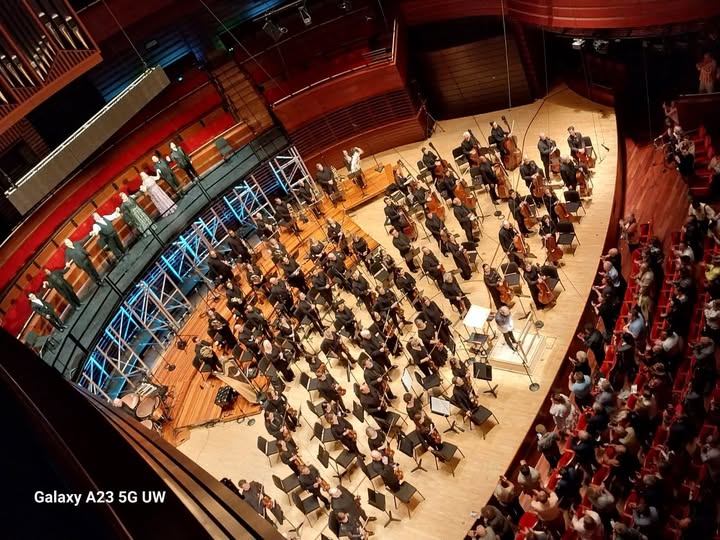
The stage performance lacked sword fights and poisoned chalices, but Skelton and Stemme held hands and touched foreheads during the love scenes. For the most part, the singers were positioned on a scaffold behind the orchestra, accessible from the stairs of the “Conductor’s Circle” (seating near the organ loft at the back of the stage), but occasionally they popped up unexpectedly on other tiers. I was enraptured being so close to Karen Cargill, her Brangäne keeping watch over the lovers in Act II, as she sang, hypnotically, only yards from my box. I jotted down one word: BLISS! Likewise, members of the orchestra were sent around the hall and backstage to achieve certain spatial effects. English hornist Elizabeth Starr Masoudnia had a plum part, doubling for a shepherd’s pipe and sharing the scaffold with Tristan and his wingman, Kurwenal.
Cargill was a standout among the supporting cast. Brian Mulligan, as Kurwenal, was another. But the singer who perhaps best inhabited his role, in terms of balancing the demands of voice and action, was Tareq Nazmi as King Marke, whose embodiment of the part transcended the requirements of a concert performance. His rounded portrayal drew real sympathy for the character, who is not only king, but Tristan’s uncle, come to regard the younger man as his son. Nazmi sold the realism of a betrayed, baffled, and ultimately beneficent king. If anything, it made the Friar Laurence moment of his too-late-arrival all the more poignant. Then again, no one told Tristan he had to tear off his bandages.
The opera spanned close to five hours, with two 25-minute intermissions. For the first of those I hurried down the elevator and weaved across the lobby like a running back, bypassing the concessions crowds with a dash across Broad Street to the Good Karma Cafe, adjacent to the Wilma Theater, for a medium coffee. This I supplemented with doughnut holes from a tiny Tupperware I’d smuggled from home. Once during the first act I caught myself nodding and I was afraid I might tumble right over the railing. During the second intermission, I kept my energy up by eating a banana.
Before the start of the performance (at 2:00), I couldn’t help but smile to myself as I glanced down the rows of seats in what pass for boxes in Philadelphia. The Third Tier is the Lonely Guy tier. Predominately bachelors and social misfits. Always like this wherever I go, come to think of it, with whatever I happen to enjoy. What does that say about me, I wonder? The guy in the box in front of me showed up in shorts carrying a hardbound copy of the score, which he followed most assiduously, seldom looking up for most of the first act. He disappeared for the rest of the opera. I hope it was to find a better seat. The guy behind me slipped out during the third act. I turned around, and he was gone well before the Liebestod. Did he lack the stamina, or was he hoping to avoid the traffic? I never understand people who go to a concert and then dash off before the end to beat the crowd to the garage. Kind of defeats the purpose of even attending.
One thing that impressed me was – an unfortunate, unmuffled cough at the beginning of the Prelude aside – the audience was unusually and blessedly quiet throughout. Yes, there were coughs, very occasionally, but none of those annoyingly ostentatious gotta-cough-for-the-sake-of-coughing coughs. And no cell phones! Wagnerites are a different breed. Don’t attempt to desecrate their temple.
I would have loved to have seen this “Tristan” staged, but in making it a concert performance, at least the audience was spared the Regietheater excesses that mar so many Wagner productions these days. Here, the music was allowed to speak without any sideshow distractions. I will remember Stemme’s Isolde for a long time. Were there moments when she was lost in the wash of sound? Believe me, they were few. I know I’m mixing my Wagner music dramas, but she had the vocal power of a Valkyrie. I count myself very fortunate to have experienced her instrument live.
It was instructive to attend this performance two days after having heard Richard Strauss’ “Guntram” at Carnegie Hall on Friday. I’m hoping to write that up tomorrow for Strauss’ birthday.
In the meantime: bravo, The Philadelphia Orchestra! Truly, this was a transformative event.


5 responses