• Shakespeare on the Radio: A Bard Celebration #Shakespeare400

    Shakespeare on the Radio: A Bard Celebration #Shakespeare400

    by 

    in
    3 responses

    Once more unto the breach, dear friends!

    With two weeks left in our four-part celebration of William Shakespeare this month, we’ve still got a lot of ground to cover. In case you haven’t heard, April 23 marks the 400th anniversary of the Bard’s death. (It’s also traditionally held to be the date of his birth, 52 years earlier.) Every Thursday morning on WPRB, we’re listening to music inspired by Shakespeare’s plays and sonnets.

    In the remaining hours, I am hoping to get to the following composers and works: Geoffrey Bush’s “Yorick,” Cecil Coles’ “Comedy of Errors Overture,” David Diamond’s “Music for Romeo and Juliet,” Gerald Finzi’s “Let Us Garlands Bring,” Josef Bohuslav Foerster’s “From Shakespeare,” Erich Wolfgang Korngold’s “Much Ado About Nothing,” Florent Schmitt’s “Antony and Cleopatra” (in a recent recording with the Buffalo Philharmonic Orchestra conducted by JoAnn Falletta), Jean Sibelius’ “The Tempest,” Bedrich Smetana’s “Richard III,” Ralph Vaughan Williams’ “Serenade to Music” (on a text from “The Merchant of Venice”), Sir William Walton’s “Macbeth,” and Alexander Zemlinsky’s “Cymbeline,” among others.

    In this week of the Pulitzer Prizes, we’ll also hear Paul Moravec’s “Tempest Fantasy,” the 2004 winner of the Pulitzer Prize for Music.

    With only ten hours to go, can I possibly program all of these, with additional surprises? Where there’s a Will, there’s a way! Maybe I’m a utopianist, but I sure will try. I have no idea if and when any of them will be played, so you will just have to tune in whenever you can, for as long as you can.

    I’ll also welcome two guests tomorrow: Mariusz Smolij, music director of the Riverside Symphonia, will tell us about his orchestra’s Friday night concert at St. Martin of Tours Church in New Hope – he’ll talk to us a little after 8 a.m. – and William Walker from The Princeton Singers will drop by a little after 9 to tell us about their Shakespeare-inspired concerts at Princeton University Art Museum on Saturday evening.

    We’re buried by the Bard, Thursday mornings in April, from 6 to 11 EDT, on WPRB 103.3 FM and at wprb.com. We’re all shook up for Shakespeare, on Classic Ross Amico.


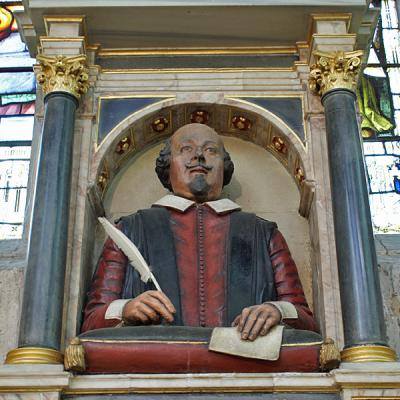
    PHOTO: Funerary monument, carved by Gerard Johnson, a Shakespeare contemporary, which overlooks Shakespeare’s grave at Holy Trinity Church at Stratford-upon-Avon.

    The epitaph on the grave itself (attributed to Shakespeare):

    Good friend for Jesus sake forbeare,
    To dig the dust enclosed here.
    Blessed be the man that spares these stones,
    And cursed be he that moves my bones.

    #Shakespeare400


  • Germaine Tailleferre’s Lost WWII Years

    Germaine Tailleferre’s Lost WWII Years

    by 

    in
    6 responses

    I find it fascinating that Germaine Tailleferre waited out World War II in Philadelphia. And yet I can never seem to find out very much about what she did while in exile.

    Tailleferre was the only female member of Les Six, that loose collective of composers who rose to prominence in Paris in the late ‘teens and 1920s, under the guiding hand of Jean Cocteau. Her famous peers included Francis Poulenc, Darius Milhaud, Arthur Honegger, and Georges Auric. Louis Durey, a hard-line communist who went on to set poems by Ho-Chi Minh and Mao Zedong, is the one nobody remembers. (I wonder why.)

    Tailleferre was strong-willed from the beginning. Her birth name was Taillefesse, but she changed it to spite her father, since the old man opposed her musical studies. However, she took piano lessons with her mother and was admitted to the Paris Conservatory. It was there that she met her future colleagues and that the prizes began to pile up. She also earned the friendship and received the support of Maurice Ravel.

    In 1925, she married Ralph Barton, an American caricaturist, and moved to New York. Two years later, the couple returned to France, then divorced. Her career thrived in the 1920s and ‘30s. With the outbreak of World War II, however, she beat it back to the United States, leaving most of her scores at her home in Grasse, and, as I said, passed the war years in Philadelphia.

    After the war, she again returned to France, where she resumed her career. As she got older, her pieces tended to be shorter, as she suffered from arthritis. She also wrote a lot for children and young pianists. She composed virtually right up until the time of her death in 1983, when she was 91 years-old. She wrote so much, in fact, that a lot of the music of her later years has never been published, and fresh discoveries from her output are being recorded all the time.

    Happy birthday, Germaine Tailleferre! If anyone has any information on her activities in Philadelphia, I would be most curious to know.


    The Concertino for Harp and Orchestra:

    The lovely and wistful “Arabesque” for clarinet and piano:


  • Stokowski Two Sides of a Conducting Legend

    Stokowski Two Sides of a Conducting Legend

    by 

    in
    4 responses

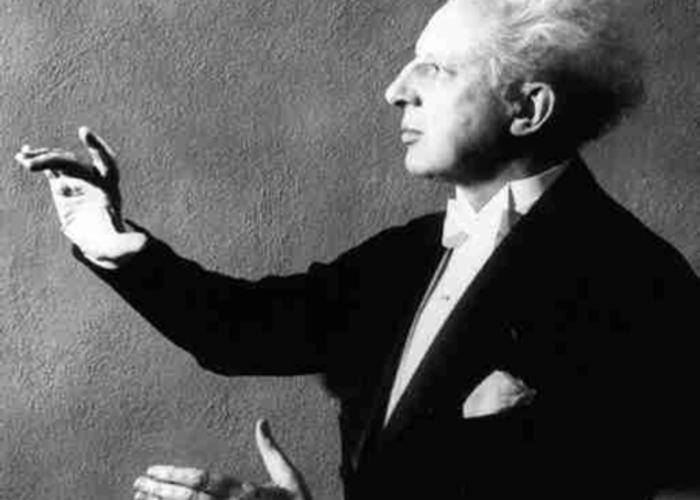
    Two faces of Leopold Stokowski:

    First, from the 1947 potboiler “Carnegie Hall,” which contrives to string together appearances by some of the greatest classical music talent of the day (including Jascha Heiftez, Gregor Piatigorsky, Arthur Rubinstein, Rise Stevens, Ezio Pinza, Bruno Walter and Fritz Reiner) using the flimsiest and hokiest of plots (renegade young pianist scandalizes – and ultimately makes good – with his new jazz concerto).

    Stokowski provides the musical high point of the picture, with the director, low budget maestro Edgar G. Ulmer – who was a set designer on “Metropolis” and “M” – indulging in Expressionist tricks (low-angle camera set-ups and stark lighting) to accentuate Stoky’s majesty, to say nothing of his hair.

    Second, Stokowski rehearsing the American Symphony Orchestra in 1968, at the age of 85. He still had ten years of conducting ahead of him. His talent, temperament – and hair – remain undiminished.

    Happy birthday, Leopold Stokowski (1882-1977).


  • Henry Threadgill Wins Pulitzer Prize

    Henry Threadgill Wins Pulitzer Prize

    by 

    in
    6 responses

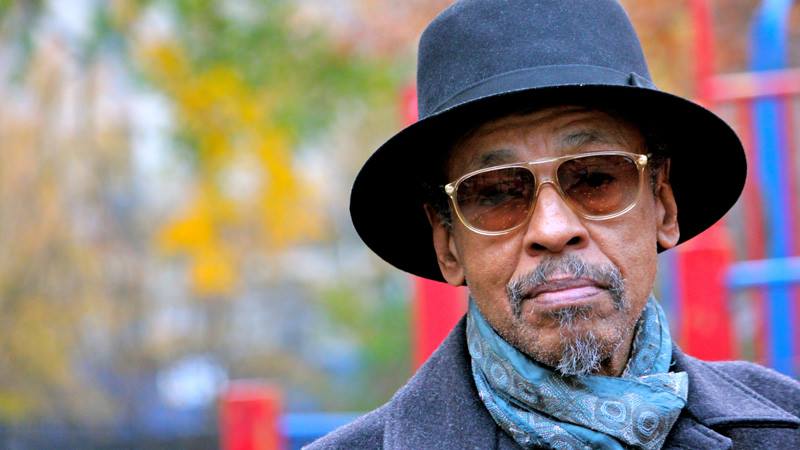
    The recipients of the centennial Pulitzer Prizes were announced this afternoon at 3:00 EDT. The final category to be addressed was that of the Pulitzer Prize for Music. And the winner is…

    Henry Threadgill, for “In for a Penny, In for a Pound.”

    Threadgill, 72, studied at the American Conservatory of Music in Chicago. He is a composer, saxophonist and flautist, whose compositions have pushed boundaries for the past 50 years. His orchestral, chamber, and solo instrumental works have been performed at BAM, Bang on a Can, and Carnegie Hall. Peter Watrous of The New York Times described Threadgill as “perhaps the most important jazz composer of his generation,” though Threadgill has distanced himself from any such easy categorization.

    You can read a review of the recording here. Threadgill plays sax in the embedded video

    http://www.allaboutjazz.com/in-for-a-penny-in-for-a-pound-henry-threadgill-pi-recordings-review-by-mark-f-turner.php

    Here’s another sample of his work (NOT “In for a Penny,” which has not, to my knowledge, been posted), this time with the composer on flute and sax, from the Library of Congress in Washington, DC:

    And a conversation with Threadgill, also from the Library of Congress:

    In other music news, Lin-Manuel Miranda was recognized with the Pulitzer Prize for Drama for his Broadway juggernaut “Hamilton.”


  • Miklós Rózsa Film Score Celebration

    Miklós Rózsa Film Score Celebration

    by 

    in
    10 responses

    Happy birthday, Miklós Rózsa (1907-1995)!

    Can you spare ten minutes to soak up some Golden Age greatness? Check out this wonderful medley of some of his classic film scores.

    I had a blast picking out the films without looking at the images. I own recordings of all of them, of course. (What? No “Lust for Life???”)

    Rózsa conducts the Pittsburgh Symphony in a suite from “Ben-Hur”:

    They don’t make ‘em like Miklós anymore.


Tag Cloud

Aaron Copland (93) Beethoven (95) Composer (114) Film Music (144) Film Score (143) Film Scores (255) Halloween (94) John Williams (195) KWAX (229) Leonard Bernstein (104) Marlboro Music Festival (125) Movie Music (159) Mozart (91) Opera (213) Philadelphia Orchestra (89) Picture Perfect (174) Princeton Symphony Orchestra (109) Radio (88) Ross Amico (244) Roy's Tie-Dye Sci-Fi Corner (290) The Classical Network (101) The Lost Chord (269) Vaughan Williams (105) WPRB (397) WWFM (881)

DON’T MISS A BEAT

Receive a weekly digest every Sunday at noon by signing up here


RECENT POSTS