• Maelzel’s Metronome The Turk & a Mysterious Death

    Maelzel’s Metronome The Turk & a Mysterious Death

    by 

    in
    3 responses

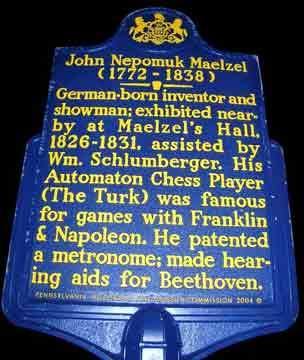
    Perhaps in your haste to escape Philadelphia by way of South 5th Street, en route to the Ben Franklin Bridge, you may have glimpsed the Johann Nepomuk Maelzel commemorative marker at the corner of 5th and St. James, just below Walnut Street.

    Maelzel died in the extraordinary act of actually trying to get back to Philadelphia. On the 21st of July, 1838, he was found dead in the berth of a brig returning from the Caribbean. Whether he died of yellow fever or alcohol poisoning is a matter of ambiguity. Maelzel was consigned to a watery grave somewhere off the coast of Charleston, South Carolina.

    In his lifetime, Maelzel was a renowned inventor of mechanical wonders. He created machines that could play works of Haydn and Mozart. No doubt his most ambitious achievement in this regard was the panharmonicon, a kind of mechanical orchestra, for which Beethoven composed “Wellington’s Victory.”

    Beethoven and Maelzel would quarrel over the division of spoils, and Beethoven would re-orchestrate the work for human performers of a conventional symphony orchestra. Maelzel, seemingly always in debt, would exhibit his creations in his own museum in Vienna, and on tours throughout the United States and the West Indies.

    He achieved notoriety for his work with automatons, most notably a mysterious humanoid engine called “The Turk.” The Turk was marketed as a thinking machine that could outmaneuver opponents in a game of chess. And the Turk almost always delivered on his promise. The device captivated figures from Edgar Allan Poe (a skeptic) to S. Weir Mitchell (haunted by it as a child).

    Some felt Maelzel had set foot into some pretty murky ethical territory, with arguments prefiguring some in our own day regarding artificial intelligence. This was the era, after all, of Mary Shelley’s “Frankenstein.” Sensible folk speculated it was all humbug and that there was a man hidden somewhere in the vicinity of The Turk. Others thought Maelzel was dabbling in matters best left to God. Maelzel was mum on the subject, and The Turk was destroyed by fire in 1854.

    Though no doubt there was a whiff of charlatanism about Maelzel, who schooled no less a figure than P.T. Barnum in the effective use of the press, he had a remarkable talent for finessing and perfecting the ideas of others.

    His most enduring legacy is the metronome, which he patented in 1815. Beethoven wrote glowingly of the device and declared that henceforth he would stop using traditional tempo indications in his scores in favor of metronome markings. We all know how well that served him. Seemingly as with anything influenced by Maelzel, Beethoven’s choices of metronome markings continue to be a source of controversy.



  • Summertime Music Imaginary Vacations

    Summertime Music Imaginary Vacations

    by 

    in
    4 responses

    Summertime. A time for vacations, even if merely of the imaginary variety.

    In music, there are two types of musical vacations: actual travel music, inspired by a trip taken to a specific locale (as per Sunday night’s edition of “The Lost Chord” – “Channel Hopping” – which will be rebroadcast Wednesday evening at 6 ET at wwfm.org); and the flight of fancy, or a vacation of the creative mind. The latter often manifests itself in a collection of miniatures given descriptive names, in the manner, perhaps, of some of the great keyboard works of Robert Schumann.

    The French composer Déodot de Séverac studied in Paris with Vincent d’Indy and Albéric Magnard. He also acted as an assistant to Isaac Albeniz, whose own character pieces certainly influenced some of his evocative regional painting for the keyboard. In writing vocal music, he set texts not only in French, but also his native Provençal (the historic language of Languedoc) and Catalan (the historic language of Rousillon).

    Séverac composed two sets of piano pieces under the title “En vacances” (“On Vacation,” or “Holiday Time”). The second was left incomplete at the time of his death at the age of 48.

    These musical snapshots are clearly skewed toward the experiences of his children, Mimi and Toto, with movements named “Invocation to Schumann,” “Grandmother’s caresses,” “Visit from the little girls next door,” “Toto pretends to be a verger,” “Mimi dresses up as a Marquise,” “In the park,” “On listening to a musical box,” and “Romantic Waltz.”

    Enjoy the first set here, performed by the late Aldo Ciccolini (complete with atmospheric LP crackle):

    I-IV: https://www.youtube.com/watch?v=qyO2JnnG9E8
    V-VIII: https://www.youtube.com/watch?v=Ugi_6-uJ4EE

    Happy birthday, Déodot de Séverac (1872-1921)!


  • Desi Arnaz Babalu So Percussion Summer Institute

    Desi Arnaz Babalu So Percussion Summer Institute

    by 

    in
    4 responses

    Desi Arnaz, Badass Babalu:

    This gives me the opportunity to remind you that the So Percussion Summer Institute (SoSI) begins in Princeton today:

    http://www.nj.com/times-entertainment/index.ssf/2015/07/classical_music_so_percussion.html

    More about Babalú-Ayé here:

    You Really Drive Me Wild When You Sing Your Babalu


  • British Composers Abroad on The Lost Chord

    British Composers Abroad on The Lost Chord

    by 

    in
    3 responses

    This Sunday night on “The Lost Chord,” we holiday on the Continent with the British. We’ll have works by English composers inspired by their travels abroad.

    Elisabeth Lutyens must have been a prickly personality. She wrote principally in a modified twelve tone idiom. While she despised the modal melodies of the English pastoralists (in reference to whose works, she coined the term “cow-pat music”), she was equally dismissive of strict serialism.

    It’s interesting that someone who made so many enemies could turn around and write a piece like “En Voyage,” a delightful suite of British light music. But I suppose it served to keep Lutyens in cucumber sandwiches.

    Lennox Berkeley met Benjamin Britten at a contemporary music festival in Barcelona in 1936. While there, they witnessed some Catalan folk dancing in a park. Britten jotted down some of the melodies onto an envelope, and the two composers worked closely to create an orchestral suite called “Mont Juic.”

    Finally, it was the remembrance of a trip to Upper Bavaria that inspired the Elgars to collaborate on a set of part-songs, which would be called “Scenes from the Bavarian Highlands.” Edward Elgar (not yet knighted), set texts of his wife, C. Alice Elgar. Three of the movements would later be published separately, in a purely orchestral version, much better known, as “Three Bavarian Dances.”

    I hope you’ll join me for “Channel Hopping” – the English abroad – this Sunday night at 10 ET, with a repeat Wednesday evening at 6; or that you’ll listen to it later as a webcast at wwfm.org.


  • Beat the Heat with Wintry Film Scores

    Beat the Heat with Wintry Film Scores

    by 

    in
    4 responses

    Though the weather is uncharacteristically lovely today in the Trenton-Princeton area, I wholly expect to be sweating it out again in front of the air conditioner sometime soon. (It will be back to 90 by the weekend.) In that glass-half-empty frame of mind, this week on “Picture Perfect,” we’ll have an hour of aural escapes from the grim heat of summer.

    “The Snow Storm” (1964) is an adaptation of Pushkin’s “The Tales of the Late Ivan Petrovich Belkan.” This year marks the centenary of the birth of the composer, Georgy Sviridov. The Waltz and Romance from “The Snow Storm” enjoyed particular popularity, bringing Sviridov two of his greatest hits.

    Then Arthur Honegger will take us to higher altitudes with his music for “The Demon of the Himalayas” (1935), complete with the eerie electronic timbre of the ondes Martenot.

    Ralph Vaughan Williams will guide us to the South Pole with selections from his score for “Scott of the Antarctic” (1948). The music perfectly reflects the sublime, austere beauty of a hostile environment. The score became the basis for Vaughan Williams’ Symphony No. 7, “Sinfonia Antarctica.”

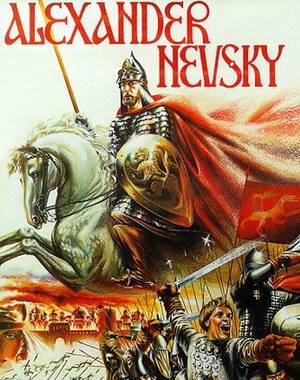
    Finally, the “Battle on the Ice” sequence from “Alexander Nevsky” (1938) provides a textbook marriage of music and film. Director Sergei Eisenstein granted the composer, Sergei Prokofiev, the unusual luxury of cutting the images to suit his music, as opposed to the usual practice, which is the other way around. The result is not only one of the great films, but also one of the great film scores.

    Chill out with wintry scenes from world cinema this week, on “Picture Perfect” – music from the movies – this Friday evening at 6, with a repeat Saturday morning at 6; or listen to it later as a webcast at wwfm.org.

    PHOTO: Very cool


Tag Cloud

Aaron Copland (93) Beethoven (95) Composer (114) Film Music (144) Film Score (143) Film Scores (255) Halloween (94) John Williams (195) KWAX (229) Leonard Bernstein (104) Marlboro Music Festival (125) Movie Music (159) Mozart (91) Opera (212) Philadelphia Orchestra (89) Picture Perfect (174) Princeton Symphony Orchestra (109) Radio (88) Ross Amico (244) Roy's Tie-Dye Sci-Fi Corner (290) The Classical Network (101) The Lost Chord (269) Vaughan Williams (105) WPRB (397) WWFM (881)

DON’T MISS A BEAT

Receive a weekly digest every Sunday at noon by signing up here


RECENT POSTS