• Rimsky-Korsakov’s Lost Operas

    Rimsky-Korsakov’s Lost Operas

    by 

    in
    9 responses

    Today is the birthday of Nikolai Rimsky-Korsakov (Julian date Mar. 6, 1844), who wrote so much enchanting music, and yet so much of it is comparatively unknown.

    In particular, his operas have failed to really secure a toehold in the West. This, despite a pre-political hot potato Valery Gergiev’s efforts to bring a taste of their opulence and pageantry to BAM, the odd touring company (the Bolshoi) bringing concert versions to Lincoln Center, or the now defunct New York City Opera putting together an English-language version of “Le coq d’or” for Beverly Sills and Norman Treigle – now almost 50 years ago!

    His works for the stage are often dismissed by Western critics, who apparently find them insubstantial, as if (non-Wagnerian) folklore is somehow less valid than an evening of Italian oom-pah-pah culminating in a jester discovering his dying daughter in a burlap sack.

    Be that as it may, I find what I’ve heard of his operas (and I’ve probably heard more than most) enthralling. He composed 16 in all, if we count the original version of “Mlada,” which he wrote in collaboration with other composers of The Mighty Handful.

    Sadly, Gergiev’s cycle of recordings for the Philips label was curtailed after only five operas, leaving one to feel one’s way through the thickets of mostly unreviewed (at least in the West) Russian recordings. The sound quality on these can be hit and miss, and the singing can be variable, but every once in a while, one hits pay dirt.

    Why is it that the most powerful recordings are from the pre-stereo era, when larger-than-life figures like Feodor Chaliapin and Mark Reizen walked the boards? If you don’t mind listening through a soup can, anything conducted by Nikolai Golovanov will knock your socks off. If ever I acquire a time-traveling DeLorean, I would make it my mission to round up some modern recording engineers and slip into the Soviet Union under Stalin’s moustache.

    Happy birthday, Rimsky. We hardly know ya.

    Chaliapin as the Viking Guest, in “Sadko”:

    Arguably topped by Reizen!

    Golovanov conducts “Christmas Eve” (complete):

    Golovanov conducts “May Night” (complete):

    Golovanov conducts “Sadko” (complete):
    https://www.youtube.com/watch?v=AMq87z_ZkPc

  • Happy St. Patrick’s Day Irish Films Barry Fitzgerald

    Happy St. Patrick’s Day Irish Films Barry Fitzgerald

    by 

    in
    3 responses

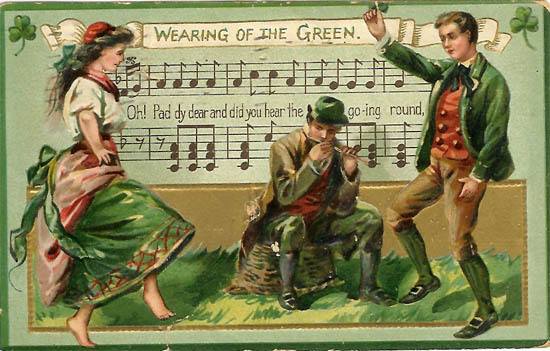
    Happy St. Patrick’s Day!

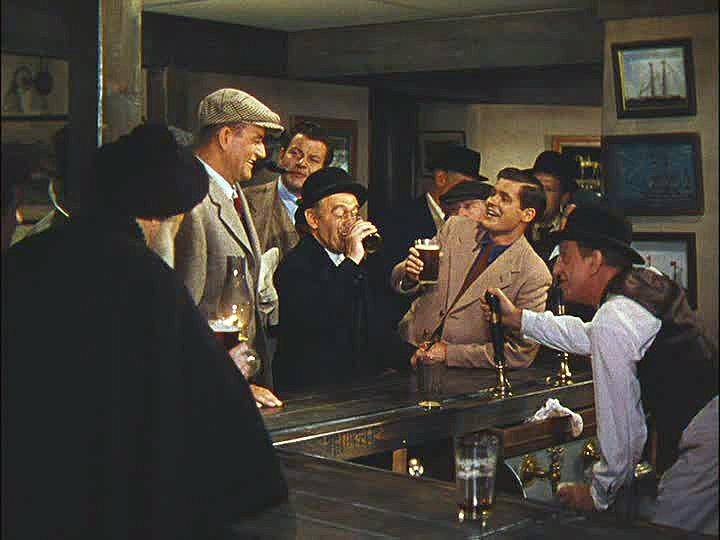
    As an alternative to “The Quiet Man,” here’s Barry Fitzgerald as “the oldest man in the world,” in “Broth of a Boy”:

    Manic leprechauns from “Darby O’Gill and the Little People”:

    The great Albert Finney in “Miller’s Crossing.” (WARNING: This one’s a little violent. Poor resolution, too.)

    Finally, since I’m not on the air, here’s one for Steffi:
    https://www.youtube.com/watch?v=MB8NhXtgG_A

    Sláinte, everyone!

    PHOTO: St. Patrick’s Day death wish: keeping pace with Barry Fitzgerald


  • Sibelius Mystery What’s He Holding

    Sibelius Mystery What’s He Holding

    by 

    in
    One response

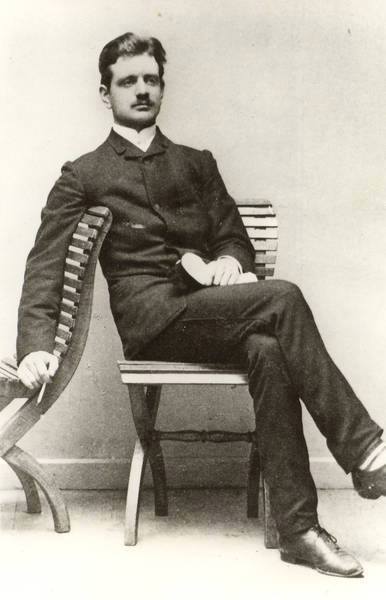
    Okay, audience participation time:

    What is it that Sibelius is holding in his left hand? (It looks like a cigarette, or maybe a pencil, in his right.) A hair brush? A shower massage? Have fun with it.


  • Irish Music on The Lost Chord

    Irish Music on The Lost Chord

    by 

    in
    3 responses

    Don’t let the Italian surname fool you; my mother’s people came from Ireland. My own sensibilities tend more toward the Northern climes than to the Mediterranean.

    This Sunday night on “The Lost Chord,” we anticipate St. Patrick’s Day, with music from, and in celebration of, the Emerald Isle. We’ll hear works by Irish composers John Larchet, Philip Hammond, Howard Ferguson and A.J. Potter, and works on Celtic themes by Percy Grainger, Sir Arnold Bax and John Foulds.

    I hope you’ll join me for “The Sharing of the Green,” tonight at 10 ET, with a repeat Wednesday evening at 6; or that you’ll enjoy it later as a webcast, at http://www.wwfm.org.


  • Pi Day 2015 Einstein Spock Princeton Celebrates

    Pi Day 2015 Einstein Spock Princeton Celebrates

    by 

    in
    4 responses

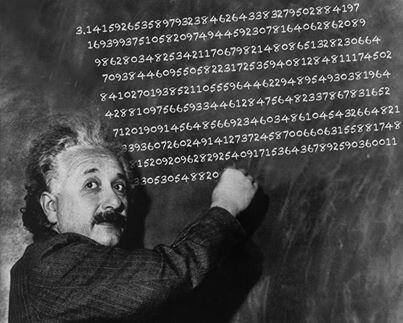
    Today is International Pi Day (3.14, get it?). In fact, it is the only Pi Day this century to be 3-14-15, the first five digits of Pi, often represented by the Greek letter “p” (“π”), the ratio of the circumference of a circle to its diameter, commonly approximated as 3.14159 – though you could take it a good deal further, since the number is wholly irrational and refuses to fall into a repeating pattern.

    Naturally, Princeton eats this stuff up. (It is Pi, afer all.) The borough is celebrating with a full day of events.

    http://www.pidayprinceton.com/

    Albert Einstein, longtime Princeton resident, was born on this date in 1879. “The difference between genius and stupidity is that genius has its limits,” he said. Is he saying, then, that Pi is stupid?

    Not so Mr. Spock, who in this episode of “Star Trek,” defeats an evil computer by asking it to calculate to the end of Pi. That Spock is such a trickster. (R.I.P. Leonard Nimoy.)

    All together now, as we sing the Albert Einstein Pi Day song!

    The tyranny of Pi:

    Face it, YouTube is crazy for Pi:

    Scariest Pi song?

    What does Pi actually sound like?

    This way madness lies. Clearly, the possibilities are endless.


Tag Cloud

Aaron Copland (93) Beethoven (95) Composer (114) Film Music (144) Film Score (143) Film Scores (255) Halloween (94) John Williams (195) KWAX (229) Leonard Bernstein (104) Marlboro Music Festival (125) Movie Music (159) Mozart (91) Opera (212) Philadelphia Orchestra (89) Picture Perfect (174) Princeton Symphony Orchestra (109) Radio (88) Ross Amico (244) Roy's Tie-Dye Sci-Fi Corner (290) The Classical Network (101) The Lost Chord (269) Vaughan Williams (105) WPRB (397) WWFM (881)

DON’T MISS A BEAT

Receive a weekly digest every Sunday at noon by signing up here


RECENT POSTS