• Diaghilev’s Lost English Ballets

    Diaghilev’s Lost English Ballets

    by 

    in
    5 responses

    Serge Diaghilev, impresario of the Ballets Russes, commissioned some of the most enduring ballet scores of the 20th century, from composers such as Claude Debussy (“Jeux”), Maurice Ravel (“Daphnis and Chloe”), Manuel de Falla (“The Three-Cornered Hat”) and especially Igor Stravinsky (“The Firebird,” “Petrushka” and “The Rite of Spring”).

    Less well known is the fact that he approached two Englishmen to write music for his famed and influential company.

    This Sunday night on “The Lost Chord,” we’ll be listening to works by Constant Lambert and Lord Berners – both figures so diverse in their interests, and possessing such outsized personalities, that it isn’t really possible to do either justice in the time allotted.

    Lambert was a brilliant polymath. In addition to his considerable talents as a composer, he was a conductor, arranger, and writer, as well as the lover of Margot Fonteyn. Alas, alcoholism and workaholism conspired with undiagnosed diabetes to hasten his demise at the age of 45.

    His ballet, “Romeo and Juliet,” presented as a play-within-a-play, turns Shakespeare’s tragedy of star-crossed lovers on its head, with the leads falling hard in a backstage romance with happier results. Lambert would go on to greater things, but the ballet is undeniably an impressive piece of work for a 20 year-old.

    Similarly, Lord Berners’ interests lay all over the place, but his was a much more relaxed character. Unfailingly productive as a composer, a painter and a writer, he never lost sight of the fact that his life would be his magnum opus. And Berners lived well.

    Furthermore, his fortune ensured that he would never be taken to task for any of his whimsical behavior. This included having a 140-foot folly tower constructed on his estate (partly to annoy the neighbors) and inviting a horse to his indoor tea parties.

    Berners wrote novels, painted portraits (always certain to include a moustache, whether the sitter had one or not), and composed a respectable amount of music, especially for the ballet.

    For the Ballets Russes, he wrote “The Triumph of Neptune,” which became a great favorite of Sir Thomas Beecham. Sacheverell Sitwell provided the scenario, which concerns a sailor who is shipwrecked en route to Fairyland, and George Balanchine supplied the choreography.

    I hope you’ll join me for “England à la Russe,” tonight at 10 ET, with a repeat Wednesday evening at 6, or that you’ll listen to it later as a webcast at http://www.wwfm.org.

    PHOTO: Berners, no doubt contemplating the placement of a moustache


  • Schubert’s Arpeggione Sonata Birthday Tribute

    Schubert’s Arpeggione Sonata Birthday Tribute

    by 

    in
    5 responses

    Okay, it’s Schubert’s birthday. No question what I should be writing about. I confess it requires a great deal of focus not to pull another bait-and-switch and just make it all about Alfredo Casella.

    Instead, here’s another composer, Benjamin Britten, with Mstislav Rostropovich, to perform Schubert’s “Arpeggione Sonata.”

    Mov’t. I https://www.youtube.com/watch?v=AonBUbPkthc
    Mov’t. II https://www.youtube.com/watch?v=hFBAVF93ve8
    Mov’t. III https://www.youtube.com/watch?v=gY9qpHg3TBk

    If you’re not familiar with the arpeggione (and who is these days?), it was an instrument invented around 1823. It had six strings, fretted and tuned like a guitar, but it was played with a bow, like a cello. By the time Schubert’s sonata saw publication in 1871, it was already long defunct.

    Schubert’s masterful sonata is the only substantial work to have been written for the instrument, but the piece was recognized too late to rescue the arpeggione from extinction. These days, the work is almost always performed on the cello.

    Happy birthday, Franz Schubert (1797-1828).

    PHOTO: Berndt Bohman, principal cellist of the Tokyo Symphony Orchestra, playing a modern arpeggione, made by Osamu Okumura, president of the Arpeggione Society Japan. Note the absence of an end pin.


  • Princeton Symphony Salutes the Silver Screen

    Princeton Symphony Salutes the Silver Screen

    by 

    in
    One response

    Lights! Camera! Music?

    The Princeton Symphony Orchestra will present “A Silver Screen Salute” on February 7 at 8 p.m.

    The concert, which will take place at Princeton University’s Richardson Auditorium, will include some of film’s most evocative music, including themes from “Gone with the Wind,” “The Magnificent Seven,” “Lawrence of Arabia” and “Star Wars.”

    Also featured will be Academy Award winning music by Franz Waxman for “Sunset Boulevard,” Bernard Herrmann’s score for Alfred Hitchcock’s “Vertigo,” Ennio Morricone’s poignant melodies for “Cinema Paradiso,” and John Williams’ Indiana Jones march from “Raiders of the Lost Ark.”

    The PSO will be joined by The American Boychoir for selections from Williams’ “Empire of the Sun,” “Amistad,” and “Saving Private Ryan,” as well as Herbert Stothart’s score for “The Wizard of Oz,” on themes of Harold Arlen.

    NPR arts commentator Bob Mondello will host the event. Read more about it in my article in today’s Trenton Times.

    http://www.nj.com/times-entertainment/index.ssf/2015/01/princeton_symphony_orchestra_p.html

    PHOTO: PSO Music Director Rossen Milanov, ready for his close-up


  • Harpsichords & Hitchcock Mystery Soundtracks

    Harpsichords & Hitchcock Mystery Soundtracks

    by 

    in
    5 responses

    The harpsichord has frequently been employed on soundtracks to mysteries and thrillers, when it has been appropriate to lend a film somewhat of a “wry” tone. This week on “Picture Perfect,” we’ll hear selections from four scores that keep tongue embedded firmly in cheek, even as the corpses begin to pile up.

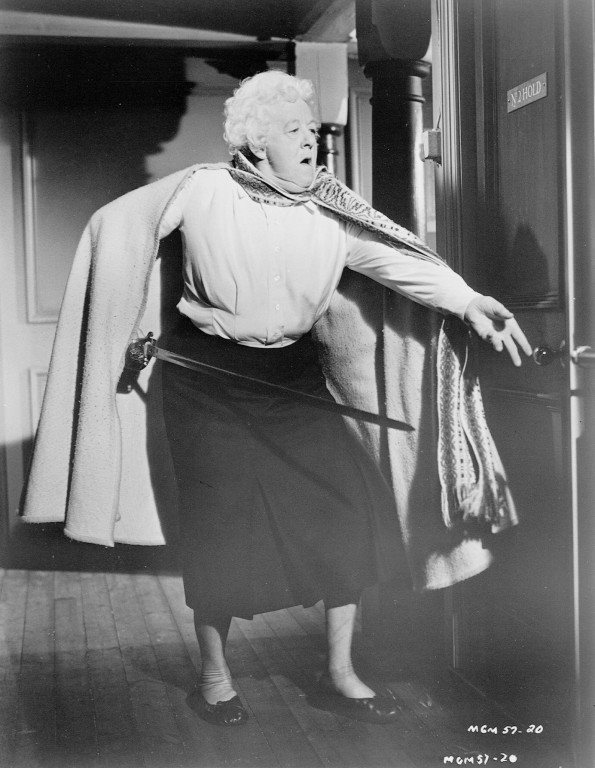
    Ron Goodwin wrote the music for a series of Agatha Christie adaptations that starred Margaret Rutherford as Miss Marple. In the first of these, “Murder She Said” (1961), Marple goes undercover as a domestic servant. The Miss Marple theme became a popular hit, which you may still recognize.

    Bette Davis enjoyed something of a comeback following her turn in “Whatever Happened to Baby Jane?,” opposite Joan Crawford. The film singlehandedly defined a subgenre which has been variously described as “psycho-biddy,” “hag horror,” “hagsploitation” and “grande dame guignol.” Camp and black comedy are essential elements. “Dead Ringer” (1964) was yet another “bad twin” film, with Davis’ delicious performance underscored by André Previn.

    Sir Laurence Olivier and Michael Caine play a deadly game of cat and mouse, as a mystery writer plans to exact revenge on his wife’s lover, in a big screen adaptation of Anthony Shaffer’s play, “Sleuth” (1972). John Addison, who had previously harpsichorded his way to an Academy Award with his score for “Tom Jones,” wrote the impish music.

    Finally, Barbara Harris plays a fake psychic and Bruce Dern her cab-driving, private investigator boyfriend, who become embroiled with serial kidnappers, in Alfred Hitchcock’s final film, “Family Plot” (1976). The composer was none other than John Williams, poised between his breakout success, “Jaws,” and “Star Wars,” which was to make him a household name. (Both “Jaws” and “Star Wars” were Academy Award winners for Best Original Score),

    Hitchcock was full of suggestions as to the music and how it should be conducted. The composer recollects that on one occasion, when trying to convey the tone he was seeking, Hitch remarked, “Mr. Williams, murder can be fun.”

    I hope you’ll join me for an hour of “arch harpsichords” this week on “Picture Perfect,” this Friday evening at 6 ET, with a repeat Saturday morning at 6, or that you’ll listen to it later as a webcast at http://www.wwfm.org.


  • Ravel’s Trio & Rediscovering Casella

    Ravel’s Trio & Rediscovering Casella

    by 

    in
    3 responses

    One hundred years ago today, the world was introduced to Maurice Ravel’s Piano Trio in A Minor. It was first performed in Paris by Gabriel Wilaume, violin, Louis Feuillard, cello, and at the keyboard, none other than the composer Alfredo Casella.

    To be able to hear any of Casella’s own music in concert these days is a rarity, but it was just announced yesterday that his Symphony No. 2 will feature on a concert next season by The Philadelphia Orchestra. Gianandrea Noseda will conduct. Last season, he directed the orchestra in a colorful suite from Casella’s opera, “La donna serpente” (“The Snake Woman”).

    The composer’s star may have faded, but his music has been increasingly present in recordings in recent years. A figure of the so-called “generazione dell’ottanta” (“Generation of ’80” – a group of composers born around 1880 – alongside Gian Francesco Malipiero, Ildebrando Pizzetti, Franco Alfano and Ottorino Respighi), Casella impressed music-loving Philadelphians of an earlier era to the extent that his Serenata, Op. 46, split the vote in a chamber music contest held by The Musical Fund Society in 1926. The rest of the prize money went to Béla Bartók, for his String Quartet No. 3.

    Casella’s “Concerto Romano” was inspired by the Wanamaker Organ.

    Here’s Ravel’s Piano Trio (with Yehudi Menuhin, Gaspar Cassadó and Louis Kentner):

    And the first movement of Casella’s Serenata for Clarinet, Bassoon, Trumpet, Violin and Cello:

    PHOTO: Casella in spats!


Tag Cloud

Aaron Copland (93) Beethoven (95) Composer (114) Film Music (144) Film Score (143) Film Scores (255) Halloween (94) John Williams (195) KWAX (229) Leonard Bernstein (104) Marlboro Music Festival (125) Movie Music (159) Mozart (91) Opera (212) Philadelphia Orchestra (89) Picture Perfect (174) Princeton Symphony Orchestra (109) Radio (88) Ross Amico (244) Roy's Tie-Dye Sci-Fi Corner (290) The Classical Network (101) The Lost Chord (269) Vaughan Williams (105) WPRB (397) WWFM (881)

DON’T MISS A BEAT

Receive a weekly digest every Sunday at noon by signing up here


RECENT POSTS