• Sherlock Holmes Movie Music on Picture Perfect

    Sherlock Holmes Movie Music on Picture Perfect

    by 

    in
    4 responses

    The game’s afoot!

    This week on “Picture Perfect,” it’s an hour of music from movies inspired by the world’s greatest detective.

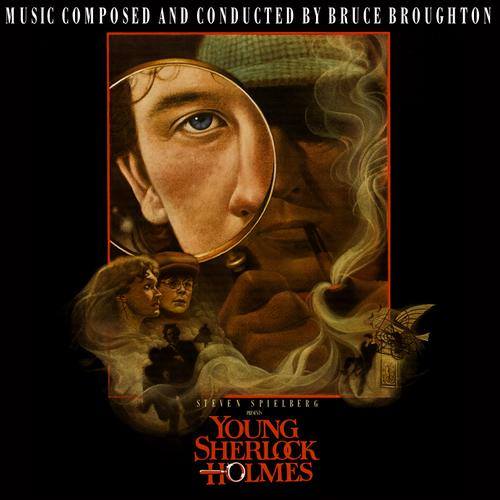
    Intrada Records has released the soundtrack to Bruce Broughton’s “Young Sherlock Holmes,” which is finally making it to compact disc after the better part of three decades.

    Steven Spielberg produced the 1985 film, which offers a conjectural origins story, including Holmes and Watson’s first meeting as teenagers (ignoring the particulars laid out by Arthur Conan Doyle in his stories, with Watson already a war veteran who had served in Afghanistan).

    It’s all for fun, though it’s unfortunate the filmmakers felt the need to interject ‘80s-style special effects, rather than simply trust in the inherent magic of the subject matter. “Young Sherlock Holmes” features the first photorealistic, fully computer-generated character. Also, some Indiana Jones B-movie antics involving an Egyptian cult seem especially out of place.

    Interestingly, the film’s screenwriter, Chris Columbus, went on to direct the first two Harry Potter films. By my recollection, “Young Sherlock Holmes,” with its boarding school setting, has some of that same feel.

    The music is certainly buoyant and beautiful, in the best John Williams tradition. Broughton, who’s probably best-known for his rousing music for the western “Silverado,” was one of the great film music hopes of the 1980s. He did score a handful of big screen hits, notably “Tombstone,” though arguably it is in the medium of television that he’s made his greatest impact. Thus far, his work has been recognized with a record 10 Grammy Awards.

    Also featured will be selections from Hans Zimmer’s score for the Robert Downey, Jr., “Sherlock Holmes” (2009), Miklós Rózsa’s lovely, melancholy music for “The Private Life of Sherlock Holmes” (1970), and Henry Mancini’s theme for the tame Holmes comedy “Without a Clue” (1988).

    It’s elementary, my dear Watson. “Picture Perfect” can be heard this Friday evening at 6 ET, or later as a webcast, at http://www.wwfm.org.

  • Brahms and Tchaikovsky Birthday

    Brahms and Tchaikovsky Birthday

    by 

    in
    3 responses

    Now, now, boys! Play nice.

    Today is the shared birthday of Brahms and Tchaikovsky, two of the great musical geniuses of their time. Brahms was born in 1833, and Tchaikovsky was born in 1840.

    Of course, Brahms has the advantage of the Austro-German propaganda machine, placing him at the center of the musical universe (although it didn’t help him with George Bernard Shaw, who described him as “a sentimental voluptuary”); Tchaikovsky has taken it on the chin not only for being born outside the German tradition, but also from his own countrymen for being too “cosmopolitan.”

    Yet audiences go crazy for his ballets, concertos and symphonies. Give him some credit for achieving such polish in a country that, until around the time of his birth, had very little serious musical tradition of its own. With his gift for melody and pathos, and his talent as an orchestrator, he would have flourished no matter where he lived.

    Brahms too was a natural. Sometimes his symphonies can seem a little over-breaded, and on occasion he can come across as something of a stuffed owl. But even so, he is Minerva’s owl, wise, learned and all-knowing. His piano works and chamber music are some of the best there are.

    Interestingly, the two composers actually met twice, and they got along smashingly. In a letter to his publisher, Tchaikovsky was effusive about Brahms’ cheerfulness and lack of pretension.

    “I’ve been on the booze with Brahms,” he wrote. “He is tremendously nice – not at all proud as I’d expected but remarkably straightforward and entirely without arrogance. He has a very cheerful disposition, and I must say that the hours I spent in his company have left me with nothing but pleasant memories.”

    That was in 1888, after a rehearsal of Brahms’ Piano Trio No. 3 in Leipzig.

    The following year, the two met again in Hamburg, where Brahms slept through a rehearsal of Tchaikovsky’s Symphony No. 5. If Tchaikovsky was insulted, he bore it lightly and was convivial all through the meal they shared after. Although Brahms was harsh in his assessment of the last movement of the symphony and Tchaikovsky confessed an overall aversion to Brahms’ style, the two seem to have parted great friends. Tchaikovsky even invited Brahms to visit him in Russia, something which never came to pass.

    How much alcohol played into the two men’s warm feelings we can only guess. It was not just anyone who could be Brahms’ drinking buddy.

    Who was the better composer? Who cares. In an open heart, there is room for both. Happy Birthday, Brahms and Tchaikovsky!


  • Yom Ha’atzmaut Celebrate Israeli Independence Day

    Yom Ha’atzmaut Celebrate Israeli Independence Day

    by 

    in
    4 responses

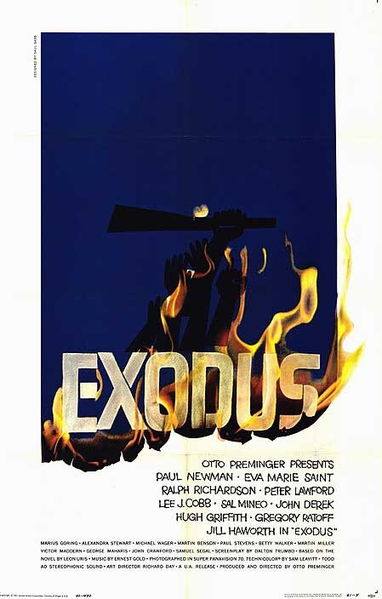
    May 6 is Yom Ha’atzmaut, Israeli Independence Day. Just try to get Ernest Gold’s music out of your head.


  • Tyrone Power A Centennial Celebration

    Tyrone Power A Centennial Celebration

    by 

    in
    5 responses

    Today would have been the 100th birthday of Tyrone Power. Power, one of the biggest box office draws of his day (in 1939, he was second only to Mickey Rooney), is remembered primarily for his swashbucklers and costume dramas, though he appeared in just about every genre.

    He was a hero in real life, as well, serving as a Marine pilot in World War II, during which he flew in cargo and flew out the wounded during the Battles of Iwo Jima and Okinanawa.

    He was descended from a long line of distinguished actors, dating back to his great-grandfather (also named Tyrone Power), who was born in 1795. He was also related to Laurence Olivier and theatrical director Tyrone Guthrie.

    In the 1950s, increasingly dissatisfied with the roles he was being offered, Power started to devote more time to the stage. Not wanting to completely alienate one of their most profitable stars, 20th Century Fox began to offer him more latitude in choosing his projects.

    Sadly, Power died of a massive heart attack while shooting a duel with George Sanders in King Vidor’s “Solomon and Sheba” in 1958. He was 44 years old.

    It was pretty standard during the Golden Age of Hollywood for actors to appear as just about any ethnicity. Though he himself was of Irish, English and French Huguenot ancestry, Power was cast as Hispanic or Latino on several occasions, most notably as the matador in “Blood and Sand” and of course as Don Diego Vega and his alter ego in “The Mark of Zorro.”

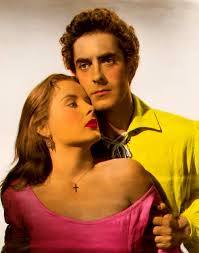
    I don’t intend this as a backhanded salute to Cinco de Mayo – I am sure there must be justifiable ambivalence over the Spanish conquest of Latin America among a certain segment of the population – but here’s Power in all his glory, from “Captain from Castile” (1947).

    “Captain from Castile” was filmed on location in Mexico and incorporates a real volcano in mid-eruption. The stirring music is by Alfred Newman.

    Main title: https://www.youtube.com/watch?v=JqTNEssSe2M

    The famous Conquest march: https://www.youtube.com/watch?v=eXVWSAMq6aA

    Theatrical trailer (not in Technicolor?!): https://www.youtube.com/watch?v=VB62g7-H8Kc

    PHOTO: Power with Jean Peters


  • Mexican Music for Cinco de Mayo Weekend

    Mexican Music for Cinco de Mayo Weekend

    by 

    in
    9 responses

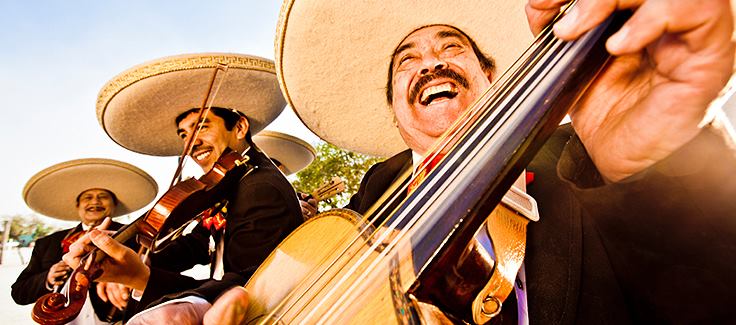
    This Sunday night on “The Lost Chord,” it’s all Mexican music on the eve of Cinco de Mayo. We’ll hear a fun solfeggio piece (“Sol-fa de Pedro”) by the baroque composer Manuel de Zumaya. Zumaya, born in Mexico around 1678, is believed to have written the first opera in the western hemisphere. He became chapel master of Mexico City Cathedral in 1715.

    Blas Galindo is best known in the United States for the evocative “Sones de Mariachi.” But he composed over 150 works, including seven ballets. One of these was “La Manda,” or “The Vow,” written in 1951. The scenario is a bit of downer, about an ailing wife on a pilgrimage who believes she is losing her husband to another woman, but the music is full of distinct nationalist character.

    Manuel Ponce is one of Mexico’s most famous composers. He’s probably best recognized for his guitar music, thanks to his association with Andrés Segovia. Less frequently heard is his Violin Concerto of 1942. We’ll have the soloist who gave the work its premiere, Henryk Szeryng, in a recording made some forty years later.

    Pour yourself a Corona, mix up some guacamole, and enjoy “Mayo My,” Mexican music for Cinco de Mayo, Sunday night at 10 ET, with a repeat Thursday night at 11, or listen to it later as a webcast at http://www.wwfm.org.


Tag Cloud

Aaron Copland (93) Beethoven (95) Composer (114) Film Music (144) Film Score (143) Film Scores (255) Halloween (94) John Williams (195) KWAX (229) Leonard Bernstein (104) Marlboro Music Festival (125) Movie Music (159) Mozart (90) Opera (212) Philadelphia Orchestra (89) Picture Perfect (174) Princeton Symphony Orchestra (109) Radio (88) Ross Amico (244) Roy's Tie-Dye Sci-Fi Corner (290) The Classical Network (101) The Lost Chord (269) Vaughan Williams (105) WPRB (397) WWFM (881)

DON’T MISS A BEAT

Receive a weekly digest every Sunday at noon by signing up here


RECENT POSTS