• Fritz Kreisler Sesquicentennial: Violin Legend

    Fritz Kreisler Sesquicentennial: Violin Legend

    by 

    in
    4 responses

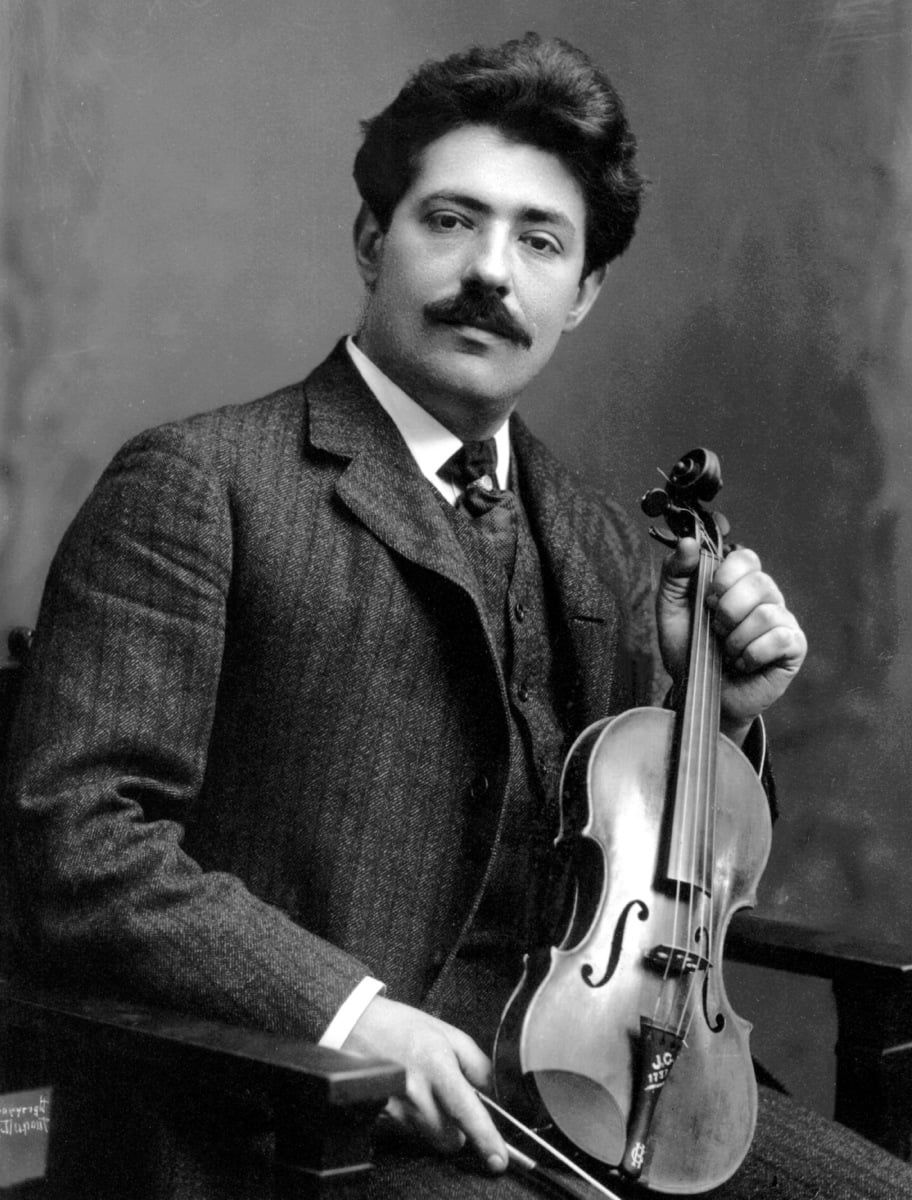
    Somehow, as I was in the thrall of the groundhog yesterday, I failed to equate February 2 with the birthday of Fritz Kreisler. And I’d had my eye on it, too, because it happened to be an important one. Kreisler was born on February 2, 1875 – 150 years ago.

    In contrast to the cool intensity of his colleague, the great violinist Jascha Heifetz, who subjected himself to a punishing, though strictly secret, regimen of self-discipline in pursuit of superhuman perfection, Kreisler was warm, gregarious, and easygoing. As a sweet-toned confectioner and purveyor of violin bonbons, Kreisler ruffled feathers, not with his playing, but because he casually let slip that many of the 18th century “rediscoveries” he had used to charm audiences, critics, and musicologists were not in fact rediscoveries at all. Nor did they date from the 18th century. Rather they were composed by Kreisler himself. When the professionals complained, Kreisler shrugged.

    It would be futile to argue against his serious musical credentials. He gave the world premiere of the Elgar concerto and became a favorite recital partner of Sergei Rachmaninoff. A famous anecdote relates that Kreisler and Rachmaninoff were giving a concert in New York. In the middle of a performance, Kreisler suffered a memory lapse, and as he noodled around on his violin, trying to find his way back, he inched closer to his pianist. “Where are we?” Kreisler whispered. To which Rachmaninoff replied, “Carnegie Hall.”

    In 1941, Kreisler was crossing the street, when he was hit by a milk truck. The accident fractured his skull and put him in a coma. Like something out of an early Woody Allen comedy, when he awoke, he could communicate only in Latin and Greek. Thankfully, the effect was only temporary.

    Kreisler met Heifetz, with whom he shared a birthday (Heifetz was born in Vilnius on February 2, 1901), for the first time at a private press party in 1912. After listening to the boy play through the Mendelssohn concerto, Heifetz declared, “We can all just break our fiddles over our knees.”

    Happy belated birthday, and a joyous sesquicentennial, Fritz Kreisler. And since February 3 happens to be the anniversary of the birth of Felix Mendelssohn, here’s Kreisler performing Mendelssohn’s evergreen concerto.

    Kreisler plays the “Meditation” from Massenet’s “Thaïs”

    Kreisler, master of the miniature

    Kreisler and Rachmaninoff play Schubert

    Kreisler plays Rachmaninoff

    Rachmaninoff plays Kreisler

    Kreisler with John McCormack, in an aria from Benjamin Godard’s “Jocelyn”

    Two-part radio interview on the occasion of Kreisler’s 80th birthday, with spoken tributes from Elman, Menuhin, Milstein, Stern, Szigeti and others:


  • Fritz Kreisler Autograph Find

    Fritz Kreisler Autograph Find

    by 

    in
    3 responses

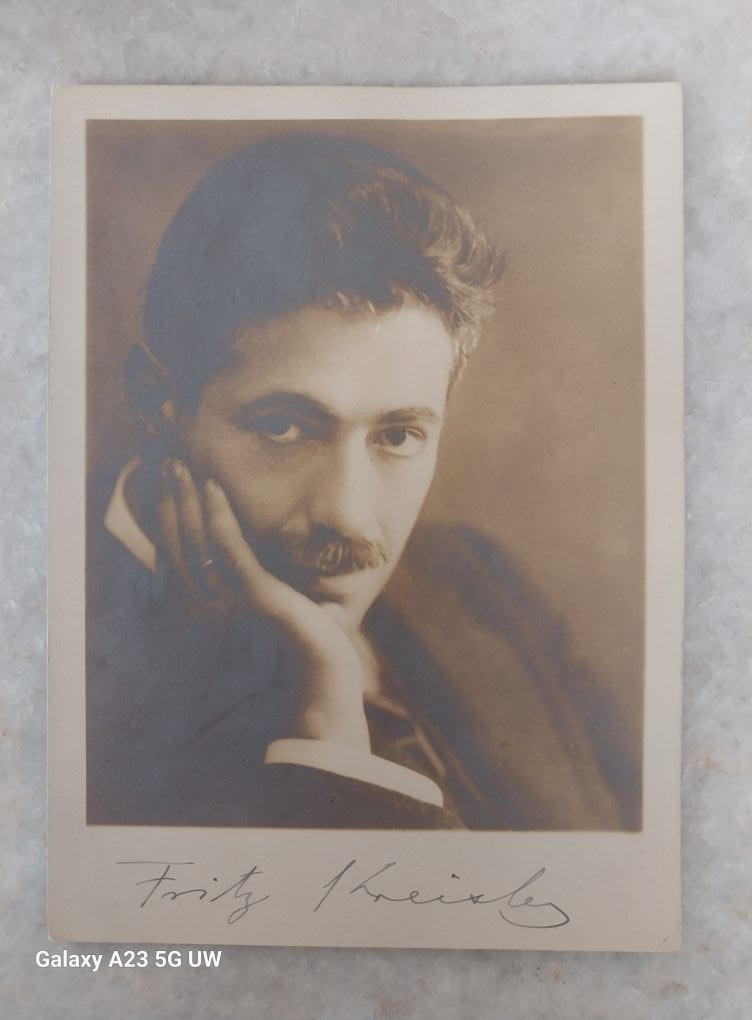
    Eesh. I totally forgot I have an autographed photo of Fritz Kreisler.


  • Beardsley’s Mendelssohn Grotesque Genius

    Beardsley’s Mendelssohn Grotesque Genius

    by 

    in
    7 responses

    A caricature of Felix Mendelssohn from 1896 by Aubrey Beardsley. Beardsley was a leading figure in the Aesthetic Movement of fin-de-siècle England that also included Oscar Wilde and James McNeill Whistler.

    Traveling to Paris, Beardsley encountered the poster art of Henri Toulouse-Lautrec and a rage for Japanese prints. He managed to assimilate these influences, in addition to Pre-Raphaelite models, especially Edward Burne-Jones, in the development of his own distinctive style and contributed significantly to the development of Art Nouveau.

    His frequent choice of decadent, grotesque, and salacious subject matter was a cause of continuous controversy, until his early death of tuberculosis at the age of 25.

    Salome, I get… but Mendelssohn???


  • Groundhog Day Fun Predicting Winter’s End

    Groundhog Day Fun Predicting Winter’s End

    by 

    in
    4 responses

    I love how every year on February 2 everyone from scientists to journalists to scoffers on the street (or at any rate those on the internet) all feel compelled to point out that groundhogs aren’t really able to predict the weather. Oh, REALLY? I suppose there’s no Tooth Fairy either. These anemic killjoys are free to scowl over their soulless weather apps until the blue light eats away their maculae; I don’t want to live in a world without a prognosticating groundhog. This year even the calendar falls in with the mystic rodent. Six weeks until March 20 = six more weeks of winter! All hail Punxsutawney Phil!


  • Black Composers Shine on KWAX Radio

    Black Composers Shine on KWAX Radio

    by 

    in
    4 responses

    Very little is known about the Chevalier de Meude-Monpas. Among what we DO know is that he was a musketeer in the service of Louis XVI, who went into exile with the onset of the French Revolution. He also studied music in Paris and published six concertos for violin in 1786. In 1997, violinist Rachel Barton (now Rachel Barton Pine) put together a revelatory album for Cedille Records, “Violin Concertos by Black Composers of the 18th and 19th Centuries.” Meude-Monpas’ Violin Concerto No. 4 will be among the featured works this morning on “Sweetness and Light,” cumulatively guaranteed to put a smile on your face.*

    Much better known, William Grant Still was regarded in his day as the “Dean of Afro-American Composers.” He the first composer of color to have a symphony performed by a major orchestra, the first to have a symphony widely performed, the first to conduct a major orchestra, and the first to have an opera televised nationally. A pupil of both George Whitefield Chadwick and Edgard Varèse, Still certainly had “serious” credentials, but he also worked in pit bands and wrote arrangements for Hollywood musicals. In many senses, he was the quintessential American composer. Also, he always knew how to write a good tune. This morning we’ll enjoy his “Danzas de Panama,” performed by the Oregon String Quartet.

    It took nearly 90 years for Florence Price to become an overnight success. Price was the first African American woman to have a symphony performed by a major orchestra. Her Symphony No. 1 was played by the Chicago Symphony, conducted by Frederick Stock, in 1933. But it’s only fairly recently, after decades of comparative neglect, that her music has finally begun to gain traction. From a 2-disc set devoted to her piano works on the Guild label, we’ll hear Kirsten Johnson play “Dreamboat.”

    Duke Ellington requires little introduction. He was a major figure in American music, especially in the field of jazz. But for the past hundred years or so, there has been quite a bit of “blurring of the lines” between genres of art music. In 1943, Ellington composed “New World a-Comin’,” a work for piano and 15-piece band. He never wrote down the piano part, so it was reconstructed by ear by Maurice Peress from a recording made of an Ellington concert at Carnegie Hall in 1943. Subsequently, Peress expanded the jazz band to full orchestra. The soloist on the recording we’ll hear, Jeffrey Biegel, obtained permission from Sir Roland Hanna to transcribe the improvised final cadenza from a recording Hanna made with the American Symphony Orchestra under Peress’ baton.

    So, yeah, it’s February 1 – Black History Month – not that any excuse is required to share these delights. But it does ensure that they will make it to the air waves and, hopefully, your ears. We’ll be enjoying our coffee black on “Sweetness and Light,” this Saturday morning at 11:00 EST/8:00 PST, exclusively on KWAX, the radio station of the University of Oregon!

    Stream it, wherever you are, at the link:

    https://kwax.uoregon.edu/


    • Please note: Meude-Monpas is not to be confused with that other swashbuckling composer, the Chevalier de Saint-Georges, whose music also appears on Barton Pine’s record.

Tag Cloud

Aaron Copland (93) Beethoven (95) Composer (114) Film Music (144) Film Score (143) Film Scores (255) Halloween (94) John Williams (195) KWAX (229) Leonard Bernstein (104) Marlboro Music Festival (125) Movie Music (159) Mozart (91) Opera (213) Philadelphia Orchestra (89) Picture Perfect (174) Princeton Symphony Orchestra (109) Radio (88) Ross Amico (244) Roy's Tie-Dye Sci-Fi Corner (290) The Classical Network (101) The Lost Chord (269) Vaughan Williams (105) WPRB (397) WWFM (881)

DON’T MISS A BEAT

Receive a weekly digest every Sunday at noon by signing up here


RECENT POSTS