Tag: Abraham Lincoln

  • Lincoln Walks: Price Harris & a Nation’s Burden

    Lincoln Walks: Price Harris & a Nation’s Burden

    Before “Lincoln in the Bardo,” there was “Abraham Lincoln Walks at Midnight.”

    Vachel Lindsay’s poem, written in 1914, portrays Lincoln stirring from his eternal rest to roam the streets of Springfield, Illinois, still burdened by the nation’s troubles. I’d hate to think what Lincoln’s spirit must be going through today.

    On Lincoln’s birthday, here’s Florence Price’s setting of Lindsay’s meditation. It is one of three Price settings of the poem rediscovered in 2009. From the information available, it would seem that all three would fit on one album. Somebody record these, please!

    By coincidence, today also happens to be the anniversary of the birth of Roy Harris. Born on Lincoln’s birthday in 1898 – in a log cabin in Lincoln County, Oklahoma – surely Harris must have been filled with an apposite sense of destiny. Harris also set Lindsay’s poem, for mezzo-soprano, violin, cello and piano.

    Harris was regarded as one of America’s greatest composers. He was particularly renowned for his symphonies. His Symphony No. 3 is his most famous work. The Symphony No. 6, formulated over a reading of Sandburg, is subtitled “Gettysburg.”

    Each of the four movements bears a superscription from Lincoln’s Gettysburg Address:

    I. Awakening (“Fourscore and seven years ago…”);

    II. Conflict (“Now we are engaged in a great civil war…”);

    III. Dedication (“We are met on a great battlefield of that war…”);

    IV. Affirmation (“…that we here highly resolve that these dead shall not have died in vain…).

    I call that putting a Price on linkin’ Harris and Lincoln.


    “Abraham Lincoln Walks at Midnight”

    (In Springfield, Illinois)

    It is portentous, and a thing of state
    That here at midnight, in our little town
    A mourning figure walks, and will not rest,
    Near the old court-house pacing up and down,

    Or by his homestead, or in shadowed yards
    He lingers where his children used to play,
    Or through the market, on the well-worn stones
    He stalks until the dawn-stars burn away.

    A bronzed, lank man! His suit of ancient black,
    A famous high top-hat and plain worn shawl
    Make him the quaint great figure that men love,
    The prairie-lawyer, master of us all.

    He cannot sleep upon his hillside now.
    He is among us:—as in times before!
    And we who toss and lie awake for long,
    Breathe deep, and start, to see him pass the door.

    His head is bowed. He thinks of men and kings.
    Yea, when the sick world cries, how can he sleep?
    Too many peasants fight, they know not why;
    Too many homesteads in black terror weep.

    The sins of all the war-lords burn his heart.
    He sees the dreadnaughts scouring every main.
    He carries on his shawl-wrapped shoulders now
    The bitterness, the folly and the pain.

    He cannot rest until a spirit-dawn
    Shall come;—the shining hope of Europe free:
    A league of sober folk, the Workers’ Earth,
    Bringing long peace to Cornland, Alp and Sea.

    It breaks his heart that things must murder still,
    That all his hours of travail here for men
    Seem yet in vain. And who will bring white peace
    That he may sleep upon his hill again?


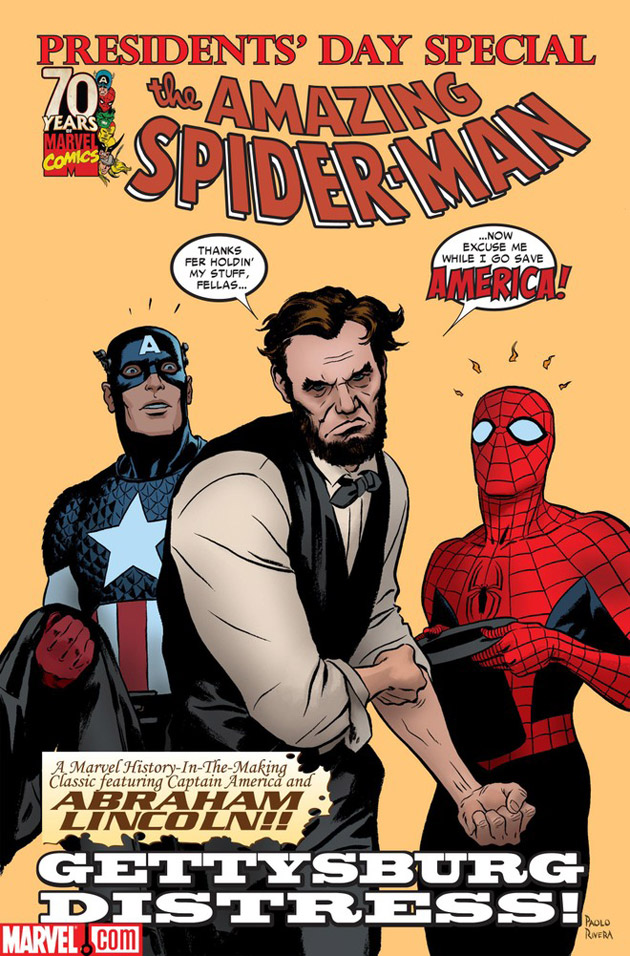
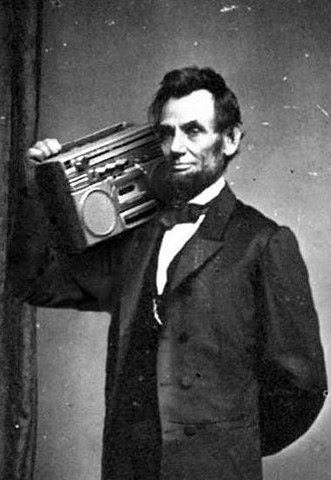
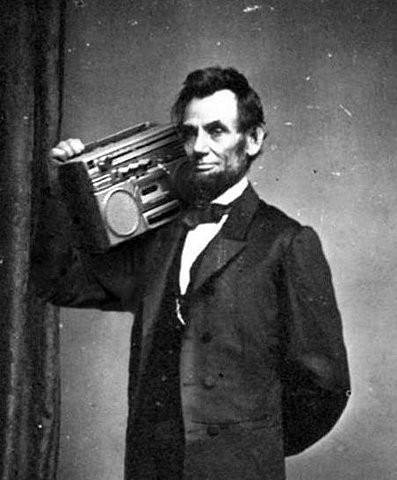
    Clockwise from upper right: Florence Price, Roy Harris, and Abraham Lincoln walking at midnight
  • Lincoln, the Marine Band, and Gettysburg

    Lincoln, the Marine Band, and Gettysburg

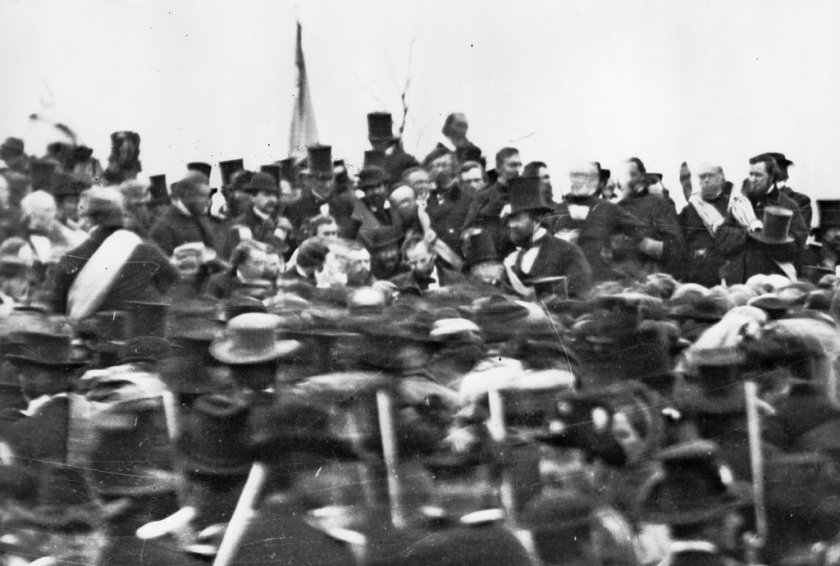
    On November 18, 1863, the United States Marine Band accompanied President Abraham Lincoln to Gettysburg for the dedication of the Soldiers’ National Cemetery there, for which Lincoln was to deliver his celebrated Gettysburg Address.

    Lincoln and the band traveled by train from Washington, by way of Baltimore and Hanover Junction. Directed by Francis M. Scala, the 27-member ensemble, which included trombonist Antonio Sousa, father of John Philip Sousa, serenaded the president on route with a lunchtime concert.

    The next day, November 19th, 157 years ago this afternoon, members of “The President’s Own” performed the “Old Hundred” at the consecration and dedication ceremony, with Lincoln honoring those who fell. According to an article in the Washington Daily Morning Chronicle, the music was played “with great effect, in all its grand and sublime beauty.”

    Lincoln’s Address had a more divided reception – ironic, since this modest, three-minute speech is now ensconced as one of the most hallowed pieces of American oratory. We as Americans have revered Lincoln’s noble sentiments since childhood, for generations, as well we should. It is all the more striking, when viewed through the lens of the present, for not labeling those who laid down their lives as “losers” and for delivering a message of national unity – and respect – at a time of unprecedented national conflict. It doesn’t get more patriotic than that.

    A copy of the Address, signed and dated by President Lincoln, is on display in the Lincoln Room at the White House – a room apparently never visited by the outgoing administration. Here is a reminder of what Lincoln said regarding the sacrifice of those who died.

    “Four score and seven years ago our fathers brought forth on this continent, a new nation, conceived in Liberty, and dedicated to the proposition that all men are created equal.

    “Now we are engaged in a great civil war, testing whether that nation, or any nation so conceived and so dedicated, can long endure. We are met on a great battle-field of that war. We have come to dedicate a portion of that field, as a final resting place for those who here gave their lives that that nation might live. It is altogether fitting and proper that we should do this.

    “But, in a larger sense, we can not dedicate – we can not consecrate – we can not hallow – this ground. The brave men, living and dead, who struggled here, have consecrated it, far above our poor power to add or detract. The world will little note, nor long remember what we say here, but it can never forget what they did here. It is for us the living, rather, to be dedicated here to the unfinished work which they who fought here have thus far so nobly advanced. It is rather for us to be here dedicated to the great task remaining before us – that from these honored dead we take increased devotion to that cause for which they gave the last full measure of devotion – that we here highly resolve that these dead shall not have died in vain – that this nation, under God, shall have a new birth of freedom – and that government of the people, by the people, for the people, shall not perish from the earth.”

    Abraham Lincoln
    November 19, 1863

    https://www.tecom.marines.mil/News/News-Article-Display/Article/527553/the-gettysburg-address-2-minutes-that-changed-a-young-nation-forever/

    The Marine Band at Gettysburg:

    http://tapsbugler.com/wp-content/uploads/2018/11/Lincoln-and-The-Marine-BAnd-at-Gettysburg.pdf

    Copland’s “Lincoln Portrait,” narrated by James Earl Jones:

  • Lincoln’s Birthday Celebrated with Music

    Lincoln’s Birthday Celebrated with Music

    Happy birthday, Abraham Lincoln! We’re honoring you right now, with Aaron Copland’s “Lincoln Portrait” (with Marian Anderson narrating and the composer conducting the Philadelphia Orchestra) and Roy Harris’ Symphony No. 6 “Gettysburg.” These musical celebrations top an afternoon of Lincoln tributes. It’s all Abe until 4 p.m. EST, on WWFM – The Classical Network and wwfm.org.

  • Sounds of Light and Shade New Music Concerts

    Sounds of Light and Shade New Music Concerts

    So what exactly do light and shade sound like? Network for New Music would have us know.

    Join me for today’s Noontime Concert on The Classical Network as we listen to pieces by contemporary composers Ingrid Arauco, Anna Weesner, Morton Feldman, Joan Tower, Pierre Jalbert, and Augusta Read Thomas, most of them presented under the unifying theme of “The Sounds of Light and Shade.”

    Network for New Music’s mission is to perform a great diversity of new musical works of the highest quality by both established and emerging composers; to strengthen the new music community in the Philadelphia region; and to build support for new music by engaging in artistic and institutional collaborations, as well as educational activities. Now in its 34th year, Network for New Music has commissioned 147 works from leading composers.

    The organization’s next program, “Millennial Music,” will be presented twice: this Sunday at 3 p.m. at the University of Pennsylvania’s Rose Hall, 3340 Walnut Street in Philadelphia, and Monday at 7:30 p.m. at Stockton University’s Campus Center Theatre, 101 Vera King Farris Drive, in Galloway, NJ. For more information and a complete schedule, look online at networkfornewmusic.org.

    Featured prominently on today’s broadcast, as well as on the upcoming concerts, will be Clipper Erickson, piano. Erickson is arguably the world’s foremost champion of the music of R. Nathaniel Dett.

    Dett was born in what is now Niagara Falls, Ontario. The grandson of a former slave who found freedom on the Underground Railroad, he became an important figure in the American music of his time. Yet if he is remembered at all, it is probably for his piano suite, “In the Bottoms,” or perhaps only its concluding dance, “Juba,” which was championed by Percy Grainger and others.

    Erickson was the first to record Dett’s complete piano works. We’ll sample some of them following today’s concert, from a 2-CD set, “My Cup Runneth Over,” issued on Navona Records, PARMA Recordings.

    Then it’s music in celebration of the Great Emancipator, on this, Abraham Lincoln’s birthday. Stick around for Robert Russell Bennett’s “Abraham Lincoln: A Likeness in Symphony Form,” Jennifer Higdon’s “Dooryard Bloom,” Roy Harris’ Symphony No. 6 “Gettysburg,” and of course Aaron Copland’s “Lincoln Portrait,” in a live concert recording featuring Marian Anderson as narrator and the Philadelphia Orchestra conducted by the composer.

    Our 16th president will take precedence, this Tuesday afternoon from 12 to 4 p.m. EST, on WWFM – The Classical Network and wwfm.org.


    PHOTOS: Lincoln light and shade

  • Lincoln Birthday Music WWFM

    Lincoln Birthday Music WWFM

    Coming up, it’s a musical celebration of our 16th president. Join me for music by Aaron Copland, Louis Moreau Gottschalk, Roy Harris, Jennifer Higdon, Paul Turok, and John Williams, on this, Abraham Lincoln’s birthday, between 5 and 7:00 p.m. EST, on WWFM – The Classical Network and wwfm.org

Tag Cloud

Aaron Copland (92) Beethoven (95) Composer (114) Film Music (119) Film Score (143) Film Scores (255) Halloween (94) John Williams (185) KWAX (229) Leonard Bernstein (99) Marlboro Music Festival (125) Movie Music (134) Opera (198) Philadelphia Orchestra (86) Picture Perfect (174) Princeton Symphony Orchestra (106) Radio (87) Ralph Vaughan Williams (85) Ross Amico (244) Roy's Tie-Dye Sci-Fi Corner (290) The Classical Network (101) The Lost Chord (268) Vaughan Williams (102) WPRB (396) WWFM (881)

DON’T MISS A BEAT

Receive a weekly digest every Sunday at noon by signing up here


RECENT POSTS