Tag: American Composers

  • American Composers & July 4th Music

    American Composers & July 4th Music

    I can’t guarantee any fife and drum music (I didn’t bring any), but you never know.

    Nonetheless, I can promise wall-to-wall American composers, as we anticipate Independence Day. These may include (and won’t be limited to) George Antheil, Paul Bowles, Romeo Cascarino, John Corigliano, Daniel Dorff, Irving Fine, Lou Harrison, Bernard Herrmann, Jennifer Higdon, Ruth Crawford Seeger, Peter Schickele, Caroline Shaw, Michael Torke, and George Walker.

    I am very pleased to add that Jerry Rife, for 30 years conductor of The Blawenburg Band, has found time in his busy schedule to join me around 9:00 to share just a little bit about the band’s upcoming concerts at Princeton Shopping Center (tonight at 7 p.m.), Yardley Community Centre in Yardley, Pa. (July 4 at 4 p.m.), and Hopewell Train Station (July 6 at 7:30 p.m.).

    It’s pure Americana this week, when you tune in Classic Ross Amico, this morning from 6 to 11 a.m. ET, at WPRB 103.3 FM or online at wprb.com – classical music radio as the Founding Fathers intended.

  • Anderson & Herrmann American Music Legends

    Anderson & Herrmann American Music Legends

    Today marks the birthday anniversaries of two composers who, in their own individual ways, gained fame through their invaluable contributions to American popular culture. Interestingly, both died 40 years ago.

    Leroy Anderson (1908-1975), whose fluency in foreign languages (especially those of Scandinavia) made him an asset to the U.S. Army during the Second World War, was more or less staff composer for the Boston Pops.

    His early work for the Pops was as an arranger. It was Arthur Fiedler who recognized his talent and began requesting original work. Good call. Anderson turned out to be the Irving Berlin of American light orchestral music, producing hit after hit after hit: “Blue Tango,” “The Typewriter,” and “Plink! Plank! Plunk!” among them. Johnny Mathis scored a gargantuan success with his vocal rendition of “Sleigh-Ride,” for over half a century a holiday staple. Anderson’s “The Syncopated Clock,” a favorite from the start, became further entrenched in the popular consciousness as the theme music for “The Late Show,” the late night movie, shown on CBS.

    Bernard Herrmann (1911-1975) was staff conductor on CBS radio. In this role, he introduced American audiences to an impressive array of comparatively arcane music for the era, including works by Charles Ives, Nikolai Myaskovsky, Gian Francesco Malipiero, Edmund Rubbra, and Richard Arnell (Classical Discoveries’ Marvin Rosen!).

    He fell in with Orson Welles, with whom he worked on radio shows like “Mercury Theatre on the Air.” When Welles went to Hollywood, he brought Herrmann with him to write the music for “Citizen Kane.” This led to decades of finely-crafted film scores, always orchestrated by Herrmann himself (an unusual practice in Hollywood) and always perfectly suited to the images on screen, or their psychological underpinnings.

    Of course, Herrmann is best-known for his collaborations with Alfred Hitchcock, but he also wrote top-notch, ear-opening scores for producer Charles Schneer and special effects artist Ray Harryhausen (including that for “Jason and the Argonauts”). Amazingly, he won only a single Oscar, for his work on “The Devil and Daniel Webster,” in 1941. Herrmann died of a heart attack shortly after conducting the recording sessions for Martin Scorsese’s “Taxi Driver,” in 1975.

    Happy birthday, gentlemen! Thanks for the music.

  • American Composers & Arthurian Legend

    American Composers & Arthurian Legend

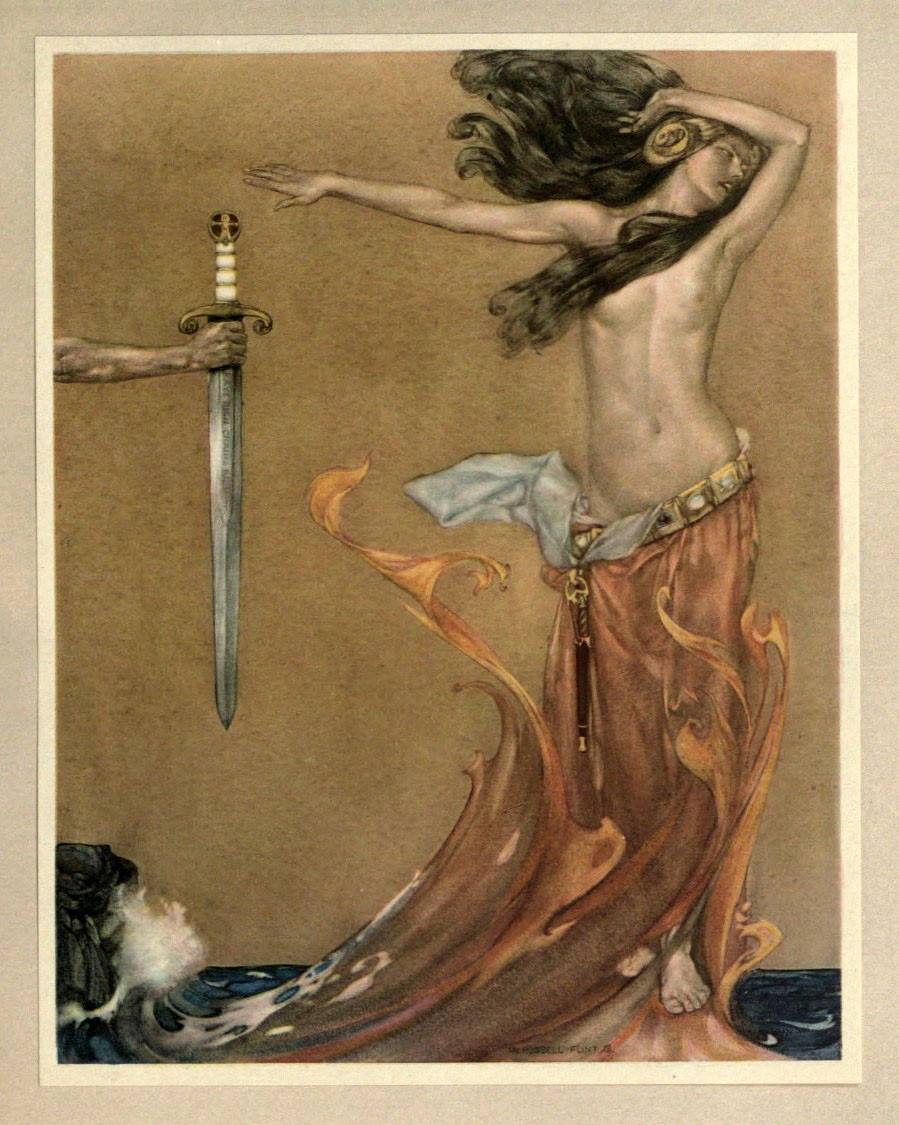
    In the wake of Hurricane Arthur, while continuing to honor our native musical heritage on this Independence Day weekend, this Sunday night on “The Lost Chord,” the focus will be on treatments of the Arthurian legends by a couple of American Romantics.

    We’ll hear “Excalibur,” a symphonic poem after Arthur’s magic sword, by Louis Coerne (pronounced “Kern”). Coerne was born in Newark, NJ, in 1870. As was the custom at the time, he studied abroad, in France and Germany, then closer to home with John Knowles Paine. In Munich, he pursued organ and composition studies with Josef Rheinberger.

    After that, it was back and forth to Germany, between church and conducting appointments in the United States, and then the assumption of a series of academic posts throughout the American Northeast and Midwest. In his 52 years, despite all the worn shoe leather, he managed to produce 500 works.

    The remainder of the hour will be taken up by the Straussian tone poem “Le Roi Arthur,” a work in three movements, by George Templeton Strong, son of the famous Civil War diarist, born in 1856. Strong, Jr., studied at the Leipzig conservatory, where Joachim Raff was among his teachers. For a time, he played viola in the Gewandhaus Orchestra. He rubbed shoulders with Liszt and Wagner, then was lured back to the United States by the offer of a teaching position at the New England Conservatory (by former European transplant Edward MacDowell).

    However, in part because the work didn’t agree with him, and in part because of health issues, Strong soon took off for Switzerland, where he settled on the banks of Lake Geneva. There, he dedicated the remainder of his life to painting watercolors and composing, even after musical fashion had changed, playing an active role in Geneva’s musical life.

    That’s “Kinetic Yankees in King Arthur’s Court” – treatments of the Arthurian legends by peripatetic American composers. “The Lost Chord” can be heard tonight at 10 ET, with the repeat in its new slot, Friday at 3 a.m. If you’re not a vampire bat, you can listen to it later as a webcast, at http://www.wwfm.org.

Tag Cloud

Aaron Copland (92) Beethoven (95) Composer (114) Film Music (120) Film Score (143) Film Scores (255) Halloween (94) John Williams (185) KWAX (229) Leonard Bernstein (100) Marlboro Music Festival (125) Movie Music (135) Opera (198) Philadelphia Orchestra (88) Picture Perfect (174) Princeton Symphony Orchestra (106) Radio (87) Ralph Vaughan Williams (85) Ross Amico (244) Roy's Tie-Dye Sci-Fi Corner (290) The Classical Network (101) The Lost Chord (268) Vaughan Williams (103) WPRB (396) WWFM (881)

DON’T MISS A BEAT

Receive a weekly digest every Sunday at noon by signing up here


RECENT POSTS