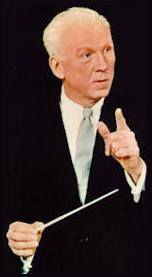
Today marks the birthday anniversaries of two composers who, in their own individual ways, gained fame through their invaluable contributions to American popular culture. Interestingly, both died 40 years ago.
Leroy Anderson (1908-1975), whose fluency in foreign languages (especially those of Scandinavia) made him an asset to the U.S. Army during the Second World War, was more or less staff composer for the Boston Pops.
His early work for the Pops was as an arranger. It was Arthur Fiedler who recognized his talent and began requesting original work. Good call. Anderson turned out to be the Irving Berlin of American light orchestral music, producing hit after hit after hit: “Blue Tango,” “The Typewriter,” and “Plink! Plank! Plunk!” among them. Johnny Mathis scored a gargantuan success with his vocal rendition of “Sleigh-Ride,” for over half a century a holiday staple. Anderson’s “The Syncopated Clock,” a favorite from the start, became further entrenched in the popular consciousness as the theme music for “The Late Show,” the late night movie, shown on CBS.
Bernard Herrmann (1911-1975) was staff conductor on CBS radio. In this role, he introduced American audiences to an impressive array of comparatively arcane music for the era, including works by Charles Ives, Nikolai Myaskovsky, Gian Francesco Malipiero, Edmund Rubbra, and Richard Arnell (Classical Discoveries’ Marvin Rosen!).
He fell in with Orson Welles, with whom he worked on radio shows like “Mercury Theatre on the Air.” When Welles went to Hollywood, he brought Herrmann with him to write the music for “Citizen Kane.” This led to decades of finely-crafted film scores, always orchestrated by Herrmann himself (an unusual practice in Hollywood) and always perfectly suited to the images on screen, or their psychological underpinnings.
Of course, Herrmann is best-known for his collaborations with Alfred Hitchcock, but he also wrote top-notch, ear-opening scores for producer Charles Schneer and special effects artist Ray Harryhausen (including that for “Jason and the Argonauts”). Amazingly, he won only a single Oscar, for his work on “The Devil and Daniel Webster,” in 1941. Herrmann died of a heart attack shortly after conducting the recording sessions for Martin Scorsese’s “Taxi Driver,” in 1975.
Happy birthday, gentlemen! Thanks for the music.
Leave a Reply