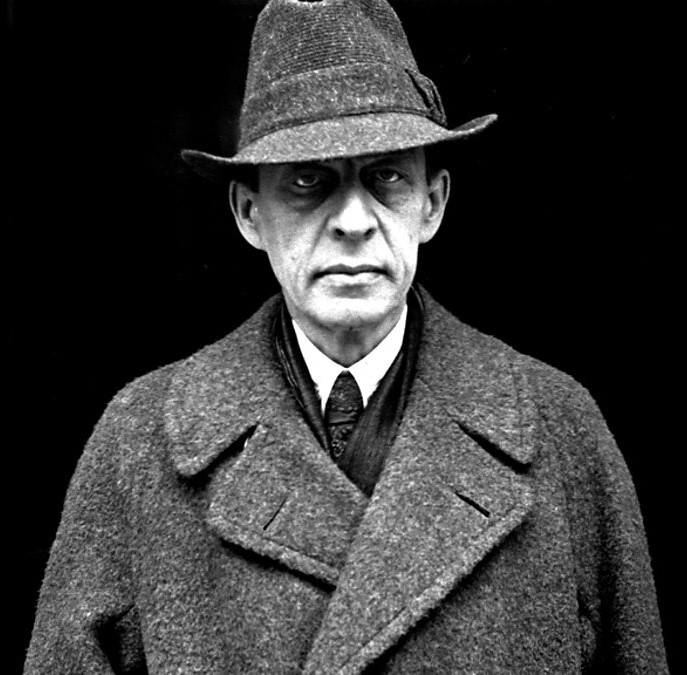
Happy April Fool’s birthday to laugh-riot Sergei Rachmaninoff.
Depending on where you look, Igor Stravinsky described his dour compatriot as either “six-foot-two of Russian gloom” or “a six-and-a-half-foot scowl.” Perhaps both. It’s true, you won’t find very many photos of Rachmaninoff smiling. But just to prove he was not entirely without a sense of humor, I share with you the following anecdote:
Rachmaninoff was a favorite recital partner of violinist Fritz Kreisler. Once, in the middle of a concert in New York, Kreisler suffered a memory lapse. As he continued to noodle on his violin, feigning nonchalance while attempting to grope his way out of the labyrinth, he subtly inched closer to his pianist.
“Where are we?” he whispered.
To which Rachmaninoff replied, “Carnegie Hall.”
On this day devoted to fun and frivolity, the two friends are reunited in spirit in Rachmaninoff’s transcription of Kreisler’s “Liebesfreud,” or “Love’s Joy.”
Also, a shout-out to inadvertent prankster Ferruccio Busoni, another great pianist born on this date. Actually, his parents named him Ferruccio Dante Michelangelo Benvenuto Busoni. So clearly he had a sense of destiny. Or at any rate, he had a lot to prove! Perhaps that’s what spurred him to write what could very well be the most grandiose piano concerto of all time.
Busoni’s concerto swings for the fences, with an epic, 70-minute running time, large orchestration, demanding solo part, and men’s chorus in the finale (which doesn’t start singing until an hour in).
The text, from Adam Oehlenschläger’s verse-drama “Aladdin,” begins:
“Deep and quiet, the pillars of rock begin to sound:
Lift up your hearts to the power eternal,
Feel Allah’s presence, behold all his works!”
In the score, Busoni instructs that the chorus should be “invisible.” Somehow, this was mistranslated, resulting in a widespread belief that he actually wanted the singers to perform nude. Whether or not it’s ever been presented that way (in the interest of authenticity) is anyone’s guess.
Oddly, the concerto isn’t designed as a showcase for a fire-eating virtuoso. Beyond it being something of an endurance test for the soloist, there aren’t really any flashy cadenzas or too many opportunities to hot dog. The work is more like a gargantuan piano fever dream.
I particularly like the movement “All’Italiana,” evocative of Italian folk music and popular song. It always makes me think of Chico Marx.
To give you a sense of perspective, Rachmaninoff’s ever-popular Piano Concerto No. 2, at less than half the length, was first performed three years earlier, in 1901. The work would later be used on the soundtrack to “Brief Encounter.” There is nothing brief about Busoni’s concerto.
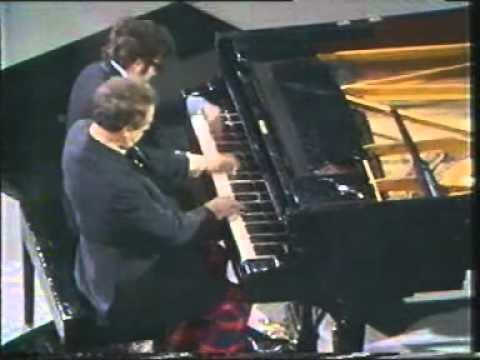
The pianist here is Marc-André Hamelin, who used to come into my bookshop looking for arcane sheet music, back in the day. Just a few years before this video, as a matter of fact. About a decade later, I saw him perform Busoni’s concerto at Carnegie Hall.
The Chico Marx business begins about 46 minutes in. The movement gets zanier and zanier.
Here Eileen Joyce plays Rachmaninoff’s Piano Concerto No. 2 in “Brief Encounter,” with Celia Johnson and a young Trevor Howard:
Happy birthday, Busoni and Rachmaninoff!