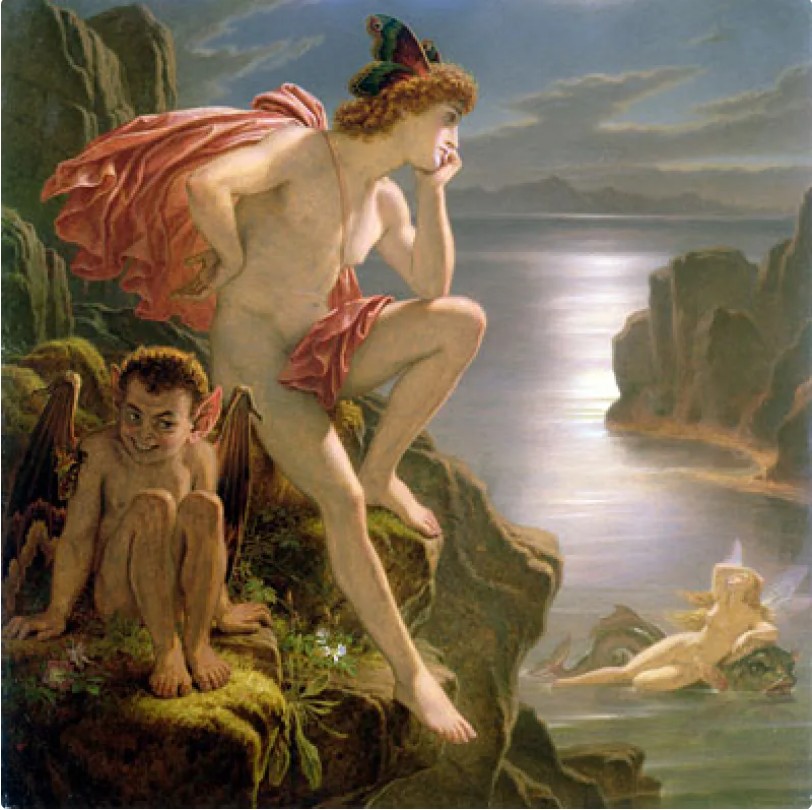
In this year of Carl Maria von Weber anniversaries – the influential German composer died 200 years ago (on June 25, 1826, to be exact) – it’s worthwhile to note the bicentennial of his final opera, actually a singspiel (an opera with spoken dialogue), “Oberon,” which was first performed on this date at Covent Garden, a little more than two months before his passing.
Oberon, of course, is king of the fairies, as we all know from “A Midsummer Night’s Dream.” Weber also imports Puck and Titania. But from there James Robinson Planché’s libretto (which George Grove, of Grove Dictionary fame, described as “unmitigated awfulness”) goes its own way. The story combines elements of Christoph Martin Wieland’s German poem “Oberon” and the 13th century French romance “Huon de Bordeaux.”
In Shakespeare, the fairy royals quarrel over the guardianship of an Indian prince (and accusations of infidelity). Here, Oberon refuses to reconcile with his queen until a faithful human couple is found. Puck directs his attention to Huon, a knight of Charlemagne, charged with assassinating the Caliph’s “right-hand man,” who is engaged to marry the Caliph’s daughter, Reiza. In the meantime, Huon and Reiza both have visions that draw them to one another. A number of trials ensue, including shipwreck, abduction by pirates, and enslavement. The plot thickens, though ultimately a happy ending is achieved, thanks to some blasts on Oberon’s magic horn.
Weber’s “Oberon” overture still appears regularly on orchestra programs and of course on classical radio. The delicacy of some of the music anticipates Mendelssohn’s more famous treatment of the fairies. Mendelssohn pays more overt tribute to his predecessor by actually quoting a theme from the Act II finale, “Hark, the mermaids,” in his own “A Midsummer Night’s Dream” overture.
Weber was not enthusiastic about the London production, but the opera was a great success. The first performance elicited many encores. Sadly, the composer died before he could set to work on a revision. Undoubtedly, he would have overseen the translation of text and dialogue to his native tongue (work which would be undertaken posthumously by other hands).
“Oberon” was first performed in the United States later that year – it would be performed at the Metropolitan Opera between 1918 and 1921 – but if it’s encountered at all now, it’s often as a concert performance, bypassing the requirements of elaborate staging or scenery.
Here’s a performance of the overture from an electric concert given in Tokyo by George Szell and the Cleveland Orchestra in 1970. Szell was fatally ill with cancer (it was his final concert), but you would never know it from what he was able to draw from his players. Their performance of Sibelius’ Symphony No. 2, on the same program, was especially stunning.
https://www.youtube.com/watch?v=PFE0tcRDtm8
Here it is, given the Franz Liszt treatment.
https://www.youtube.com/watch?v=OyWGTWuBZww
And as an arrangement for guitar quartet by Anthony Burgess (author of “A Clockwork Orange”), who was something of a composer himself.
https://www.youtube.com/watch?v=yYetHoiCv9M
Johann Nepomuk Hummel’s “Fantasy on Oberon’s Magic Horn”
https://www.youtube.com/watch?v=-aKwy4BLekw
Act II Mermaids’ chorus, transcribed by Charles-Valentin Alkan
https://www.youtube.com/watch?v=HAbgs0osOac
A complete recording of the opera
https://www.youtube.com/watch?v=rht8LHy2C4Q
A staged production (which I have yet to watch)
https://www.youtube.com/watch?v=ImXedOZXqhw
Weber’s most influential opera, of course, was “Der Freischütz” (“The Free-Shooter”), of 1821. With its pact with the devil, magic bullets, and lurid Wolf’s Glen sequence, replete with thunder and lightning, withered trees, skulls, and apparitions, it set the prototype for a more extreme branch of German Romantic opera. The work was a great favorite of Hector Berlioz.
Interestingly, Berlioz’s sympathetic arrangement of “Der Freischütz,” undertaken to meet the requirements for Parisian performance – including adaptation of spoken dialogue to recitative and orchestration of Weber’s piano piece “Invitation to the Dance” for use as a ballet (de rigueur in Paris) – will be presented in concert at Carnegie Hall this Thursday by vocal soloists and the American Symphony Orchestra conducted by Leon Botstein. I’ve already got my ticket – and I didn’t have to barter my soul to Samiel!
https://americansymphony.org/2025-2026/der-freischutz/
More about Weber, at the very least on June 25, for the bicentennial of his passing…
——-
PAINTING: “Oberon and the Mermaid” (1883), by Sir Joseph Noel Paton
Leave a Reply