Tag: Mendelssohn

  • Weber Operas: 200 Years of “Oberon;” “Der Freischütz” in Concert

    Weber Operas: 200 Years of “Oberon;” “Der Freischütz” in Concert

    In this year of Carl Maria von Weber anniversaries – the influential German composer died 200 years ago (on June 25, 1826, to be exact) – it’s worthwhile to note the bicentennial of his final opera, actually a singspiel (an opera with spoken dialogue), “Oberon,” which was first performed on this date at Covent Garden, a little more than two months before his passing.

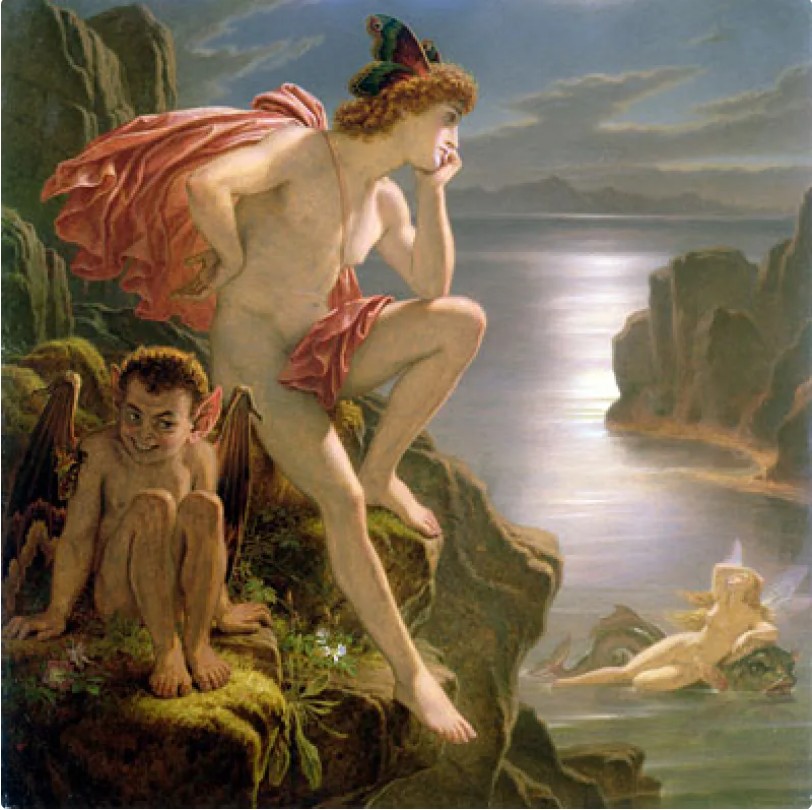
    Oberon, of course, is king of the fairies, as we all know from “A Midsummer Night’s Dream.” Weber also imports Puck and Titania. But from there James Robinson Planché’s libretto (which George Grove, of Grove Dictionary fame, described as “unmitigated awfulness”) goes its own way. The story combines elements of Christoph Martin Wieland’s German poem “Oberon” and the 13th century French romance “Huon de Bordeaux.”

    In Shakespeare, the fairy royals quarrel over the guardianship of an Indian prince (and accusations of infidelity). Here, Oberon refuses to reconcile with his queen until a faithful human couple is found. Puck directs his attention to Huon, a knight of Charlemagne, charged with assassinating the Caliph’s “right-hand man,” who is engaged to marry the Caliph’s daughter, Reiza. In the meantime, Huon and Reiza both have visions that draw them to one another. A number of trials ensue, including shipwreck, abduction by pirates, and enslavement. The plot thickens, though ultimately a happy ending is achieved, thanks to some blasts on Oberon’s magic horn.

    Weber’s “Oberon” overture still appears regularly on orchestra programs and of course on classical radio. The delicacy of some of the music anticipates Mendelssohn’s more famous treatment of the fairies. Mendelssohn pays more overt tribute to his predecessor by actually quoting a theme from the Act II finale, “Hark, the mermaids,” in his own “A Midsummer Night’s Dream” overture.

    Weber was not enthusiastic about the London production, but the opera was a great success. The first performance elicited many encores. Sadly, the composer died before he could set to work on a revision. Undoubtedly, he would have overseen the translation of text and dialogue to his native tongue (work which would be undertaken posthumously by other hands).

    “Oberon” was first performed in the United States later that year – it would be performed at the Metropolitan Opera between 1918 and 1921 – but if it’s encountered at all now, it’s often as a concert performance, bypassing the requirements of elaborate staging or scenery.

    Here’s a performance of the overture from an electric concert given in Tokyo by George Szell and the Cleveland Orchestra in 1970. Szell was fatally ill with cancer (it was his final concert), but you would never know it from what he was able to draw from his players. Their performance of Sibelius’ Symphony No. 2, on the same program, was especially stunning.

    https://www.youtube.com/watch?v=PFE0tcRDtm8

    Here it is, given the Franz Liszt treatment.

    https://www.youtube.com/watch?v=OyWGTWuBZww

    And as an arrangement for guitar quartet by Anthony Burgess (author of “A Clockwork Orange”), who was something of a composer himself.

    https://www.youtube.com/watch?v=yYetHoiCv9M

    Johann Nepomuk Hummel’s “Fantasy on Oberon’s Magic Horn”

    https://www.youtube.com/watch?v=-aKwy4BLekw

    Act II Mermaids’ chorus, transcribed by Charles-Valentin Alkan

    https://www.youtube.com/watch?v=HAbgs0osOac

    A complete recording of the opera

    https://www.youtube.com/watch?v=rht8LHy2C4Q

    A staged production (which I have yet to watch)

    https://www.youtube.com/watch?v=ImXedOZXqhw

    Weber’s most influential opera, of course, was “Der Freischütz” (“The Free-Shooter”), of 1821. With its pact with the devil, magic bullets, and lurid Wolf’s Glen sequence, replete with thunder and lightning, withered trees, skulls, and apparitions, it set the prototype for a more extreme branch of German Romantic opera. The work was a great favorite of Hector Berlioz.

    Interestingly, Berlioz’s sympathetic arrangement of “Der Freischütz,” undertaken to meet the requirements for Parisian performance – including adaptation of spoken dialogue to recitative and orchestration of Weber’s piano piece “Invitation to the Dance” for use as a ballet (de rigueur in Paris) – will be presented in concert at Carnegie Hall this Thursday by vocal soloists and the American Symphony Orchestra conducted by Leon Botstein. I’ve already got my ticket – and I didn’t have to barter my soul to Samiel!

    https://americansymphony.org/2025-2026/der-freischutz/

    More about Weber, at the very least on June 25, for the bicentennial of his passing…

    ——-

    PAINTING: “Oberon and the Mermaid” (1883), by Sir Joseph Noel Paton

  • Walpurgis Night Music and Mayhem on the Brocken

    Walpurgis Night Music and Mayhem on the Brocken

    Get ready to rock the Brocken! It’s April 30th – Walpurgis Night.

    Walpurgis Night, the eve of the feast day of Saint Walpurga, is a time when evil spirits are believed to roam the earth. Tradition holds that a witches’ sabbath and orgy of the damned are held atop the Brocken, the highest peak of the Harz Mountains in Central Germany. It’s the last blast of diablerie before May Day. In Goethe’s “Faust,” Mephistopheles guides his imperiled charge into a swirling cauldron of witches and demons so as to complete his moral degradation.

    Of course, “Faust” has inspired innumerable pieces of music – operas, symphonies, cantatas, piano works, and songs. Here, Samuel Ramey sings “Ecco il mondo” from the Walpurgis Night scene (Act II, Scene 2) of Arrigo Boito’s “Mefistofele.” Sadly, the clip doesn’t run to the end of the act.

    However, if your curiosity is piqued, the complete performance, in this amusing Robert Carson production, is posted here.

    Another Goethe poem provides the basis for Felix Mendelssohn’s cantata “Die erste Walpurigisnacht” (“The First Walpurgis Night”), about a band of prankish Druids playing mind games with some superstitious Christians.

    Johannes Brahms wrote a song, “Walpurgisnacht,” on a text of Alexis Willibald (nom de plum of Wilhelm Häring), about a mother freaking out her daughter, telling her a thunderstorm is actually the sound of witches celebrating on the Brocken. As if that isn’t enough, she adds that she herself is a witch! Ha ha! So German.

    Walpurgis Night is an occasion for leaping over bonfires, vandalizing neighbors’ property, and rioting, all in the name of welcoming spring. It is not to be confused with St. John’s Eve (June 23), the night the demon Chernobog emerges from the Bald Mountain. More on that later, I’m sure.

    I’m hoping I still fit into my goat-leggings. Have fun, but remember… keep Walpurga in Walpurgis Night!


    “The Goat of Mendes! The Devil himself.”

  • Bruch’s Moses A Passover Oratorio Rediscovered

    Bruch’s Moses A Passover Oratorio Rediscovered

    With Passover upon us, last week I was going through my collection, looking for something to listen to, and I was astonished by how many recordings I have of works inspired by Moses, the plagues, the Exodus, and the Ten Commandments. In the oratorio department alone, there’s Handel’s “Israel in Egypt,” Leopold Koželuch’s “Moise in Egitto,” Paul Dessau’s “Haggadah del Pesach,” and R. Nathaniel Dett’s “The Ordering of Moses.” I’m pretty sure somewhere I’ve also got a recording of Anton Rubinstein’s “Moses.”

    Here’s another one I picked up from Princeton Record Exchange for $2 in 2022 and, like the Rubinstein, never got around to listening to it – until now. And it’s been in my player more or less all week. Max Bruch’s “Moses” is no Mendelssohn’s “Elijah,” but it’s agreeable enough, and it has its own rewards as entertainment, even if it never quite seems to achieve the lift – that level of transcendence – you experience when everything comes together in the greatest masterworks.

    “Elijah” invites the most obvious comparison for several reasons. Aside from the fact that Elijah’s cup is present and filled at the Passover Seder, Mendelssohn’s dynamic, moving rendition of the prophet’s story was the most successful Biblical oratorio of the 19th century, and it’s the only one that still seems to get performed with any frequency.

    Also, taking into account Bruch’s most popular works, most people I think would classify him as a composer of the Mendelssohnian variety, a conservative Romantic, as opposed to a radical, Wagnerian one. It’s not for no reason that in the glory days of the LP, Bruch’s evergreen Violin Concerto No. 1 was always on the flip side of recordings of Mendelssohn’s own masterpiece in the genre.

    So imagine my surprise to discover that Bruch’s “Moses” contains at least as much Wagner as it does Mendelssohn. Perhaps even more so. The irony of classical music’s most notorious antisemite (i.e. Wagner) being mentioned in connection with an oratorio about the most revered of Jewish prophets is not lost on me. I hasten to add, I am speaking more of the Wagner of “Tannhäuser” and “Lohengrin” than of “The Ring” and “Tristan.” You won’t find any of the harmonic innovation, but you will find leitmotif and certainly a Wagnerian influence in the choral writing and in the dramatic vocal parts for Moses (bass), Aaron (tenor), and the Angel of the Lord (soprano).

    All the soloists on this Orfeo recording from 1999, featuring the Bamberg Symphony conducted by Claus Peter Flor, do service to the material, with Michael Volle the standout in the title role.

    Interestingly, another work it brings to mind is Josef Rheinberger’s “The Star of Bethlehem.” Different season, different faith, but something about Bruch’s handling of Moses’ inspirational leitmotif recalls – for me, anyway – Rheinberger’s Christmas cult classic, composed in 1890, five years before Bruch’s Passover oratorio. Again for this listener, Bruch’s “Moses” never achieves the same lift or touching sincerity.

    Another widely-held assumption, of course, is that Bruch himself was Jewish. It’s easy to understand why, as his treatment of the Yom Kippur chant “Kol Nidre” for cello and orchestra is easily the most popular of the classical music settings. Bruch handles the tune with great sensitivity and evidently pours his heart into it. So it surprises many (as it did, later, the Nazis) to learn that Bruch was indeed Protestant. He did, however, recognize a good tune when he heard one, and clearly when he took up his pencil he was inspired.

    It always knocks me off my pins to be reminded that Bruch was born in 1838 – five years after Brahms and three years before Dvořák – yet he died in 1920. Brahms checked-out in 1897 and Dvořák in 1904. Romanticism was still very much in its glorious twilight. What changes Bruch lived through! For someone who was clearly an heir of Mendelssohn to have experienced the era of “The Rite of Spring” boggles the mind.

    Anyway, if you’re interested to hear what Bruch does with the Moses story, here’s a link. Just don’t go into it expecting anything special from the Golden Calf episode, which is nowhere near the level of that in Schoenberg’s “Moses und Aron.” It’s more like the Druid shenanigans of Mendelssohn’s “Die erste Walpurgisnacht” – more apt to amuse than to scandalize or to conjure any sense of genuine transgression or blasphemy.

    A nice effort from Bruch, but unlikely to dislodge Elijah from his chariot. Still, someone might consider performing it sometime.

  • Myna Bird Personality Gregarious vs World-Weary

    How does one reconcile this gregarious, Ravel-loving myna bird with the world-weary myna of the Warner Bros. cartoons, bowed by Mendelssohn’s ponderous “Hebrides?”

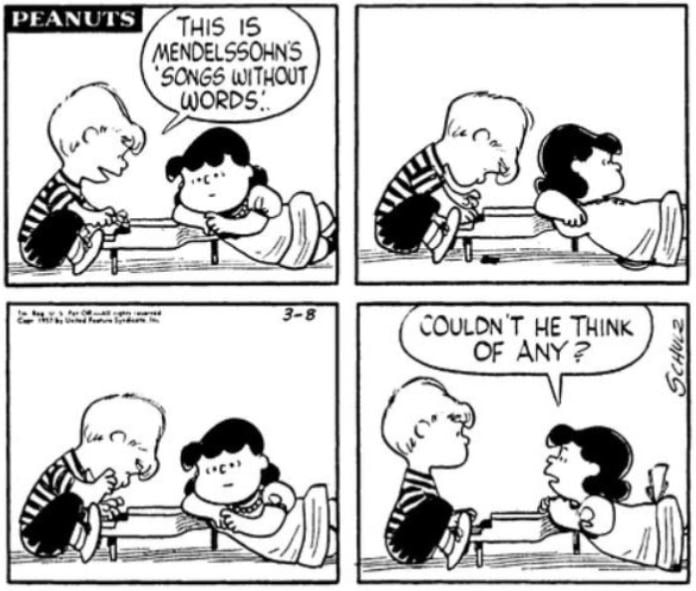
  • Schulz’s Surprising Mendelssohn Peanuts Strip

    Schulz’s Surprising Mendelssohn Peanuts Strip

    Well, what do you know? Here’s a SECOND Peanuts strip devoted to Mendelssohn, for the composer’s birthday! I hadn’t realized Schulz had even touched on Mendelssohn. I recall one moment of weakness when Schroeder was about to play Brahms, but otherwise, to my knowledge, it’s been pretty much straight Beethoven.

    Other composers have been referenced in the strip – Handel and Ellen Taaffe Zwilich spring to mind – but can anyone remember if anyone else ever made it into Schroeder’s piano bench (figuratively speaking, since he sits on the floor)?

Tag Cloud

Aaron Copland (92) Beethoven (95) Composer (114) Film Music (120) Film Score (143) Film Scores (255) Halloween (94) John Williams (185) KWAX (229) Leonard Bernstein (100) Marlboro Music Festival (125) Movie Music (135) Opera (198) Philadelphia Orchestra (88) Picture Perfect (174) Princeton Symphony Orchestra (106) Radio (87) Ralph Vaughan Williams (85) Ross Amico (244) Roy's Tie-Dye Sci-Fi Corner (290) The Classical Network (101) The Lost Chord (268) Vaughan Williams (103) WPRB (396) WWFM (881)

DON’T MISS A BEAT

Receive a weekly digest every Sunday at noon by signing up here


RECENT POSTS