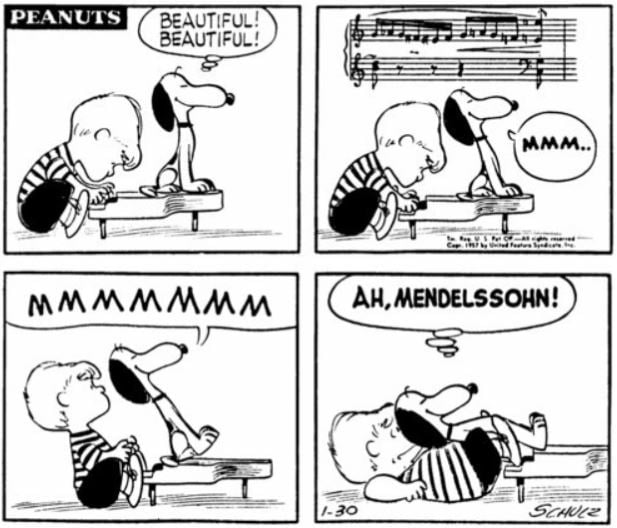
On Felix Mendelssohn’s birthday, Schroeder takes a break from Beethoven with the “Spinning Song” from the “Songs without Words.”
Here it is played by Earl Wild at the age of 88:
A broader selection played by Danielle Laval:
For those of a us of a certain vintage, the best known of these will have been absorbed at any early age, thanks to its prevalence in classic cartoons. The “Spring Song” kicks in at around 1:37:
Happy birthday, Felix Mendelssohn. Six more weeks of winter, but spring in our hearts.
Mozart’s birthday is always a signal to me that we are entering a season of great composer birthdays.
Perhaps it is all coincidence, but for whatever reason, music history has arrayed itself in such a way that larger patterns can be discerned. Autumn is heavy with birthdays of significant American composers (Gershwin, Ives, Hanson, Copland, and Virgil Thomson, to name a few). Revered violinists Fritz Kreisler and Jascha Heifetz were born on the same day (February 2), as were venerated pianists Sergei Rachmaninoff and Ferruccio Busoni (April 1). Brahms and Tchaikovsky share a birthdate (May 7). So do two of the most prominent film composers, Max Steiner and Dimitri Tiomkin (May 10). After 34 years in radio, these natal serendipities are etched in my memory like tablets carved on Mount Sinai.
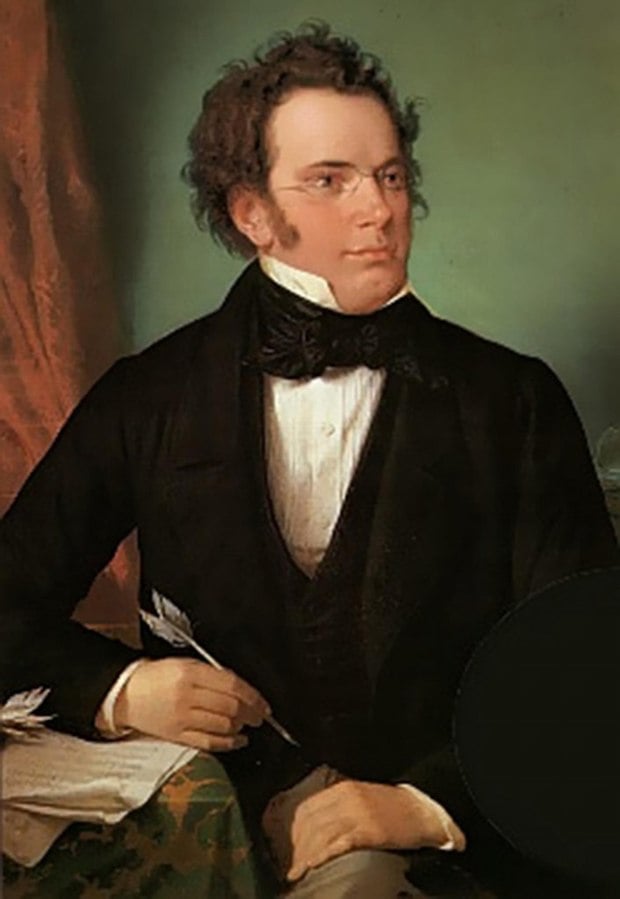
Nonetheless, even as I anticipated the birthday of Franz Schubert (January 31), in my eagerness to pay tribute to Mario Lanza on the occasion of his centenary, I inadvertently let it slip by. Please forgive me, Schwammerl. Today, on the anniversary of the birth of Felix Mendelssohn (1809-1847), I hope to make amends.
Mendelssohn, of course, was one of the most astonishing of musical prodigies. He composed his earliest masterpieces, the overture to “A Midsummer Night’s Dream” and the Octet for Strings in E-flat major, at the ages of 16 and 17 respectively. This is some of the “youngest” music in the entire repertoire. In their precocity and polish, both pieces are on a par with anything written by the teenaged Mozart.
Of course, by then, Mendelssohn had already generated piles of manuscripts – dozens of works, including three piano quartets, a violin sonata, a piano sonata, a singspiel, songs and “Songs without Words,” twelve symphonies for strings, and his first symphony for full orchestra.
And he would go on to write his “Italian” Symphony, his “Scottish” Symphony, the “Hebrides Overture,” the Violin Concerto in E minor, and the oratorio “Elijah,” all of which are still played in heavy rotation, both on radio and in the concert hall.
As a conductor, there’s no question he was one of the most influential musicians in Europe, if not the world. For twelve years, he directed the Leipzig Gewandhaus Orchestra, many of whose players went on to distinction in their own right. His performances were especially admired for their precision. He also laid the groundwork for modern concerts in developing a musical “canon.”
He gave important premieres of music by his contemporaries, while also reviving works of Mozart, Beethoven, and of course Johann Sebastian Bach. It was Mendelssohn who famously dusted off the “St. Matthew Passion,” reinvigorating Bach’s reputation.
Another composer who benefited from Mendelssohn’s advocacy was Franz Schubert. In 1838, ten year’s after Schubert’s death, his brother, Ferdinand, shared an unpublished manuscript with Robert Schumann, during one of the latter’s visits to Vienna. Schumann returned to Leipzig with a copy of the piece, a Symphony in C major. Mendelssohn gave the symphony its first public performance in 1839.
Schumann reviewed the concert in the Neue Zeitschrift für Musik, famously praising the work for its “heavenly length.” For this reason, and to distinguish it from an earlier, shorter Schubert symphony composed in the same key, it is usually identified as the “Great” C major.
Standing only five-foot-one, Schubert himself bore the nickname “Schwammerl” (“Little Mushroom”), bestowed upon him by his friends. Even a minute fungus, it would seem, is more than capable of creating something “Great.”
Happy birthday, Felix Mendelssohn, and happy belated birthday, Franz Schubert.
Mendelssohn, “Hebrides Overture”
His first masterpiece, the Octet in E-flat major, composed at the age of 16:
Live performance of Leonard Bernstein conducting Schubert’s Symphony No. 9 “Great”
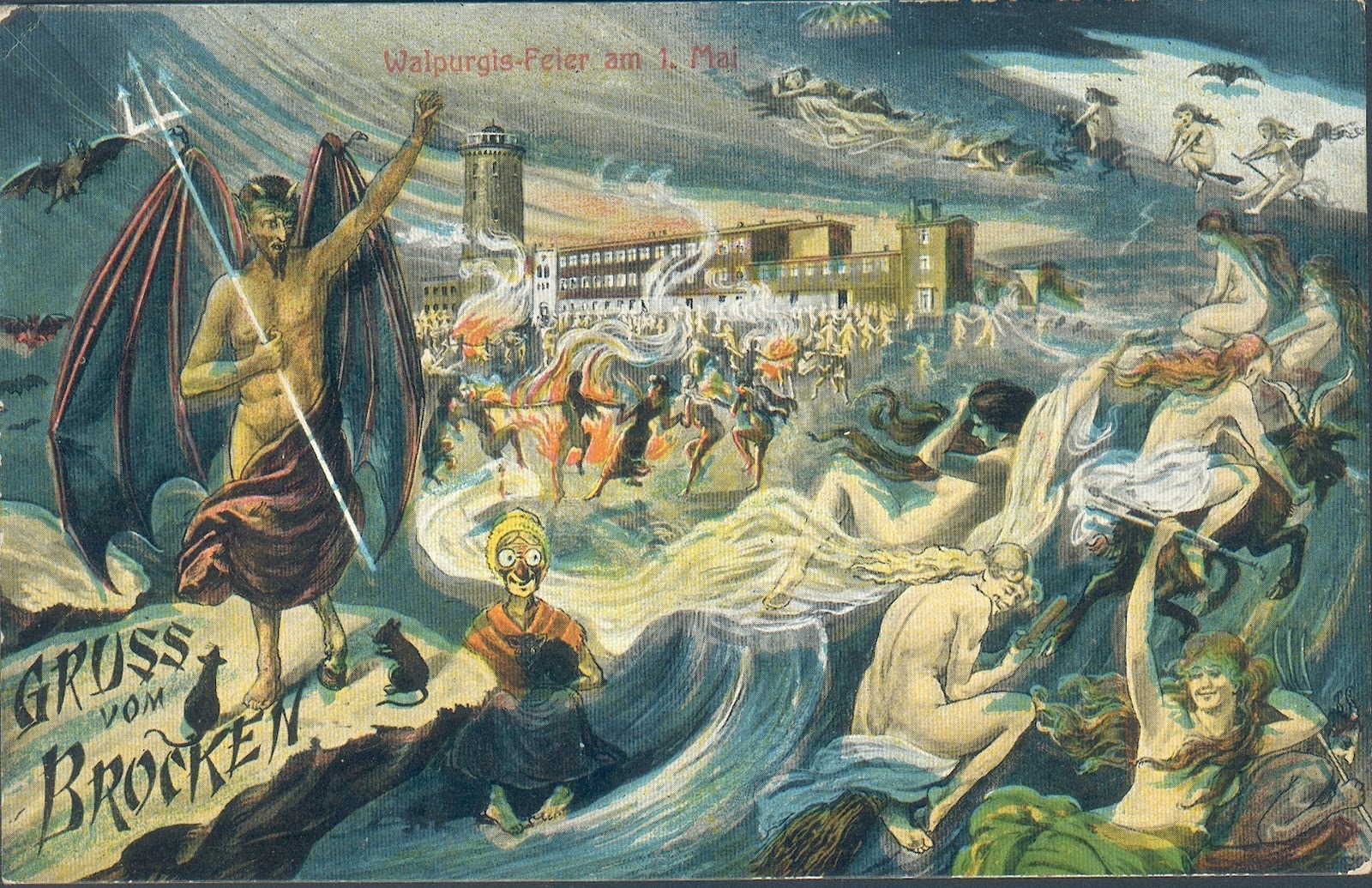
Get ready to rock the Brocken! It’s April 30th – Walpurgis Night.
Walpurgis Night, the eve of the feast day of Saint Walpurga, is a time when evil spirits are believed to roam the earth. Tradition holds that a witches’ sabbath and orgy of the damned are held atop the Brocken, the highest peak of the Harz Mountains in Central Germany. It’s the last blast of diablerie before May Day. In Goethe’s “Faust,” Mephistopheles guides his imperiled charge into a swirling cauldron of witches and demons so as to complete his moral degradation.
Of course, “Faust” has inspired innumerable pieces of music – operas, symphonies, cantatas, piano works, and songs. Here, Samuel Ramey sings “Ecco il mondo” from the Walpurgis Night scene (Act II, Scene 2) of Arrigo Boito’s “Mefistofele.” Sadly, the clip doesn’t run to the end of the act.
Another Goethe poem provides the basis for Felix Mendelssohn’s cantata “Die erste Walpurigisnacht” (“The First Walpurgis Night”), about a band of prankish Druids playing mind games with some superstitious Christians.
Johannes Brahms wrote a song, “Walpurgisnacht,” on a text of Alexis Willibald (nom de plum of Wilhelm Häring), about a mother freaking out her daughter, telling her a thunderstorm is actually the sound of witches celebrating on the Brocken. As if that isn’t enough, she adds that she herself is a witch! Ha ha! So German.
Walpurgis Night is an occasion for leaping over bonfires, vandalizing neighbors’ property, and rioting, all in the name of welcoming spring. It is not to be confused with St. John’s Eve (June 23), the night the demon Chernobog emerges from the Bald Mountain. More on that later, I’m sure.
This year, sadly, you’ll have to do all your cavorting over Zoom. Have fun, but remember… keep Walpurga in Walpurgis Night!
Last week, the Princeton Symphony Orchestra launched “At Home with the PSO,” a new gateway to original online content, including performance webcasts, musicians’ recipes, photo albums, and more, with fresh content being added weekly.
But my Spidey sense didn’t start tingling until they linked my program note for one of their past concerts. This week, the focus is on Felix Mendelssohn’s “Reformation Symphony.”
Read the note, enjoy the performance, and while you’re over there, learn to cook maple soy sauce glazed tofu with music director Rossen Milanov!
Look online at princetonsymphony.org, click on “At Home with the PSO,” and scroll down under “Play it Forward.”
We’ll be casting fists full of seed and suet on this week’s “Music from Marlboro.”
Felix Mendelssohn’s Octet for Strings is still regarded as one of the most amazing feats by one the great composer prodigies in all of music. Mendelssohn completed the work in the fall of 1825, when he was 16 years-old. He cemented his reputation the very next year, in 1826, with his spritely overture to “A Midsummer Night’s Dream.”
Around the time of the overture – as a matter of fact, written just before – Mendelssohn produced a String Quintet in A major. The Octet had been conceived as a birthday gift for the composer’s friend and violin teacher Eduard Rietz. Rietz would have an unwitting influence on the Quintet, as well, as Mendelssohn replaced the slow movement six years later, following Rietz’s death, with a new one composed in his memory. It was in this form that the Quintet would be published in Beethoven’s home town of Bonn, Germany, in 1832.
We’ll hear it performed in a spin-off recording from the 1978 Marlboro Music Festival, featuring violinists Jaime Laredo and Ani Kavafian, violists Heiichiro Ohyama and Kim Kashkashian, and cellist Sharon Robinson.
Leoš Janáček was actually 70 by the time he came to write “Mladi,” or “Youth,” in 1924. The Czech master was at the height of his belated fame, having struck paydirt with a series of operas, including “Jenůfa,” “Káťa Kabanová ,” and “The Cunning Little Vixen.” The Sinfonietta, the “Glagolitic Mass,” and the String Quartet No. 2 “Intimate Letters” were yet to come.
“Mladi” was the outgrowth of a trip down memory lane, reflections on his younger days, which he was in the process of sharing for a projected biography. The work is a kind of musical reminiscence of his life as a schoolboy at the Augustinian monastery of St. Thomas in Old Brno, where he received his earliest education.
We’ll hear it performed by Marlboro wind players in 1997, including flutist Paula Robison, oboist Jennifer Kuhns, clarinetist Igor Begelman, clarinetist and bass clarinetist Michael Rusinek, bassoonist Daniel Matsukawa, and hornist Radovan Vlatković.
It’s an hour of youth, age, loss, gain, and reflection. Two composers exercise their burgeoning and undiminished creativity, at either end of their careers. Birds of a feather flock together, on the next “Music from Marlboro,” this Wednesday evening at 6:00 EST, on WWFM – The Classical Network and wwfm.org.
BTW – Marlboro musicians will be in Philadelphia, at the American Philosophical Society, to perform works by Schubert, Handel, Brahms, and Kate Soper, tonight at 7:30 p.m. The concert is part of a Marlboro tour, with further stops in DC (on Thursday), Chicago (on Friday), and Boston (on Sunday). To learn more, visit marlboromusic.org.
Marlboro School of Music and Festival: Official Page