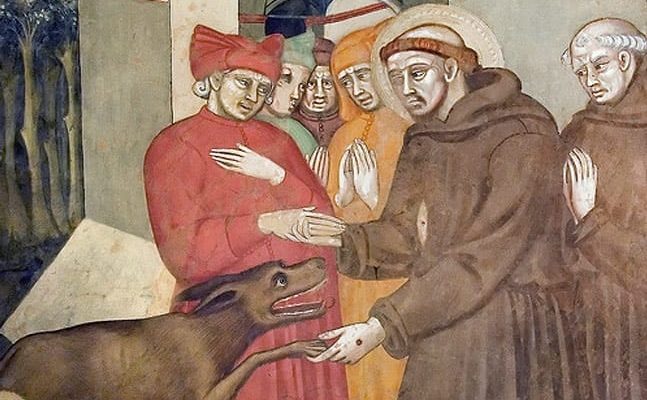
As an animal lover, I’ve always had a soft spot for St. Francis of Assisi. (Also, I was fortunate enough to visit his hometown before the devastating earthquakes of 1997.)
Today is Saint Francis’ feast day. This is a saint who was never too busy to chat with the birds or to befriend a wolf. He introduced the crèche to Christmas, complete with livestock. He even lobbied for a special law so that people would provide for the birds and the beasts. How could you not love this guy?
Regardless of one’s creed, no one, I should think, would take umbrage at the idea of love and respect for the natural world. Take a moment today to be kind to the animals. Hug your pet. Water the birds. Let a cricket out of the house. Bless all animals! Then enjoy some of the music below, only a fraction of the music inspired by St. Francis.
———-
Franz Liszt’s “Saint Francis of Assisi Preaching to the Birds” (piano)
Liszt’s “Saint Francis of Assisi Preaching to the Birds” (orchestra)
Francis Poulenc’s “Quatre petites prières de saint François d’Assise”
Paul Hindemith’s “Nobilissima Visione” (suite, conducted by the composer)
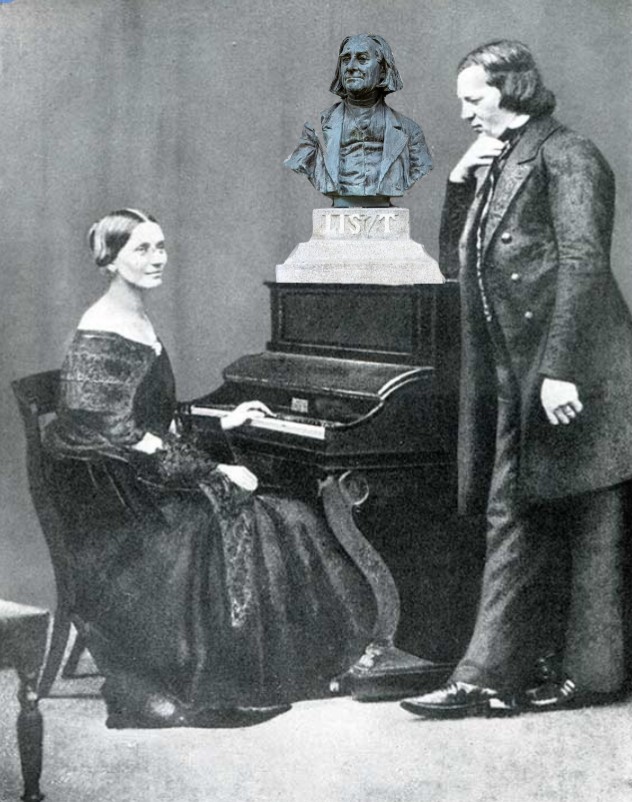
The other day I was pulling together selections for my annual “June Weddings” show on “Sweetness and Light” (my light music program, which streams Saturday mornings at 11:00 EDT/8:00 PDT from KWAX Classical Oregon), and one of the pieces that sprang to mind – that I was unable to include – was Robert Schumann’s “Widmung,” or “Dedication,” after a poem of Friedrich Rückert. Schumann wrote the song for his bride, Clara.
The couple had wanted to marry for years, but Clara’s father – Friedrich Wieck, Robert’s former teacher – bitterly opposed the match, so violently in fact that the matter landed everyone in court.
At the time of their first meeting, Robert was 20 years-old and was invited into the Wieck household as a live-in student. Clara was 11. Clearly circumstances were problematic.
The minute Clara turned 18, she accepted Robert’s proposal of marriage. The elder Wieck declined to grant his permission, and the young couple was compelled to bring suit against him. In the end, the judge ruled in the lovers’ favor, and the two were at last able to wed, in 1840, one day before Clara’s 21st birthday – at which point she would no longer have needed her father’s consent!
Ah well. In the interim, after he had been tossed out of the house, Robert’s passion for Clara was sublimated into ardent love letters and bursts of creative energy. He composed reams of piano music at white heat up until the year of their marriage. Thereafter, he wrote for piano and orchestra, always with Clara in mind.
The two maintained a joint diary, and the entries are frequently touching. The Schumanns, like any married couple, had their issues, but they clearly loved one another very much. They became one of the great power couples of their time, with Robert a composing dynamo and Clara one of the outstanding concert pianists of her day. More than 20 years after Robert’s death, she became a professor at the Hoch Conservatory in Frankfurt. Her 61-year concert career played a huge role in molding public taste in so far as what we have come to expect, down to the present day, from a piano recital.
“Widmung” caught the fancy of Franz Liszt, who always liked the Schumann’s a great deal more than they liked him. For whatever reason, he really rubbed Clara the wrong way. Essentially, everything about his approach to music ran counter to what she and her husband believed the art form should be. But it wasn’t always the case.
Clara first met Liszt in 1838, prior to her marriage, when she was 19 years-old. Like everyone else, she was in awe of the pianist’s superhuman technique, but it also made her feel inadequate, especially when they played piano four-hands.
For his part, Liszt was very complimentary. In a letter to his mistress, Marie d’Agoult, he wrote, “Her compositions are truly remarkable, especially for a woman. They contain a hundred times more inventiveness and real feelings than all former and present fantasias by Thalberg.” Sigismond Thalberg was one of Liszt’s chief rivals. But this wasn’t simply “trash talk.” Liszt was consistently impressed by both Schumanns.
In 1840, he dedicated his “Transcendental Etudes” to Clara. She continued to include his music on her concert programs until 1847. Sadly, familiarity bred contempt, and increasingly she came to find everything about him abhorrent. She didn’t like that he was a showboat. She recoiled when he took liberties with the scores he played. And she was totally put off by the indelicacy with which Liszt described her husband’s Piano Quintet as “typically Leipzig.”
Liszt, clueless, continued to make friendly overtures, championing Robert’s music. Robert, for his part, responded cordially. Liszt published a long essay in praise of the artistry of both Schumanns in 1855, but Clara remained implacable.
As the War of the Romantics began to heat up in 1860, with heightened antagonism between the Brahmsians (including the Schumanns) and the New German School (followers of Liszt and Wagner), contact became rare.
In 1884, Clara wrote to Liszt with the aim of copying the correspondence he maintained with her husband, who had died in 1856. Liszt responded that he hadn’t saved any of the letters. That essentially ended all interaction between them.
45 years earlier, in 1839, Schumann completed his “Fantasie in C major,” during the period when Clara’s father forbade any contact between them. Schumann wrote to Clara, “The first movement is the most passionate I have ever composed; it is a profound lament on your account.”
Ironically, it was Liszt who received the dedication. Liszt returned the favor by dedicating his own Piano Sonata in B minor to Schumann in 1854.
Clara confided to her diary, “Today, Liszt sent me a Sonata dedicated to Robert and some more pieces, together with a polite note. But those pieces are so creepy! Brahms played them to me and I felt really miserable… This is only blind noise – no more healthy thoughts, everything is confused, one cannot see any clear harmonies! And, what is more, I still have to thank him now – this is really awful.”
Of course, Robert, at 44, had already lost his grip on sanity and was by then confined to an asylum.
Here’s the wedding gift he composed for Clara, from the collection “Myrthen,” or “Myrtles,” Op. 25.
And what Liszt made of it – much to Clara’s horror, I’m sure – played by Van Cliburn in 1958.
A year into the marriage, Clara reciprocated with an anniversary present for Robert, “Liebst du um Schönheit” (“If you love for beauty”), also after Rückert, included in her Lieder, Op. 12.
It’s Robert Schumann’s birthday, so do enjoy his Fantasie in C major.
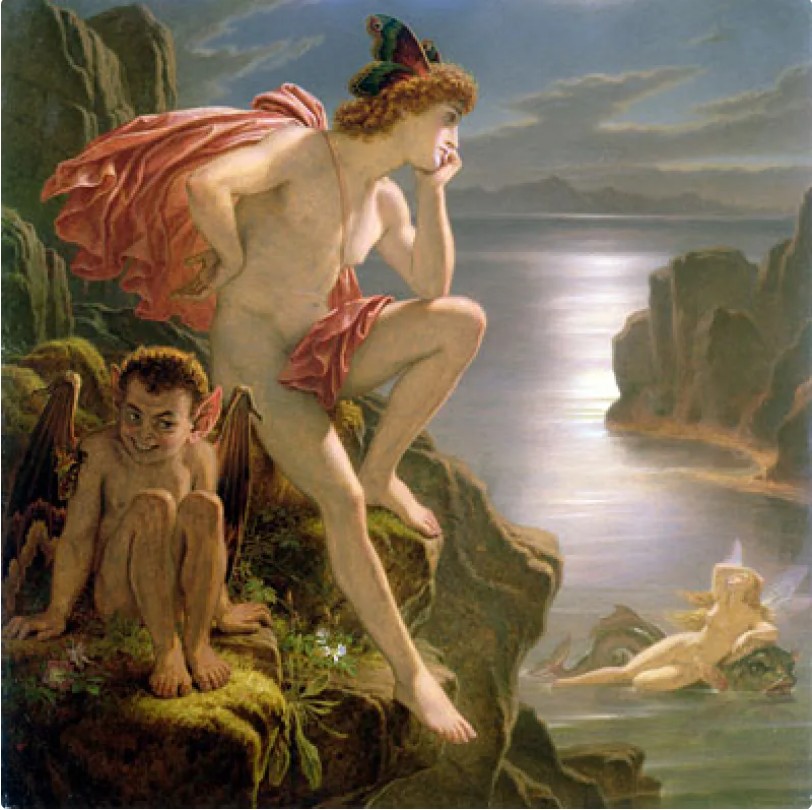
In this year of Carl Maria von Weber anniversaries – the influential German composer died 200 years ago (on June 25, 1826, to be exact) – it’s worthwhile to note the bicentennial of his final opera, actually a singspiel (an opera with spoken dialogue), “Oberon,” which was first performed on this date at Covent Garden, a little more than two months before his passing.
Oberon, of course, is king of the fairies, as we all know from “A Midsummer Night’s Dream.” Weber also imports Puck and Titania. But from there James Robinson Planché’s libretto (which George Grove, of Grove Dictionary fame, described as “unmitigated awfulness”) goes its own way. The story combines elements of Christoph Martin Wieland’s German poem “Oberon” and the 13th century French romance “Huon de Bordeaux.”
In Shakespeare, the fairy royals quarrel over the guardianship of an Indian prince (and accusations of infidelity). Here, Oberon refuses to reconcile with his queen until a faithful human couple is found. Puck directs his attention to Huon, a knight of Charlemagne, charged with assassinating the Caliph’s “right-hand man,” who is engaged to marry the Caliph’s daughter, Reiza. In the meantime, Huon and Reiza both have visions that draw them to one another. A number of trials ensue, including shipwreck, abduction by pirates, and enslavement. The plot thickens, though ultimately a happy ending is achieved, thanks to some blasts on Oberon’s magic horn.
Weber’s “Oberon” overture still appears regularly on orchestra programs and of course on classical radio. The delicacy of some of the music anticipates Mendelssohn’s more famous treatment of the fairies. Mendelssohn pays more overt tribute to his predecessor by actually quoting a theme from the Act II finale, “Hark, the mermaids,” in his own “A Midsummer Night’s Dream” overture.
Weber was not enthusiastic about the London production, but the opera was a great success. The first performance elicited many encores. Sadly, the composer died before he could set to work on a revision. Undoubtedly, he would have overseen the translation of text and dialogue to his native tongue (work which would be undertaken posthumously by other hands).
“Oberon” was first performed in the United States later that year – it would be performed at the Metropolitan Opera between 1918 and 1921 – but if it’s encountered at all now, it’s often as a concert performance, bypassing the requirements of elaborate staging or scenery.
Here’s a performance of the overture from an electric concert given in Tokyo by George Szell and the Cleveland Orchestra in 1970. Szell was fatally ill with cancer (it was his final concert), but you would never know it from what he was able to draw from his players. Their performance of Sibelius’ Symphony No. 2, on the same program, was especially stunning.
Weber’s most influential opera, of course, was “Der Freischütz” (“The Free-Shooter”), of 1821. With its pact with the devil, magic bullets, and lurid Wolf’s Glen sequence, replete with thunder and lightning, withered trees, skulls, and apparitions, it set the prototype for a more extreme branch of German Romantic opera. The work was a great favorite of Hector Berlioz.
Interestingly, Berlioz’s sympathetic arrangement of “Der Freischütz,” undertaken to meet the requirements for Parisian performance – including adaptation of spoken dialogue to recitative and orchestration of Weber’s piano piece “Invitation to the Dance” for use as a ballet (de rigueur in Paris) – will be presented in concert at Carnegie Hall this Thursday by vocal soloists and the American Symphony Orchestra conducted by Leon Botstein. I’ve already got my ticket – and I didn’t have to barter my soul to Samiel!
It’s January 6. Epiphany. The Feast of the Three Kings. The Christian feast day that marks, among other things, the Magi’s visit to the Christ Child.
I know I’ve lamented in the past about how so many of the magnificent classical music Christmas works of the past millennium have disappeared from the airwaves. Of the larger works, it seems only Handel’s “Messiah,” Bach’s “Christmas Oratorio,” and of course Tchaikovsky’s (secular) “The Nutcracker” are guaranteed.
Thankfully, I have an enormous record library with at least three shelves devoted exclusively to Christmas music, so I’m able to work through a lot of the forgotten and/or neglected masterworks at home and in the car. But it’s not the same as somebody else pulling and programming the music and knowing that I am part of a unified listening community.
I feel the same way when watching a movie that is broadcast, or actually in a theater, as opposed to playing it from my own collection or streaming it. It’s wonderful to live in an age when these things are possible, but it is just not the same as knowing that I’m a part of a communal experience. (That said, I’m certainly not going to watch “It’s a Wonderful Life” on network television with a thousand commercial breaks!)
I must give a tip of the Ebenezer Scrooge top hat to Yle Klassinen in Helsinki for airing Franz Liszt’s “Christus” complete. That station really is a marvel. Oh how I love my digital radio! Of course, I don’t speak Finnish, but I can usually make out the performers when they are announced and the playlists are posted online.
Anyway, I had already listened to the Dorati recording on my own time. I’ve done so for many, many years. It’s enriched my Christmases ever since I first encountered it on the air, broadcast on Philadelphia’s late, lamented WFLN, back in the early 1980s. Time was, when serious classical Christmas music commenced with Advent. Yes, it was leavened with gems like Victor Hely-Hutchinson’s “Carol Symphony,” the aforementioned “Nutcracker,” and Leopold Mozart’s “A Musical Sleigh-Ride,” in the hilarious recording by the Eduard Melkus Ensemble that includes the neighing horses and barking dogs. I looked forward to hearing that every year. I snapped it up when it was reissued on compact disc and have included it in my own broadcasts for decades.
Those works have their place, but it seems the serious, large-scale choral works are all going away. Commerce, secularism, short attention spans, ignorance, and grievance all work against the simple enjoyment of a lot of masterful music. It’s much safer to play three-minute arrangements of familiar Christmas carols. Over and over and over again.
I grant you, three hours is a lot of radio real estate to give up to Liszt’s “Christus.” But can’t anyone even carve out an hour for Vaughan Williams’ “Hodie?” I suppose I should just shut up and be thankful that RVW’s “Fantasia on Christmas Carols” is still in rotation.
I count myself very fortunate to have been able to share “Christus” many times over the years. I know I’ve played it complete on WXLV, WPRB, and WWFM – once I even preempted the weekly opera broadcast – and excerpted the purely orchestral movements even more frequently, working them into my morning and afternoon playlists. “The March of the Three Holy Kings” is a high point.
I am sorry I don’t have a stretch of air-time during which to play it for you now, but the entire Dorati recording of the oratorio (one of three recordings I own, and still my preferred) is posted on YouTube.
If you want to cut to the chase, here’s the march of the Kings.
Think it sounds an awful lot like Wagner’s Wotan? There’s likely a reason for that. I’ve posted about it before.
I try to be sensitive to other people’s faiths and belief systems, and frankly I am no zealot, but when it comes to music, I am very much a fundamentalist. This is not about pushing Christianity down anyone’s throat as much as a desire to preserve and disseminate the sublime Christmas works, many of them by top-tier composers, presented, like the classic movies on TCM, complete and uncut.
Of course, most of these recordings I’ve played over the years are from my own collection. I was very fortunate to be able to do my own programming, for hours at a time, for the better part of three decades. In such a situation, when a radio host loses his platform, countless hours of repertoire go with him. You’ll still get “Messiah,” but you probably won’t get Josef Rheinberger’s “The Star of Bethlehem” (here posted as a playlist of nine separate videos).
Rutland Boughton’s “Bethlehem” is another Christmas work I’m crazy about. You won’t find it in many record libraries at radio stations here in the U.S. But I’ve got it, and I’ve aired it. Rather than write about it again, I’ll refer you to one of my teasers from a few years ago.
If you’re a Vaughan Williams fan, I think you will find it delightful. For a long time, I was unable to share any of the audio online, due to Hyperion Records’ justifiably Draconian practice of not allowing any its recordings on YouTube. But the company is now in other hands, so here it is, finally, as a playlist – albeit with the tracks posted separately, so prepare to have to skip an occasional ad.
On the Twelfth Day of Christmas, your resident classical music curmudgeon gives to you… three Christmas oratorios. If I splurged for a dozen, this post would be four times the length!
Have yourself a merry “Little Christmas!”
——–
IMAGE: Detail from Edward Burne-Jones’ “Adoration of the Magi”
I don’t know about you, but if I were a kid I’d be all over my parents to be able to attend a program called “Liszt and the Devil.”
In one of his celebrated “Young People’s Concerts,” from 1970, Leonard Bernstein makes the bold assertion that “A Faust Symphony” is Franz Liszt’s greatest work. I think “grandest” would be less controversial. I mean, Liszt was the composer of probably the most revolutionary piano sonata of the 19th century.
Despite Bernstein’s effusion that “A Faust Symphony” is one of the monumental works of the whole Romantic Movement, it is hardly the most frequently programmed of his compositions. His piano concertos are heard much more frequently. So are some of his symphonic poems, at least on the radio. (When was the last time you heard “Les Preludes” in concert?) He wrote oratorios, masses, organ works, songs, and even an opera. His later works are on another plane entirely, as he hurled his lances into a future he would never live to see.
As a pianist, he is frequently cited as a kind of proto-rock star, whipping his audiences into extravagant displays of emotion. Men wept and women fainted. Some fought over carelessly abandoned gloves or cigar butts or even his coffee dregs. Doctors seriously debated the causes and effects of “Lisztomania,” as it was described, and it remains a topic of speculation in academic and medical circles today.
Liszt was a peculiar mix of prophet and showman. He could be flashy or profound, fiendishly difficult or insistently memorable, offputtingly vulgar or transcendentally beautiful. Interestingly, in his mid-30s, he retired from public life as a recitalist (recital, by the way, was a term he coined), shifting his focus instead to composition, conducting, teaching, and philanthropic efforts. In his mid-50s, he took the cloth. As the Abbé Liszt, he was, among other things, a licensed exorcist. Which takes us back to the matter at hand.
I happen to share Bernstein’s enthusiasm for “A Faust Symphony.” It’s always been a great favorite of mine. Sadly, you don’t really see it programmed very often anymore – if it ever was. But back in the day, Bernstein and Solti and maybe a few others kept it alive. Bernstein recorded it twice: with the New York Philharmonic for Columbia Records in 1960 and with the Boston Symphony Orchestra for Deutsche Grammophon in 1976. Riccardo Muti conducted it in Philadelphia, back in 1982 – sadly two years before my arrival in the City of Brotherly Love – and recorded it for EMI. The recording is very good. Come to think of it, I don’t think I’ve ever heard “A Faust Symphony” live. This must be rectified!
I love that Bernstein doesn’t talk down to the kids and lays some pretty heavy, adult concepts on them. Not only in the philosophical examination of the essential dichotomy of the human character, but also the nitty gritty of debauched adult behavior. I’m sure there are moments when the moms and dads in the audience are wondering whether maybe they should have taken the young ones to Radio City Music Hall instead. Around 28 minutes in, Bernstein delves into the Devil, the seduction of Gretchen, and “the wages of sin.”
It’s fun that Bernstein can go to the piano to illustrate so many of his musical points and that he’s got so much Liszt under his fingers.
This is the second “Young Person’s Concert” I’ve seen in which Bernstein gets so carried away conducting that he loses his baton (at 44 minutes in). The other was during a Sibelius program from 1965, in which he conducts the Symphony No. 2. In that instance, a moment after the baton takes flight, he reaches beneath the lectern and actually produces a spare! Here he rides it out with his bare hands, as Mephisto’s spirit of negation is itself negated by Gretchen’s innocence.
This is Liszt’s original version, by the way. Three years later, he appended a coda for chorus and tenor. That’s the version Bernstein recorded.
Bernstein knows a thing or two in comparing Liszt to Faust. He had a little bit of Faust in his own character, as well. But then, don’t we all?
Happy birthday, Franz Liszt!
“Young People’s Concert: Liszt and the Devil.” All in all, an intelligently presented, entertainingly delivered lecture and performance. I hope you enjoy it.
Bernstein’s classic 1960 recording with the New York Philharmonic
Also fun to hear “A Faust Symphony” turn up among the musical selections on the soundtrack to this restoration of the 1926 silent film “Masciste in Hell”