Tag: Franz Liszt

  • Happy Birthday Liszt A Generous Musical Genius

    Happy Birthday Liszt A Generous Musical Genius

    It’s Franz Liszt’s birthday, and I usually give him a pretty good write-up, since on top of all his musical achievements – his innovations, his influence, and his transcendental technique – he also happened to be a pretty good guy, if not without his foibles. In particular, he was exceptionally generous, often engaged in charitable causes and championing the needy, whether they be pupils, colleagues, or anonymous victims of disaster, and he always did so quietly and with the greatest humility. In a lot of ways, he also basically changed music, though it was often the case that others implemented or assimilated his original ideas with greater success.

    Of course, as was the case with any Romantic virtuoso, there was also a whiff of diablerie about his reputation.

    If you want to check out some of my previous posts on the subject, you can search Facebook under “Classic Ross Amico Liszt.” If you have the option to click on “photos” under the search bar, it could bring many of them up in a conveniently browsable form. Then just click on the photos for the texts.

    Sadly, I’ve got a lot to do today, so I must sheepishly defer to a silly cartoon. I love Liszt, and that’s a fact.

    You can learn more about his “Mephisto Waltzes” here:

    https://en.wikipedia.org/wiki/Mephisto_Waltzes

    Jeffrey Swann was the first pianist to record all of them on a single record.

    Here, I made it easy for you to search the older posts.

    Happy birthday, Liszt!

  • Saint Francis Feast Day Celebrate Animals

    Saint Francis Feast Day Celebrate Animals

    As an animal lover, I’ve always had a soft spot for St. Francis of Assisi. (Also, I was fortunate enough to visit his hometown before the devastating earthquakes of 1997.)

    Today is Saint Francis’ feast day. This is a saint who was never too busy to chat with the birds or to befriend a wolf. He introduced the crèche to Christmas, complete with livestock. He even lobbied for a special law so that people would provide for the birds and the beasts. How could you not love this guy?

    Regardless of one’s creed, no one, I should think, would take umbrage at the idea of love and respect for the natural world. Take a moment today to be kind to the animals. Hug your pet. Water the birds. Let a cricket out of the house. Bless all animals! Then enjoy some of the music below.


    Franz Liszt’s “Saint Francis of Assisi Preaching to the Birds” (piano)

    Liszt’s “Saint Francis of Assisi Preaching to the Birds” (orchestra)

    Francis Poulenc’s “Quatre petites prières de saint François d’Assise”

    Paul Hindemith’s “Nobilissima Visione” (suite, conducted by the composer)

    Hindemith’s “Nobilissima Visione” (rarely-heard complete version)

    Leo Sowerby’s “Canticle of the Sun” (1946 Pulitzer Prize winner)

    Kenneth Fuchs’ “Canticle to the Sun” for French horn and orchestra

  • Old Nassau The Story of Princeton’s Song

    Old Nassau The Story of Princeton’s Song

    I posted yesterday about my article on Princeton musician (born in Germany) Carl Langlotz. Langlotz, a student of Franz Liszt who played in the premiere of Wagner’s “Lohengrin,” must be one of the most overqualified composers of a university song ever. With Reunions upon us, “Old Nassau” will reverberate across town and gown all weekend, 164 years after Langlotz dashed it off while enjoying a smoke on his front porch on Mercer Street. Since the image wasn’t available yet at the time I posted, here’s a detail of the cover design. Enjoy the article in this week’s edition of the Princeton weekly U.S. 1 Newspaper – PrincetonInfo.

    https://www.communitynews.org/princetoninfo/coverstories/in-praise-of-old-nassau-meet-its-composer/article_3729e04e-f982-11ed-acc8-53b68127b320.html?utm_campaign=blox&utm_source=facebook&utm_medium=social&fbclid=IwAR2e15QKRr6Sn5es3iRMBjXn1YSP4hx2rhSp-G8wjmcua46a2b4PkfkjiQM

  • Beethoven Liszt Kiss A Musical Blessing

    Beethoven Liszt Kiss A Musical Blessing

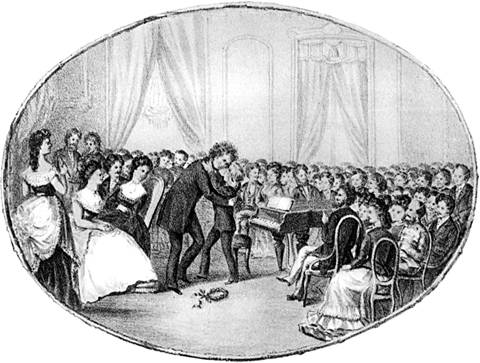
    Legend has it that, on this date 200 years ago, at the end of a concert at the Kleiner Redoutensaal of the Hofburg palace in Vienna, Beethoven spontaneously rose from the audience to plant a kiss on the brow of an 11-year-old Franz Liszt. The young pianist had just fulfilled an impromptu request from the composer for an improvisation on one of his themes.

    Unfortunately, according to Liszt, it never happened. Or rather it did, in a sense, just not on this occasion.

    It was actually a few days earlier, at Beethoven’s home, that Liszt received the “Weihekuss” – the “kiss of consecration” – after playing a movement from one of Beethoven’s concertos. Liszt would always remember it as a sort of artistic christening.

    He recalled it 52 years later, in 1875, when he was in his sixties, to one of his pupils, Ilka Horowitz-Barnay. The following translation is from Paul Nettl’s “Beethoven Encyclopedia.”

    “I was about eleven years of age when my venerated teacher Czerny took me to Beethoven. He had told the latter about me a long time before, and had begged him to listen to me play some time. Yet Beethoven had such a repugnance to infant prodigies that he had always violently objected to receiving me. Finally, however, he allowed himself to be persuaded by the indefatigable Czerny, and in the end cried impatiently, ‘In God’s name, then, bring me the young Turk!’ It was ten o’clock in the morning when we entered the two small rooms in the Schwarzspanierhaus which Beethoven occupied; I somewhat shyly, Czerny amiably encouraging me. Beethoven was working at a long, narrow table by the window. He looked gloomily at us for a time, said a few brief words to Czerny and remained silent when my kind teacher beckoned me to the piano. I first played a short piece by Ries. When I had finished Beethoven asked me whether I could play a Bach fugue. I chose the C minor Fugue from the Well-Tempered Clavier. ‘And could you also transpose the Fugue at once into another key?’ Beethoven asked me.

    “Fortunately I was able to do so. After my closing chord I glanced up. The great Master’s darkly glowing gaze lay piercingly upon me. Yet suddenly a gentle smile passed over the gloomy features, and Beethoven came quite close to me, stooped down, put his hand on my head, and stroked my hair several times. ‘A devil of a fellow,’ he whispered, ‘a regular young Turk!’ Suddenly I felt quite brave. ‘May I play something of yours now?’ I boldly asked. Beethoven smiled and nodded. I played the first movement of the C major Concerto. When I had concluded Beethoven caught hold of me with both hands, kissed me on the forehead and said gently. ‘Go! You are one of the fortunate ones! For you will give joy and happiness to many other people! There is nothing better or finer!’”

    Liszt told the preceding in a tone of deepest emotion, with tears in his eyes, and a warm note of happiness sounded in the simple tale. For a brief space he was silent and then said, “This event in my life has remained my greatest pride – the palladium of my whole career as an artist. I tell it but very seldom and – only to good friends!”

    Beethoven’s conversation book verifies the encounter. What the recollection doesn’t take into account is that by then the composer would have been completely deaf. But he could still feel the vibrations of the piano.

    One way or another, I venture to guess, Liszt didn’t wash that smacker off his forehead for quite some time.


    IMAGE: 1873 lithograph to mark the 50th anniversary of Beethoven’s Weihekuss

  • Liszt vs. Thalberg Piano Duel in Paris

    Liszt vs. Thalberg Piano Duel in Paris

    Paris of the 1830s was swarming with superstar pianists, who drifted from recital to salon with the grace and mystique of cinematic gunslingers. On this date in 1837, the two most mythologized virtuosi of the day, Franz Liszt and Sigismond Thalberg, were brought together at the home of Princess Cristina Belgiojoso-Trivulzio, an Italian patriot living in exile, to prove once and for all who was the King of the Keys.

    The duel would prove to be a clash of styles and temperaments. In contrast to Liszt’s humble beginnings and acquired polish, Thalberg was an aristocrat by association, having been taking under the wing of a wealthy patroness very early on. A large part of his allure was in his unruffled appearance. He was handsome, educated, genteel. At the piano, he remained absolutely placid, sitting as still as possible while performing the most incredible, acrobatic feats.

    One of his much remarked upon, crowd-pleasing effects was his ability to simulate the sound of three hands, which he was able to accomplish by picking out a melody with his thumbs and using the rest of his fluttering digitals to ornament with brilliant arpeggios and arabesques. Matters of showmanship aside, his legato was of such beauty that even Liszt commented, “Thalberg is the only artist who can play the violin on the piano.”

    Liszt, by contrast, was a fire-eater, who would literally destroy pianos on the stage of the Paris Opera before an audience of 3000. His playing had ladies clawing at one another to retrieve a glove or a cigar calculatedly left behind after a concert.

    Partisans and newspaper critics long speculated on who was the greater pianist. The flame of animosity was fanned by rival journalists, as Hector Berlioz (who embraced Liszt) and critic and musicologist Francois-Joseph Fétis (who championed Thalberg) played out their latest grudge match, polarizing music-lovers into two camps.

    As the debate grew in intensity, it seemed that whenever one was in town, the other was on tour or vacationing. It all finally came to a head on the morning of March 31, 1837, at Belgiojoso-Trivulzio’s salon, in a war of the gargantuas engineered for charity. March definitely went out like a lion that year, as two titans of the keyboard faced off in the ultimate piano showdown.

    The verdict was diplomatic: the princess declared Thalberg the finest pianist in the world; Liszt, she proclaimed, the ONLY pianist.

    Popular tradition holds that Liszt mopped the floor with Thalberg, but apparently this wasn’t entirely the case. Nor was there any apparent animosity between the two men, who were cordial and even dined together several times after their legendary face-off. The two would collaborate, along with Chopin and three others, on one of Belgiojoso’s other schemes, the keyboard crazy quilt “Hexameron,” which Liszt titled, orchestrated, and toured with. Proceeds generated from both the duel and the “Hexameron” project went to the benefit of Italian refugees.

    An ironic epilogue to this story: in 2017, Thalberg’s final resting place, in Naples, was desecrated, his mummified corpse tossed callously into the corner of a vault. You can wade through a dizzying array of fonts and italics to learn more here:

    https://unravelingmusicalmyths.blogspot.com/2017/03/a-neapolitan-nightmare-virtuoso-pianist.html?fbclid=IwAR3YTjyhNnigLp-ZnnChsF_enDOBsc-6aW0BjI8q6SpiO6DjvgifZmrLsWA

    On a related note, as today is also the birthday of Franz Joseph Haydn, it is perhaps worth noting, as I have on this page several times in the past, that for 150 years Haydn had no head.

    Thalberg transcribed a chorus from Haydn’s “The Seasons” as part of his collection “L’art du chant appliqué au piano” (“The Art of Singing Applied on Piano”), Op. 70. You can listen to the complete set of primarily operatic transcriptions if you want to, but I’ve cued the link to jump right to the relevant movement.

    For Liszt’s part, the pianist Alfred Brendel drew a parallel with Haydn in his introduction to a certain Liszt biography:

    “Arguably, Liszt and Haydn are the most frequently misunderstood among major composers; their biographers afford little food for pity.… In old age, Haydn reigned over the musical world as its undisputed leading light. For this, the nineteenth century punished him – as it punished Liszt for his undisputed supremacy as a performer.… Not until our century did a greater number of composers – from Richard Strauss, Ravel, and Busoni to Schoenberg, Bartók, and Boulez – appreciate Liszt by taking him seriously.”


    “Hexameron,” six variations on a theme from Bellini’s “I puritani.” Five well-known composer-pianists – Frédéric Chopin, Carl Czerny, Henri Herz, Johann Peter Pixis and Sigismond Thalberg – each contributed a variation. Liszt composed the introduction, second variation, interludes, and finale, and integrated the piece into an artistic unity.

Tag Cloud

Aaron Copland (93) Beethoven (95) Composer (114) Film Music (129) Film Score (143) Film Scores (255) Halloween (94) John Williams (192) KWAX (229) Leonard Bernstein (103) Marlboro Music Festival (125) Movie Music (144) Mozart (88) Opera (206) Philadelphia Orchestra (89) Picture Perfect (174) Princeton Symphony Orchestra (108) Radio (88) Ross Amico (244) Roy's Tie-Dye Sci-Fi Corner (290) The Classical Network (101) The Lost Chord (268) Vaughan Williams (103) WPRB (396) WWFM (881)

DON’T MISS A BEAT

Receive a weekly digest every Sunday at noon by signing up here


RECENT POSTS