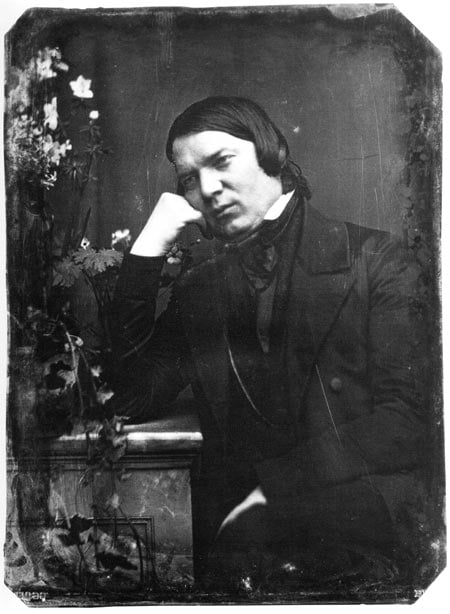
A would-be concert pianist, he’s said to have destroyed his hand through the use of a finger-strengthening device of his own design.
He took his underage sweetheart’s father – who also happened to be his teacher – to court, to sue for the right to marry, ultimately winning that right the day before she came of age.
He went mad from syphilis, hurled himself into the Rhine, and spent his final months in an asylum.
His name was Robert Schumann, and he was one of the most romantic of Romantic composers.
It’s hardly surprising that such an overheated personality would write such emotionally turbulent music. Whether tender (as per “Kinderszenen,” his reminiscences of childhood) or troubled (the “Nachtstücke,” a premonition of his brother’s death), Schumann was the ne plus ultra of tormented genius.
Happy birthday, Florestan! Or should that be Eusebius?
“Kinderszenen” (“Scenes from Childhood”), performed by Clara Haskil
“Nachtstücke” (“Night Pieces”), performed by Emil Gilels
“Fantasie in C major,” performed by Valdimir Horowitz
The “Fantasie” was completed in 1839, during Schumann’s enforced separation from Clara Wieck, his future wife. He wrote to her: “The first movement is the most passionate I have ever composed; it is a profound lament on your account.”
In the end, he dedicated the work to Franz Liszt. Liszt returned the favor by dedicating his Piano Sonata in B minor to Schumann in 1854. By that time, Liszt had long been persona non grata to the Schumanns. Clara, in particular, loathed him and his music.
She confided in her diary: “Liszt sent Robert today a sonata dedicated to him and several other things with a friendly letter to me. But the things are dreadful! [Johannes] Brahms played them for me, but they made me utterly wretched … This is nothing but sheer racket – not a single healthy idea, everything confused, no longer a clear harmonic sequence to be detected there! And now I still have to thank him – it’s really awful.”
In any case, Robert, at 44, was already in the asylum.
When Franz Liszt died in 1883, his housekeeper allowed his students to go through his belongings and carry off manuscripts to keep as mementos. Just over a hundred years later, in 1989, parts of a previously unknown piano concerto were retrieved from Weimar, Nuremberg, and Leningrad. These were reunited by University of Chicago doctoral candidate Jay Rosenblatt.
Scholars had simply assumed that the fragments were from an early draft of the much-beloved Piano Concerto No. 1. In reality, it is a “Third Piano Concerto” now believed to predate the accepted two. The work has not entered the standard repertoire, but it remains an interesting curiosity.
One of the few pianists to take up the piece has been Rosenblatt’s teacher, Jerome Lowenthal, born in Philadelphia on this date in 1932. Here is Lowenthal’s recording of the work:
Interestingly, it took the better part of a century for the truth about another lesser-known Liszt concerto to emerge.
Sophie Menter had studied with Liszt in Weimar, beginning in 1869. So gifted a musician was she that Liszt described her as “the greatest pianist of her day.” He praised her “singing hand” and called her his “only legitimate daughter as a pianist.” She was by her teacher’s side when he died in Bayreuth in 1886.
At the time, she held a professorship at the St. Petersburg Conservatory There, she became friendly with Peter Ilych Tchaikovsky. She asked Tchaikovsky to orchestrate a piano concerto she claimed that she herself had written, to showcase her talents as a performer. Tchaikovsky agreed, and also dedicated his own “Concert Fantasy for Piano and Orchestra” to her.
What he didn’t realize is that the concerto – according to Menter’s friend, fellow Liszt pupil Vera Timanoff, to whom Menter allegedly confided – was actually composed by Liszt. Had Tchaikovsky known, he might very well have torn up the manuscript. He loathed Liszt, and was especially disgusted by Liszt’s transcription of the Polonaise from “Eugene Onegin.” As it was, Tchaikovsky conducted the work’s first performance in Odessa in 1893.
Here is the “Concerto in the Hungarian Style” – formerly known as the “Sophie Menter Concerto” – performed by Janina Fialkowska, the same pianist who gave the first public performance of Liszt’s “Third Piano Concerto” in 1990:
As an addendum, György Cziffra plays the Liszt transcription that Tchaikovsky so despised.
In classical music, sometimes it’s not so much who you know, as who you don’t know that matters!
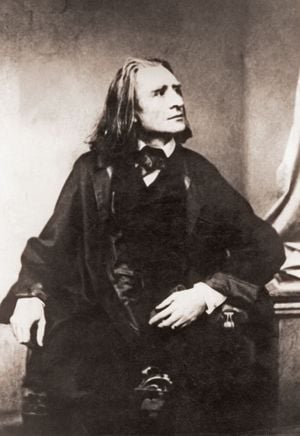
Clockwise from left: Franz Liszt, Sophie Menter, Janina Fialkowska, and birthday boy Jerome Lowenthal
While the adjective “diabolical” could be applied to Franz Liszt, both in terms of his prowess as a pianist and as a ladies’ man, its application is justified, really, by only two aspects of his outsized personality.
Liszt was an especially complex individual, marked by much nobility of character. He was a generous human being, a humanitarian, and an all-around nice guy. He was also quite devout. It was his intention to marry his long-time companion, the Princess Carolyne zu Sayn-Wittgenstein, on his 50th birthday, but his hopes were dashed, after the Church refused to grant her an annulment (she had been estranged from her husband long before she met the handsome touring virtuoso). He reacted by taking minor orders and living in a monastic cell in Rome, where he became known as the Abbé Liszt. (He had also recently lost two of his three children born to him by Marie d’Agoult.)
Liszt’s religiosity was not something he wore lightly. From an early age, he felt certain he would be a musician or a priest. In the end, he became both.
This Sunday night on “The Lost Chord,” we’ll sample from two of at least seven of Liszt’s works inspired by his fascination with the saints – “The Legend of St. Elisabeth” and “St. Stanislaus.” St. Elisabeth was the Hungarian princess much concerned with the welfare of the poor, and St. Stanislaus the patron saint of Poland. These are the subjects of Liszt’s first and last oratorios.
I hope you’ll join me, on All Saints’ Day, for “Liszt of Saints,” this Sunday night at 10:00 EST, on WWFM – The Classical Network and wwfm.org.
THANK YOU to everyone who contributed to WWFM’s fall membership campaign. It’s because of listeners like you that The Classical Network is able to bring you homegrown specialty shows like “The Lost Chord.” If you haven’t had a chance to contribute and have been meaning to do so, you can still make your donation online at wwfm.org. You don’t have to be a saint to make a difference. Thanks again for your support of classical music on WWFM!
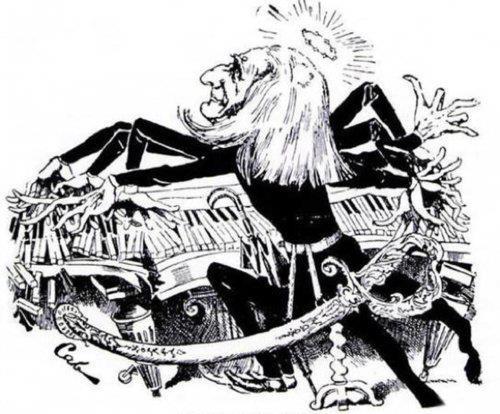
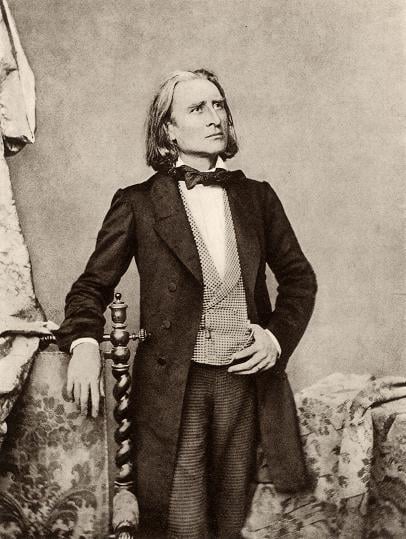
In his years before the public, he was recognized as a pianist of diabolical stamina. Franz Liszt was the inventor of the modern piano recital. While most of his rivals cultivated their reputations on the more intimate salon circuit, Liszt graduated to the larger halls. He was the first to turn the piano sideways, the better to show off his long hair and noble profile, like that of a Hungarian falcon.
He made mincemeat of the delicate instruments of his day, which were unable to withstand his musical onslaughts. In a masterstroke of showmanship, he always kept a spare on stage. On at least one occasion, he went to head-to-head with an orchestra. He mesmerized his audiences with his superhuman transcriptions and paraphrases, whipping them into frenzies. The ladies of Europe forgot their manners and rushed the stage. Skirmishes broke out, as they wrestled for his gloves and cigar butts, carelessly, calculatedly, left behind.
Liszt enjoyed enormous fame. He accumulated staggering wealth. And he enjoyed prodigious love affairs. Then all at once, at the age of 35, he simply walked away. He knew he was more than a vulgar showman, and he was eager to explore other avenues. He may have been a man who savored the privileges of celebrity, but he was also an intellectual and an artist of the spirit. In fact, he was one of the most innovative musical thinkers who ever lived.
Among his innumerable achievements, he pioneered a technique known as thematic transformation, which he employed in his own compositions, as a radical alternative to traditional classical form. He is also credited with the creation of the symphonic poem. Without Liszt, there would have been no Wagner as we know him. In fact, Romantic music would have had to find its own way.
He also happened to be extraordinarily generous. He never took payment from any of his pupils. He programmed the operas of Wagner and Berlioz, when nobody else would touch them. He selflessly promoted the works of Grieg, Smetana, Debussy, Saint-Saëns, Fauré, Borodin, and many others. He was lured back to the concert stage only for charitable purposes – for the relief of victims of fire and flood, in support of political refugees, and to raise money for a Beethoven monument in Bonn.
When Wagner was on the run as a fugitive for his role in the 1849 Dresden uprising, Liszt, then a prominent conductor at the Weimar court, not only gave him the money to flee to Switzerland, he endorsed Wagner’s courtship of his (already married) daughter. Wagner’s “Tristan chord” would send shockwaves throughout Europe, changing music forever, but in actuality it was only one of the many innovations he borrowed from his future father-in-law.
Liszt’s later music at times anticipates the experiments of the 20th century, by composers as diverse as Debussy, Scriabin, and Schoenberg. “My sole ambition as composer,” he once pronounced, “is to hurl my lance into the infinite space of the future.”
For his pains, he was unrelentingly lambasted by his critics and intrigued against by jealous rivals. At various points throughout his career, he was dismissed for pandering to the mob, ridiculed as a charlatan and a hypocrite, and shunned for his long-term relationships with two women who fled troubled marriages.
Yet there is a depth and spirituality in his greatest music that defies all charges. Liszt may have been something of a glamor puss, but he was not a shallow man. He was an intellectual, and he was also devoutly religious, even to the point of taking minor orders and living in a cell in Rome. In all, he was a fascinating amalgam of charlatan and visionary, sinner and saint, peacock and messiah.
Happy birthday, Franz Liszt (1811-1886). One thing you were not was listless!
“Totentanz” (“Dance of Death”), 1849, rev. 1859
“Nuages gris” (“Grey Clouds”), gnomic and existential,1881
“La lugubre gondola,” Liszt’s premonition of Wagner’s funeral procession through the canals of Venice, 1882
Transcription of Saint-Saëns’ “Danse Macabre,” 1874
You might say Hector Berlioz was a man easily governed by his passions.
When denied by the object of his affection, the Irish Shakespearean actress Harriet Smithson, he responded by furiously scrawling his “Symphonie fantastique,” an opium-induced fever dream that imagines his own execution for her murder. She then reappears during the course of a witches’ sabbath to mock his corpse. Perhaps counterintuitively, Smithson went for this in a big way, and the two were married on this date in 1833. Franz Liszt was one of the witnesses. Hardly surprising, but the union would not be a happy one.
Here’s a knock-out recording of “Dream of a Witches’ Sabbath,” from “Symphony fantastique,” led by Argentinean powder keg Carlos Païta:
The witches’ sabbath quotes from the portentous “Dies irae,” a medieval plainchant still widely familiar thanks to its continued use in countless horror movies (including the opening credits of “The Shining”).
Liszt also used this theme as the basis for a set of variations for piano and orchestra, which he titled “Totentanz” (“Dance of Death”). Marvel here at the mercurial György Cziffra, captured live in concert: