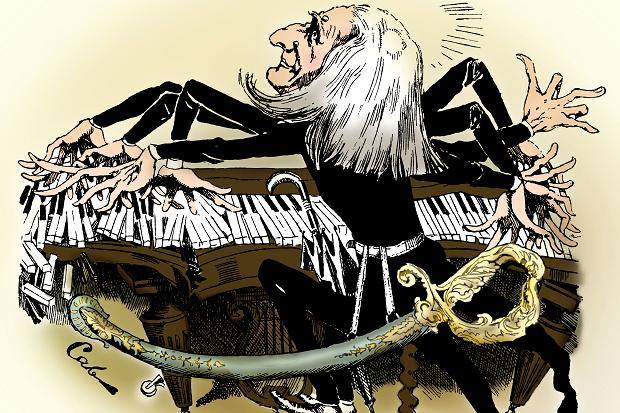
It’s hard to believe, I know, but I just have been too busy today to post anything. As an easy way out, my recent anecdotes about Liszt put me in mind of this classic — and brilliant — piece of shtick with Victor Borge. Enjoy.
Tag: Franz Liszt
-

Alexandre Dumas in Music on The Lost Chord
He is best known as the author of “The Three Musketeers” and “The Count of Monte Cristo.” However, Alexandre Dumas churned out historically-inspired prose on all manner of subjects, and he did so by the yard.
This Sunday night on “The Lost Chord,” we present an hour of music inspired by his works, including rarely-heard incidental music, written for a revival of the play, “Caligula,” by Gabriel Fauré; ballet music from an opera, “Ascanio,” taken from a novel featuring Benvenuto Cellini, by Camille Saint-Saëns; and a poetic monologue, “Joan of Arc at the Stake,” by Franz Liszt. We’ll also hear the suite for symphonic band, “The Three Musketeers,” by George Wiliam Hespe.
I hope you’ll join me for “The Lost Sword,” tonight at 10 ET, with a repeat Wednesday evening at 6; or that you’ll listen to it later as a webcast at http://www.wwfm.org.
-
Liszt Saves Beethoven’s Monument
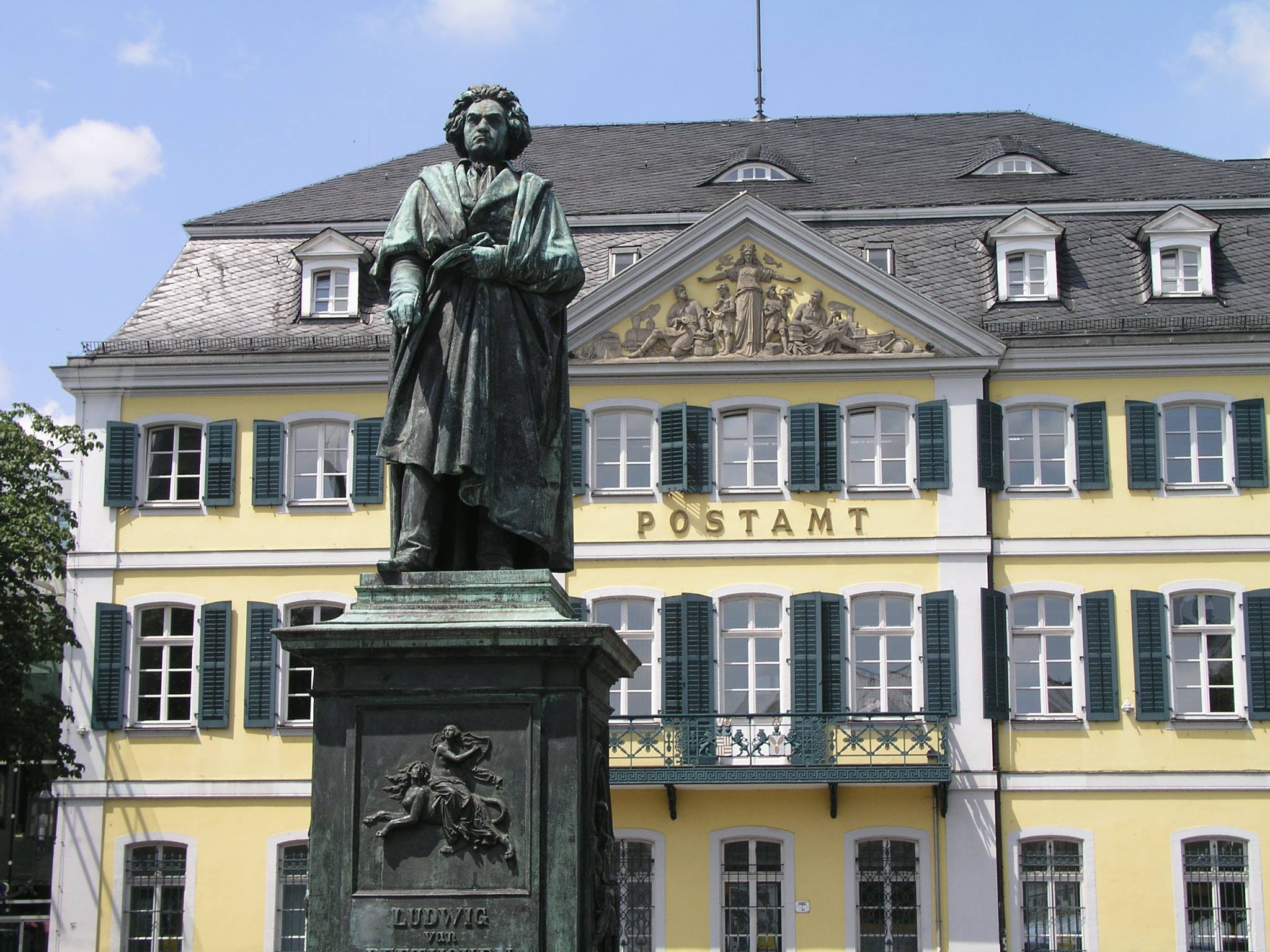
On this date in 1841, not for the first or last time, Franz Liszt came to the rescue. Liszt performed Beethoven’s “Emperor” Concerto in Paris, with Hector Berlioz conducting. The occasion was a fundraising project for a Beethoven monument to be erected in Bonn. Up to that time, it was not the custom to raise statues to cultural icons. Schiller finally got his only a few years earlier.
Then as now, virtually every musician revered Beethoven. Even so, some were reluctant to put forth the effort to make the monument a reality. Those who did were met with a tepid response.
Enter Liszt. When the project was in danger of floundering through lack of financial support, he personally donated over 10,000 francs. Until then, the total amount collected in France was barely 425 francs! More significantly, he returned from his early retirement from performing to put Europe on its collective ear with a series of concerts and recitals. Among these were a pair of duo piano programs with Frédéric Chopin.
Ca-Ching!
The monument would finally be unveiled on August 12, 1845, in honor of the 75th anniversary of the composer’s birth. Beethoven died in 1827, at the age of 56. On top of everything else, Liszt wrote a special work for the occasion, the “Festival Cantata for the Inauguration of the Beethoven Monument in Bonn.” The title pretty much says it all.
Robert Schumann, who had something of a cagey relationship with Liszt, actually dedicated his “Fantasie in C” to the cause AND to the pianist. Felix Mendelssohn contributed his “Variations sérieuses.”
The unveiling of the monument was to be the high point of a three-day Beethoven Festival. A month before the event, the planning committee realized that there was not a suitable venue in all of Bonn that would accommodate 3000 attendees. At Liszt’s urging, an architect was engaged and a new hall was built, Liszt picking up the tab himself. By the time construction began, it was less than two weeks before the festival, and builders had to work around the clock in order to complete the structure in time.
The unveiling took place in the morning, with Liszt again performing the “Emperor” concerto in the afternoon. He followed that up by conducting Beethoven’s Fifth Symphony. The next day, his “Festive Cantata” was featured as part of a four-hour concert.
You would think, after all he had poured into the occasion, the Bonn authorities would have kissed his feet. However, Lola Montez crashed a reception at the Hotel Der Stern, danced on a table, and insisted that she was Liszt’s personal guest. This embarrassed Liszt and created a bit of a scandal, so that the man who did the most to make both the Beethoven monument and festival realities was not invited back for the centenary celebrations.
This kind of thing happened to Liszt all the time. Is it any wonder that, also on this date, in 1865, Liszt took the cloth, Pope Pius IX conferring upon him the title of “Abbé?”
-

Liszt’s Christus A Christmas Weekend Listen
ADVENT CALENDAR – DAY 21
I try to make it a point to listen to Franz Liszt’s oratorio, “Christus,” every year, whether I need it or not.
It helps that I love Liszt, of course. Not all of his music – someone so prolific had to turn out a clunker now and then – but he was such a noble, well-intentioned guy. I’ve been a hardcore admirer ever since I read Alan Walker’s biography about 14 years ago. And hearing so many performances of his Piano Sonata certainly didn’t hurt.
Liszt was one of the most original musical thinkers of the 19th century. In fact, I’d go so far as to say that, after Beethoven, Liszt was probably the most influential musician of the 1800s. There was likely no composer who didn’t at some point make a decision to follow or react against him. Liszt wrote a lot of wonderful music, and at least as much that might be construed as a little embarrassing. He was more successful as a musical thinker than he was a consistent executor of his ideas. But Wagner, to name just one, would have been a very different composer without Liszt. And we all know how influential Wagner was.
Liszt’s flamboyance was legendary, but I think his reputation in that regard stemmed mostly from the overwhelming impressions he created in recital, and the crowds’ hysterical reactions to them. Liszt was also an introverted, thoughtful, pious man. He was so pious, in fact, that at one point he wound up taking minor orders and living in a cell in Rome, where he was known as the Abbé Liszt. So his religious works were not mere posturing.
The incredible “Christus” is an oratorio in three parts that is really part oratorio, part loose collection of symphonic poems. Part I, the Christmas portion, contains two purely orchestral movements, which together comprise about half an hour. The concluding “March of the Three Holy Kings” is a corker. It’s also interesting in that one of the movement’s main themes is nearly identical to Wagner’s motif for Wotan. Which came first? Both “Christus” and “Das Rheingold” were written at just about the same time.
I know it’s the last weekend before Christmas, so everyone is likely very busy, but if there is any time to listen to “Christus” it is on a weekend. Maybe you can block out three hours late on your Sunday afternoon. Kick back on the sofa with the Christmas lights on, enjoy the tree, and wallow in this ambitious, romantic music.
Part I: https://www.youtube.com/watch?v=F_KWFIl_XR4
Part II: https://www.youtube.com/watch?v=pcFd4m2wa1M
Part III: https://www.youtube.com/watch?v=6hEdexzXqcIIf you just can’t get enough, here’s Liszt’s “Christmas Tree Suite.”
Some of the movements in the first half incorporate traditional carols (including “Adeste Fideles,” in yet another evocation of the Three Holy Kings). In the later movements, Liszt just kind of dreamily wanders into the future the way only Liszt can. All of the movement titles are listed on the page containing the video.
PHOTOS: Liszt takes the cloth (left); Jesus gets frankincense and myrrh
-

Borodin Chemist Composer Nationalist
The connection between music and science has been much remarked upon.
In the case of Alexander Borodin, he was a doctor and chemist. Borodin was born on this date in 1833. As a boy he had had piano lessons, but he received his formal education at the Medical-Surgical Academy in St. Petersburg. He then served as a surgeon in a military hospital before undertaking three years of advanced scientific study in Western Europe.
In 1862, he returned to his alma mater to teach. There, he managed to establish courses for women. In 1872, he founded a school of medicine for women. He devoted the remainder of his scientific career to research. He is co-credited with the discovery of the aldol reaction, a means of forming carbon-carbon bonds in organic chemistry.
Around the time of his return to the Academy, he met Mily Balakirev, the persuasive advocate of Russian nationalism in music, who took the chemist under his wing and supervised the composition of his Symphony No. 1. Borodin began work on his Symphony No. 2 in 1869. Since regarded as a particularly successful blend of Slavic drama and lyricism with European classical form, it was not a particular success at its premiere in 1877.
Borodin became sidetracked while working on the piece by his absorption in an opera on the subject of Prince Igor. This was to become his most significant musical contribution and one of the most important Russian historical operas. Because of his other commitments and repeated distractions, the work was left unfinished at the time of his death. It was completed by his friends and colleagues, Nikolai Rimsky-Korsakov and Alexander Glazunov.
The big show-stopper, of course, is his “Polovtsian Dances,” which has been used to sell everything from records to cleanser.
Borodin was yet another beneficiary of the exceeding generosity of Franz Liszt, whose contributions in this regard are not widely enough acknowledged. It was Liszt’s advocacy as a conductor that brought Borodin to the attention of European audiences. In gratitude, the composer dedicated “In the Steppes of Central Asia” to Liszt in 1880.
Borodin was also embraced by the French Impressionists, who admired his unusual harmonies. Of course, he achieved even greater renown when melodies from his works became the basis for the musical “Kismet” in 1953. In 1954, he was honored with a posthumous Tony Award!
Since for Borodin music was basically an avocation, something to which he devoted himself mostly during holidays or when he was otherwise unable to report to work, it became a running gag among his friends that they’d wish him poor health.
“In winter I can only compose when I am too unwell to give my lectures,” he wrote. “So my friends, reversing the usual custom, never say to me, ‘I hope you are well’ but ‘I do hope you are ill.’”
He had plenty of experience with illness. The composer survived cholera and suffered several heart attacks. He finally dropped dead during a ball at the Academy in 1887.
Happy birthday, Alexander Borodin!
PHOTO: Alexander Borodin: chemistry to burn
Tag Cloud
Aaron Copland (94) Beethoven (95) Composer (114) Film Music (149) Film Score (143) Film Scores (255) Halloween (97) John Williams (197) KWAX (232) Leonard Bernstein (105) Marlboro Music Festival (125) Movie Music (164) Mozart (91) Opera (215) Philadelphia Orchestra (90) Picture Perfect (174) Princeton Symphony Orchestra (110) Radio (90) Ross Amico (244) Roy's Tie-Dye Sci-Fi Corner (290) The Classical Network (101) The Lost Chord (269) Vaughan Williams (107) WPRB (397) WWFM (881)