Tag: Franz Liszt

  • Princeton’s Dead Composers A Musical Ghost Tour

    Princeton’s Dead Composers A Musical Ghost Tour

    Did you know, the composer of “Old Nassau” was a pupil of Franz Liszt? That Princeton was the birthplace of one of the great stride pianists? That a colleague of Igor Stravinsky rests in St. Paul’s Parish Cemetery?

    Put on some sensible shoes, and grab your coffee to go. Just in time for Halloween, I lead a “dead composers” tour of Princeton cemeteries in this week’s U.S. 1 Newspaper – PrincetonInfo, available online and in area vending machines today.

    https://www.communitynews.org/princetoninfo/coverstories/a-requiem-for-princeton-s-passed-composers/article_a83ca082-5487-11ed-9182-8771c220bdaf.html

  • Rosemary Brown Liszt’s Medium?

    Rosemary Brown Liszt’s Medium?

    The medium is the message.

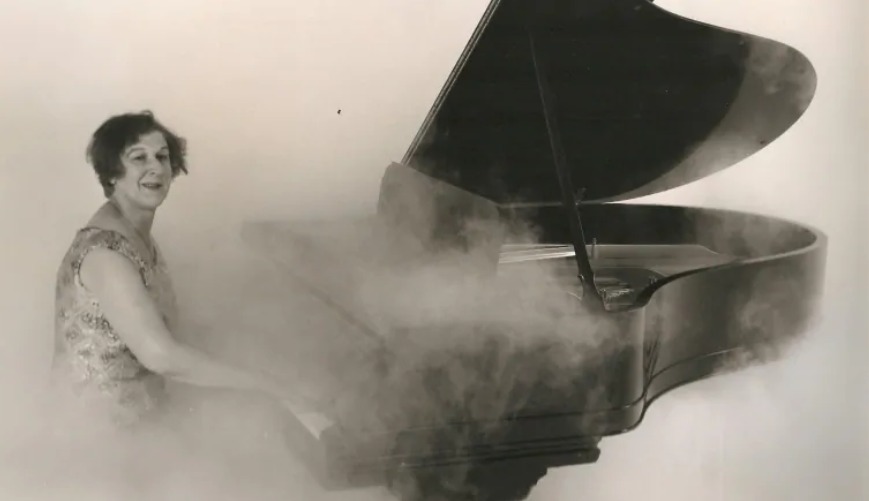
    On the birthday of Franz Liszt, I conjure Rosemary Brown. Brown was the English spiritualist who claimed that the great composers were still very much active and dictating posthumous works to her.

    At the age of 7 (circa 1923), Brown maintained she was confronted by a curious specter with long white hair and a flowing cassock. The specter prognosticated that one day he would make her famous. It was ten years before she stumbled across an old photograph and realized that what she had encountered was no less than the shade of Liszt.

    Brown was born into a family of alleged psychics. Both her parents and grandparents claimed extrasensory powers. Brown took up the piano at the age of 15. Her period of study is unclear, as she seems to have changed her story over the decades, but she would have us believe she was basically a dilettante with little formal training.

    Then, in 1964, the ghost of Liszt reappeared and she began “transcribing” new works by the great composers – Bach, Mozart, Beethoven, Schubert, Schumann, Chopin, Brahms, Grieg, Debussy, Rachmaninoff, and Stravinsky. And Liszt, of course. These included two symphonies she attributed to Beethoven, a new “Fantaisie-Impromptu” by Chopin, and a 40-page sonata by Schubert.

    She claimed that some of the composers directed her hands on the keyboard (Chopin and Liszt); others sang (Schubert) or dictated notes (Bach and Beethoven). All of them communicated in English.

    Skeptics abounded. A number of critics and musicologists dismissed the new compositions as substandard pastiches, claiming that the great composers tended to reinvent themselves and push boundaries, while these freshly “dictated” works offered nothing of the sort.

    Some psychologists attributed the phenomena to extraordinary activity on the part of Brown’s subconscious, with the medium essentially reworking and synthesizing all the music she had been exposed to as a child.

    Still, they had to admit it was impressive. Over the course of her life, Brown produced hundreds of such pieces. One expert described it as “the most convincing case of unconscious composition on a large scale.”

    Respected concert pianists Howard Shelley, Peter Katin, Cristina Ortiz, and John Lill have all included these perhaps spurious works on their programs.

    Brown died in 2001. Whether or not she herself is now dictating is anyone’s guess.


    Rosemary Brown plays a piece allegedly transmitted to her by Liszt

    Brown meets the Amazing Kreskin. (She makes her appearance 9 minutes in; she plays at 12:30.) She claims Liszt helped her son with his homework!

    Documentary on Brown from 1976

    Her obituary in The Guardian:

    https://www.theguardian.com/news/2001/dec/11/guardianobituaries

  • Clara Schumann’s Liszt Problem

    Clara Schumann’s Liszt Problem

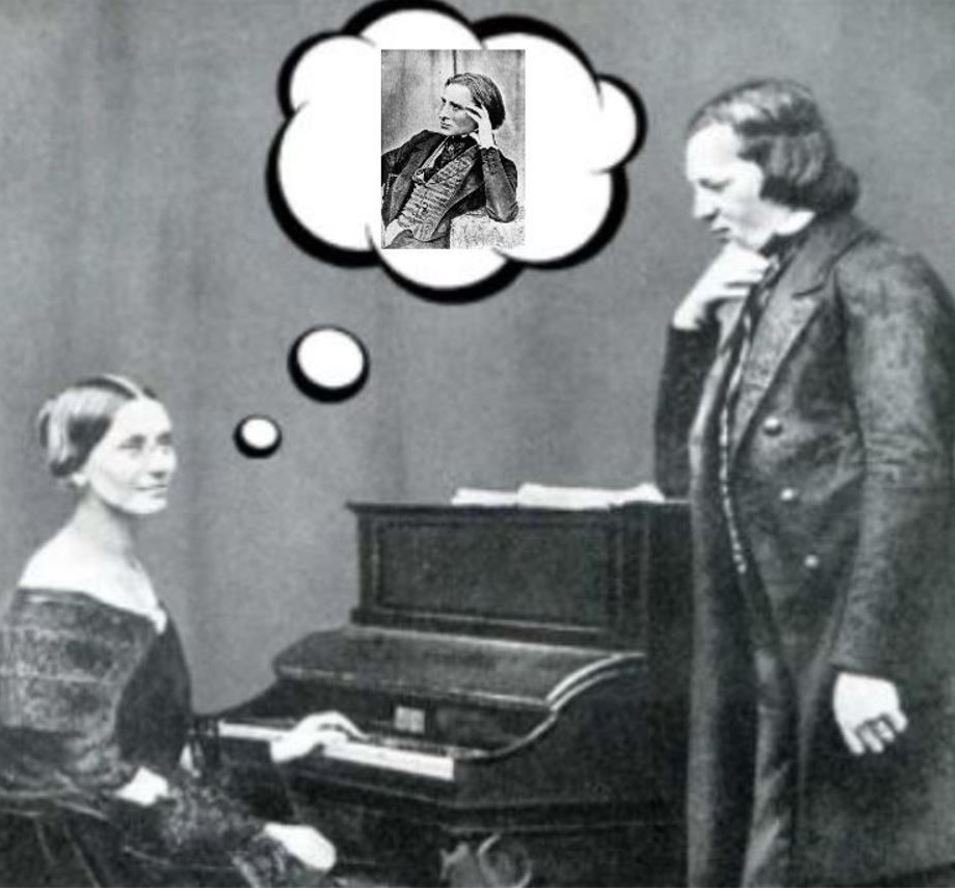
    For whatever reason, Franz Liszt really rubbed Clara Schumann the wrong way. Essentially, everything about him ran counter to what she and her husband thought music should be. But it wasn’t always the case.

    Clara first met Liszt in 1838, prior to her marriage. Clara Wieck was 19 years-old. Like everyone else, she was in awe of his superhuman technique, but it also made her feel inadequate, especially when they played piano four-hands.

    For his part, Liszt was very complimentary. In a letter to his mistress, Marie d’Agoult, he wrote, “Her compositions are truly remarkable, especially for a woman. They contain a hundred times more inventiveness and real feelings than all former and present fantasias by Thalberg.” Sigismond Thalberg was one of Liszt’s chief rivals. But this wasn’t simply “trash talk.” Liszt was consistently impressed by both Schumanns.

    In 1840, he dedicated his “Transcendental Etudes” to Clara. She continued to include his music on her concert programs until 1847. Sadly, familiarity bred contempt, and increasingly she came to find everything about him repugnant. She didn’t like that he was a showboat. She recoiled when he took liberties with the scores he played. And she was totally put off by the indelicacy with which Liszt described her husband’s Piano Quintet as “typically Leipzig.”

    Liszt, clueless, continued to make friendly overtures, championing Robert’s music. Robert, for his part, responded cordially. Liszt published a long essay in praise of the artistry of both Schumanns in 1855, but Clara remained implacable.

    As the War of the Romantics began to heat up in 1860, with heightened antagonism between the Brahmsians (including the Schumanns) and the New German School (followers of Liszt and Wagner), contact became rare.

    In 1884, Clara wrote to Liszt with the aim of copying the correspondence he maintained with her husband, who had died in 1856. Liszt responded that he hadn’t saved any of the letters. That essentially ended all interaction between them.

    45 years earlier, in 1839, Schumann completed his “Fantasie in C major,” during an imposed separation from his future wife. Clara’s father, Schumann’s piano teacher, flew into a rage when he discovered their relationship and forbade any further contact between them. (Clara had not yet reached her majority and had no say in the matter.) Following a protracted and acrimonious legal battle, the court found in favor of the young lovers, and the two married the day before Clara turned 21 – at which age she could have done as she pleased!

    Schumann wrote to Clara about the “Fantasie,” “The first movement is the most passionate I have ever composed; it is a profound lament on your account.”

    Ironically, it was Liszt who received the dedication. Liszt returned the favor by dedicating his own Piano Sonata in B minor to Schumann in 1854.

    Clara confided to her diary, “Today, Liszt sent me a Sonata dedicated to Robert and some more pieces, together with a polite note. But those pieces are so creepy! Brahms played them to me and I felt really miserable… This is only blind noise – no more healthy thoughts, everything is confused, one cannot see any clear harmonies! And, what is more, I still have to thank him now – this is really awful.”

    Of course, Robert, at 44, had already lost his grip on sanity and was by then confined to an asylum.

    With that in mind, on Robert Schumann’s birthday, enjoy his Fantasy in C major.

    Schumann vs. Wieck

    https://interlude.hk/composers-in-the-court-room-robert-schumann-versus-friedrich-wieck/

    Henry Daniell, one of Hollywood’s stock villains, hilariously cast as Liszt in “Song of Love” (1947), with Katharine Hepburn as Clara Schumann and Paul Henreid as Robert. As if this weren’t ridiculous enough, Robert Walker plays Brahms!

    Hepburn pantomimes selections from Schumann’s “Carnaval.”

    Van Cliburn in concert, playing Liszt’s transcription of Schumann’s “Widmung,” written as a wedding present for Clara.

  • Liszt’s Operatic Keyboard Magic

    Liszt’s Operatic Keyboard Magic

    In the days before the phonograph, it was common practice to arrange works from stage and concert hall for the piano, so that the music could be disseminated and enjoyed in the home. A figure like Franz Liszt went above and beyond, frequently elevating the original material to a whole other level of artistry.

    These “paraphrases,” as he often called them, could hardly have been considered reductions. Most would have been too difficult for amateur pianists. Nevertheless, some of them have become very well known – the “Reminiscences of Don Juan,” “Reminiscences of Norma” and “Rigoletto Paraphrase” spring to mind. This Sunday night on “The Lost Chord,” we’ll sample a few which are perhaps not so frequently heard.

    For his famous showdown against rival pianist Sigismond Thalberg, at the Paris salon of Princess Belgiojosa-Trevulzia in 1837, Liszt selected his “Niobe Fantasy,” a prime example of his ability to spin gold from the flax of a now-forgotten opera, in this case by Giovanni Pacini. When the dust settled, Belgiojosa-Trevulzia rose to declare Thalberg the greatest pianist, and Liszt the ONLY pianist – a very diplomatic assessment.

    Liszt’s paraphrases were not only means to capitalize on popular operas of the time, they were also a medium through which to champion particular scores. As kappelmeister at the Weimar Court Theatre for many years, Liszt mounted operas by controversial composers of the time, like Wagner and Berlioz. It’s hard to conceive these days just how incendiary a figure Wagner was.

    But Liszt thought nothing of breaking a lance for those he believed in. In fact, his reckless idealism and blind generosity would contribute to his being pushed out of the theater directorship. To honor his special relationship with Wagner – who would become his son-in-law – we’ll hear “Valhalla,” based on motives from Wagner’s “Das Rheingold.”

    Then, to demonstrate the astonishing breadth of his arrangements, we’ll turn to a paraphrase on Handel’s “Almira.” This dates from Liszt’s later period – his only arrangement from that time based on a Baroque source. It was written in 1879 for his English piano student Walter Bache for performance at the Handel Festival in London. It should be noted that Handel’s operas were virtually forgotten at the time. Again, Liszt’s treatment is by no means a straight transcription, but a skillful reimagining of the Baroque, in almost Busonian terms, and an impressive piece of music in itself.

    Handel’s operas may have been regarded as obscurities in those days, but very much the opposite was the case with the grand operas of Giacomo Meyerbeer. In contrast to Handel’s operatic reputation, which has increased enormously in recent decades, Meyerbeer’s once wildly-popular works for the stage have virtually disappeared. There are several reasons for this, not least of which is that these grandest of grand operas cost a fortune to mount.

    Liszt made ambitious arrangements of all of Meyerbeer’s greatest works and put some of these through quite extensive revisions. Tonight, we’ll hear a “Grand Fantasy on Meyerbeer’s ‘The Huguenots,” the third of three versions, from 1842.

    Liszt’s transcriptions and paraphrases were numerous, and no mere sidebar. On the contrary, they were central to his creative output. He was an astoundingly prolific arranger, especially when considering his other activities as composer, conductor, and teacher.

    I hope you’ll join me for “Grand Opera to Hand Opera” – Franz Liszt’s operatic paraphrases for the keyboard – this Sunday night at 10:00 EST, on WWFM – The Classical Network and wwfm.org.

  • Liszt & Friends A Collaborative Genius

    Liszt & Friends A Collaborative Genius

    Sometimes even Romantic geniuses can use a hand.

    This Sunday night on “The Lost Chord,” we’ll hear several works on which Franz Liszt was aided and abetted by his peers.

    While it’s true that, early on, Liszt possessed a degree of insecurity over his abilities as an orchestrator, enlisting the aid of pupils like Joachim Raff and Franz Doppler during his years as Kapellmeister Extraordinaire in Weimar– after all, the bulk of his experience had been as a keyboard composer – he soon mastered the art himself and set about revising every bar, stamping his early orchestral works very much with his own distinctive voice.

    The story behind Liszt’s “Concerto in the Hungarian Style,” however, is quite a different matter.

    German pianist Sophie Menter studied with Liszt in Weimar, beginning in 1869. Her gift was such that Liszt dubbed her “the greatest pianist of her day.” He admired her “singing hand” and called her his “only legitimate daughter as a pianist.” George Bernard Shaw compared her favorably to Paderewski. She was by Liszt’s side in Bayreuth when he died in 1886.

    Menter taught at the St. Petersburg Conservatory between 1883 and 1887. There, she became friendly with Tchaikovsky and convinced him to orchestrate a piano concerto she claimed to have written to showcase her talents as a performer. Tchaikovsky did so and also dedicated the orchestral score of his own “Concert Fantasy” to her.

    What he didn’t realize, and what is now widely believed – thanks to fellow Liszt pupil and Menter confidante Vera Timanoff – is that the piece was actually written, at least in part, by Liszt himself. Had Tchaikovsky known, he may very well have torn up the manuscript. He had come to loathe Liszt, and was particularly disgusted by Liszt’s transcription of the Polonaise from “Eugene Onegin.” But the truth – if truth it be – didn’t emerge, for nearly a hundred years, and Tchaikovsky conducted the first performance of the work in Odessa in 1893.

    Roll over Beethoven, tell Tchaikovsky the news!

    Alongside this colorful concerto by Menter’s mentor, we’ll also hear “The Black Gondola,” orchestrated by John Adams, about a century after Liszt’s death; “Hexameron,” a titanic set of piano variations with contributions from six virtuoso superstars of the 1830s, including Liszt, Carl Czerny, Sigismond Thalberg, and Frederic Chopin; and a selection from the ballet “Apparitions,” engineered in 1936 by Constant Lambert and Gordon Jacob.

    Liszt gets by with a little help from his friends, on “An Assist for Liszt,” this Sunday night at 10:00 EDT, on WWFM – The Classical Network and wwfm.org.

Tag Cloud

Aaron Copland (92) Beethoven (95) Composer (114) Film Music (123) Film Score (143) Film Scores (255) Halloween (94) John Williams (187) KWAX (229) Leonard Bernstein (101) Marlboro Music Festival (125) Movie Music (138) Opera (202) Philadelphia Orchestra (89) Picture Perfect (174) Princeton Symphony Orchestra (106) Radio (87) Ralph Vaughan Williams (85) Ross Amico (244) Roy's Tie-Dye Sci-Fi Corner (290) The Classical Network (101) The Lost Chord (268) Vaughan Williams (103) WPRB (396) WWFM (881)

DON’T MISS A BEAT

Receive a weekly digest every Sunday at noon by signing up here


RECENT POSTS