This week on “Sweetness and Light,” we’ll lend plenty of paprika and poppyseed to your breakfast with an hour of Hungarian delights.
Enjoy a selection from a beloved film score by Miklós Rózsa (you can take the composer out of Hungary, but you can’t take Hungary out of the composer!), a “Hungarian Capriccio” by Eugene Zador (who assisted Rózsa as an orchestrator), some old Hungarian dances arranged by Ferenc Farkas, Hungarian fantasies by Franz Lehár and Franz Doppler, Doppler’s orchestration of a work by Franz Liszt, Liszt’s arrangement of a patriotic melody, and a schmaltzy treatment of a work by Jenő Hubay.
That’s an ample helping of goulash and czardas on “Sweetness and Light,” this Saturday morning at 11:00 EDT/8:00 PDT, exclusively on KWAX, the radio station of the University of Oregon!
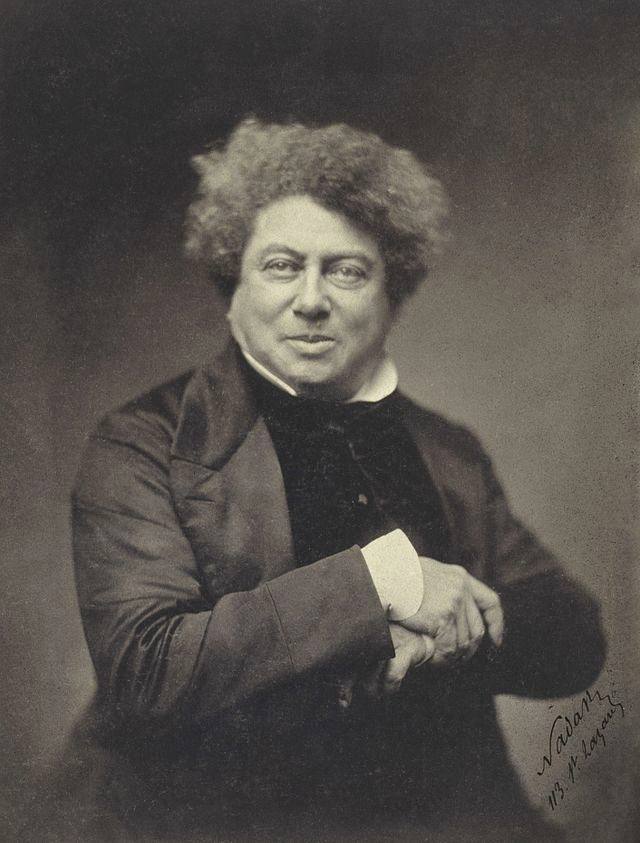
He is best known as the author of “The Three Musketeers” and “The Count of Monte Cristo.” However, Alexandre Dumas churned out historically-inspired prose on all manner of subjects, and he did so by the metre.
This week on “The Lost Chord,” we present an hour of music inspired by his writings, including rarely-heard incidental music composed for a revival of his play “Caligula,” by Gabriel Fauré; ballet music from an opera, “Ascanio,” taken from a novel featuring Benvenuto Cellini, by Camille Saint-Saëns; and a poetic monologue, “Joan of Arc at the Stake,” by Franz Liszt. We’ll also hear the suite for symphonic band “The Three Musketeers,” by George William Hespe.
It’s all for one, and one for all! I hope you’ll join me for “The Lost Sword,” on “The Lost Chord,” now in syndication on KWAX, the radio station of the University of Oregon!
Clip and save the start times for all three of my recorded shows:
PICTURE PERFECT, the movie music show – Friday at 8:00 PM EDT/5:00 PM PDT
SWEETNESS AND LIGHT, the light music program – Saturday at 11:00 AM EDT/8:00 AM PDT
THE LOST CHORD, unusual and neglected rep – Saturday at 7:00 PM EDT/4:00 PM PDT
I know it’s not Epiphany yet, but with the more intense part of the holiday season now behind us, it looks as if I’ve managed to survive another year. I hope yours have been good ones.
Unfortunately, as previously reported, my laptop was the last casualty of 2024. I’ll have a replacement under my fingers today, but retrieving the old files is an ongoing challenge. For the time being, I’d like to share with you a few of my Christmas gifts.
Yes, I am still very much into physical media. If it doesn’t exist on compact disc or vinyl, it may as well be a live performance in a concert hall, because I’ll probably never listen to it again. Also, compact discs are extremely handy for the kind of work that I do. But enough with the apologies. I like what I like.
For one thing, I happen to be a nut for Franz Liszt’s rarely-heard “Christmas Tree Suite.” Liszt dedicated the work to his granddaughter, Daniela von Bülow, the daughter of Cosima Liszt and conductor Hans von Bülow. Some of the early movements are reflections on familiar carols, but as the suite progresses, the movements become dreamier and more introspective. The work was first performed on Christmas Day in 1881, the day Daniela’s birthday was always observed, though she was actually born on Christmas Eve. I have many recordings of the piece, but this is probably the most recently available, issued on the Naxos label. I have to say, having listened to it only once, it’s not likely to become a personal favorite. I’ll certainly go back and give it another chance, but I feel like Wojciech Waleczek is a little too soporific in his interpretation, especially in the earlier movements, in which the more familiar carols mosey a little more than would be desirable. This is only a first impression, and I may revise my opinion with increased exposure. Certainly, there is plenty of space for interpretive subjectivity as the work becomes more ruminative in the later movements.
The Charles Ives Anniversary Edition is one of the happy tie-ins with the 2024 Ives sesquicentennial celebrations. The five-CD box, released by Sony, and which I haven’t taken out of the shrink wrap yet, contains coveted reissues of plenty of Ives rarities and curios, including an album of the composer performing his own music at the keyboard.
Stefan Jackiw and Jeremy Denk gave an unforgettable concert of the Ives Violin Sonatas here in Princeton, on Ives’ birthday, October 20, in 2020. I didn’t know they had recorded the pieces, but lo and behold, here they are, on a recent Nonesuch release that also includes both of Ives’ piano sonatas. I haven’t listened to it yet, but I am very much looking forward to it.
The book is about the cellist Beatrice Harrison, long familiar to me from her classic recording of the Elgar Cello Concerto, but only recently did I learn of her worldwide fame in connection with a nightingale in her garden with whom she performed impromptu duets over the radio, captivating millions around the world. 2024 marked the centenary of the first of those broadcasts. I wrote a little more about it here before.
Not a bad haul, if I do say so myself. I must have been a good boy, after all. Now that the New Year’s festivities have passed, I am looking forward to being back in my burrow until spring.
Lord knows, there have been plenty of eyerolling movies about classical musicians, especially classical music composers. How many times have I seen Liszt portrayed (by Dirk Bogarde, Henry Daniell, Julian Sands, Roger Daltrey, etc.)? Sometimes, these historical figures are played by actual musicians (Gustav Leonhardt as Bach, Gidon Kremer as Paganini; there was even talk at one point about Leonard Bernstein playing Tchaikovsky, with Greta Garbo as Nadezhda van Meck!), but can even the most skilled virtuoso, or maestro, as the case may be, ever live up to accrued legend?
I know I’ve posted a link to the Leonhardt Bach film here in the past (“The Chronicle of Anna Magdalena Bach,” 1968). Now, on the anniversary of the birth of Franz Liszt – the progenitor of the piano recital, the creator of the symphonic poem, and perhaps the greatest pianist in an era teeming with great pianists – is footage of one of his most renowned interpreters, Sviatoslav Richter, portraying Liszt in a Soviet film about Mikhail Glinka.
Can even Richter live up to the legend? See for yourself in this clip from “The Composer Glinka” (1952).
BONUS SECTION:
Henry Daniell, one of Hollywood’s most supercilious villains, as Liszt in “Song of Love” (1947)
Roger Daltrey as the Abbé Liszt, in cassock, having his blood sucked by vampire Wagner in Ken Russell’s “Lisztomania” (1975)
Corny Hungarian peasant sequence with Dirk Bogarde as Liszt in “Song without End” (1960)
Frustration of the day: only 60 seconds of Richter playing Liszt’s Piano Sonata in B minor
Richter talks about the Liszt sonata, with more footage from the same read-through
Richter playing the complete work in concert (audio only)
Figurative laurels for Franz Liszt (1811-1886) on his birthday!
Cartoon in this week’s The New Yorker. What’s the dealio with all the standing ovations the last number of years? You’d think we were watching a Franz Liszt-Niccolò Paganini smackdown every night of the week, with Farinelli grinding over a row of crush cars in his monster truck. Standing ovations for unexceptional performances – that is to say, performances that are absolutely fine, but not exactly life-altering – is the shadow pandemic nobody talks about. Worst of all is when the numbnuts in front of me stand, blocking my view of the stage, making me look like a numbnut, because now I have to stand too!